Showing posts with label culture. Show all posts

4/01/2024

The Upside of Being An Outsider

Scientific American magazine published an article titled, “In Atheists We Distrust.” The article opened with, “Atheists are one of the most disliked groups in America. Only 45 percent of Americans say they would vote for a qualified atheist presidential candidate, and atheists are rated as the least desirable group for a potential son-in-law or daughter-in-law to belong to.” The gist of the article is that all of those people with imaginary friends “distrust” atheists. Weirdly, this article claims that a research found “People identifying themselves as having no religious affiliation held similar opinions. Gervais and his colleagues discovered that people distrust atheists because of the belief that people behave better when they think that God is watching over them.” Of course, “no religious affiliation” just describes people who spend Sunday at a bar watching football and praying for some god to help their team beat the snot out of some other team, so that isn’t particularly interesting information.

From my Midwestern perspective, I’ve mostly decided that superstitious people have such a tenuous hold on their “beliefs” that any sort of challenge to the existence of their particular “god in the mirror” is too much to stand. The “individual quality” of the gods those people worship is also suspiciously mirror-like. And, with even minimal knowledge of modern astronomy, physics, and neurology, it takes a shitload of “confidence” (i.e. “ego”) to believe there is anything special in this universe about an individual human. As a lifetime outsider to the whole mystical experience and an introverted observer of human weirdness, I’ve seen this behavior from every “god-fearing:” character in my life; from my father and family to co-workers and acquaintances to public figures. (Especially black collar public figures whose outrage and general intolerant behavior I’ve always written off as financially motivated. After all, if enough people were atheists, nobody would get to pretend to speak for the gods.)   

In the past few decades, I’ve somewhat modified my opinion to something more like, “Nobody believes this shit, based on their behavior.” You can make a pretty rational argument that everyone is statistically atheist because of the currently existing approximately 4,200+ religions, churches, denominations, religious bodies, faith groups, tribes, cultures, movements, or otherwise supernatural beliefs, few of us believe more than one of the pack. 1/4200th is 2.380952380952381e-4 or approximately 0.024% away from no faith in the supernatural at all. In all of human history, there have been at least 10,000 religions. A 1/10,000th belief is close enough to zero for reasonable and practical purposes. Either of those options demonstrate hardly a significant difference between the faithful and atheists. Other than arrogance and tradition, picking a god to believe in is about as random a choice as possible. So, you might as well invent one as take on an existing god. It’s obvious from behavior and conversations away from peers that a substantial number of “the faithful” pretend to be so for social, financial, and other cultish reasons. In those situations, I’ve had a number of ministers admit to me that their own personal faith is considerable less magically-based than the one they project to their parishioners/minions. Back in the Sam Kinison days, it was almost popular for fundamentalist ministers to tryout different career options, admitting they’d been in the religion thing for the money. At least in the US, we’ve regressed a long ways since then and the majority of Americans are back pretending they believe the same shit as everyone else. Cult behavior, in other words.

Again, in my experience and observation, it is fascinating how much even a supposed single god, like the Jewish Jehovah Yahweh, Elohim, the Lord, God, and his/her/its other pseudonyms has at least as many personality traits as believers. And, on a personal basis, those gods more accurately reflect the personality, habits, interests, prejudices, and other traits of the believer than any description on the various holy books. Which is why I call those various deities “the God in the mirror.” It’s pretty obvious that “God created man in his own image” is the reverse of the objective facts. Men and women create their gods in almost exactly their own image; or the image they have of themselves.

For the nearly-70-years I have been an atheist, it seems to me that I have saved a ton of time, money, and energy for useful activities by missing out on the whole magical world thing. I not only don’t have to tithe to some self-proclaimed Speaker-to-God, I don’t have to knock on wood, worry about stepping on sidewalk cracks, carry a rabbit’s foot, wear offensive and uncomfortable jewelry, or worry about what kind of life I’ll have to suffer after death.

And suffering it would be if the after-life my family and neighbors describe is anything like the real thing their heaven would be. I first got a hint of what that would be like as a little kid in my father’s Dodge City Methodist Church. Those “joyful voices” our minister kept calling for were clearly pitch and rhythmically impaired and the polar opposite of anything that could be described as “:heavenly.” Demonic, maybe. Heavenly, definitely not. Crows make happier and more musical noises as do cats.

When my mother died at 34, the “comfort” my family was given from the church and its members amounted to “God works in mysterious ways.” Clearly, not a satisfying answer for anyone smarter than a brick. I was rapidly falling into the group of “people who reject religion because they find a god either insufficiently loving or insufficiently credible.” When my father and I argued about his church attendance requirement, he responded with “Live in my house, go to my church.” A few weeks later, I’d rented a tiny trailer with a friend and I moved out on my own the summer I turned 16 and lived there until I graduated high school and was “finished” with my first year of college (I dropped out.). When my father and step-mother were old, disabled, and no longer in a financial position to pour money and energy into their church, that church vanished from their lives.

Living in the Midwest for most of my life, I’ve been exposed to every variety of what passes for “Christianity” this country has to offer. A few, like Unitarian Universalists have enough other positives to outweigh the occasional mythical and superstitious fantasies, but most are based on cult-like conformity and fear of the impossible unknown (a vengeful god or his bad-tempered fiery sibling). I do not see any advantage, other than not being “different,” to pretending to believe in this silliness and at my age I care even less than before what people think of me for not playing make-believe religious games.

11/16/2022

Missin’ This?

50208038443_41f241bf63_b-485741317

All Rights Reserved © 2022 Thomas W. Day

 “You think I’ll miss all this?” He pointed out the window of his Fitzsimons General Hospital room. It wasn’t much of a window, but it wasn’t much of a room, either: white tiled, white ceiling tiles, even a white metal door and just enough space for his hospital bed, some medical equipment and two friends to sit in folding chairs near the bed. His window looked over a parking lot across miles of Denver rooftops to the west, but most days the view of the mountains was right there, filling the window through the Denver haze. We were, all three of us, young and from western Kansas and the mountains were a rare sight. Any kind of variation in the earth’s topology was rare, for us. I wasn’t sure the mountains were what he meant, though. For the purposes of this story our hospitalized friend’s name will be “David,” for several reasons.

It had been a rare spontaneous trip across the Kansas desert into the Colorado foothills and a blizzard just a few miles outside of Denver for Don and I. We had been in a band together, but the Vietnam War was winding that down for us. Don, the band’s drummer, and Ed, our lead singer, guitarist, and my songwriting conspirator were both going into the Army in a few months. I’d flunked the Navy physical exam, due to asthma, early that spring. So, I was “free” from military service, but that meant I had to grow up on my own without any of the social guardrails some of my friends would meet in the Army. There were a few gigs booked, but not for me, it would turn out. I was registered to start classes at a fly-by-night computer school in Texas in a few months.

The reason Don and I were in Denver was Don had heard that a kid who had been a neighbor of mine a few years earlier and who was a Catholic school classmate and friend of Don’s was back from Vietnam, struck in a hospital room in Denver, but who would soon be released from both the hospital and the Army with full disability veteran’s benefits. Neither Don or I understood the implications of the full disability designation, but we knew it must be something serious.

My memory of the seriousness of our friend’s illness is sketchy, more than 50 years later. Other than being extremely thin and pale, he looked pretty much as I remembered him. For a more perceptive kid, that should have been an obvious clue since I hadn’t seen him since we were both 13 years old. He was upbeat, smiled a lot, was anxious to “get back home,” and seemed glad to see us. We thought he had it made, a few months in the Army, a trip overseas, a plane ride back to Denver, and he was financially set for life. That’s what we, especially me, thought.

A few years later, Don and I would be in a band again. Me back from a hippy urban-survivalist adventure in Dallas and him back from a tour of Vietnam, a mental breakdown, and a general discharge from the Army for not being able to hold up his end of terrorizing a third world country as an in-country sniper and, later, a CID spy in Germany. Don would definitely not have it made with his general discharge. In getting reacquainted after three years of mutual absence from our “home” town, Don was back in school, in a community college electronics technician program and trying to be a good citizen. The stigma of his general discharge would follow him for the rest of his short life. While I occasionally took some heat as a “draft dodger,” that slowly went into the background as the nation quietly tried to forget about Vietnam and our unimpressive showing as “the most powerful nation in the world.” But Don’s general discharge stuck to him until he died. In one more act of kindness, Don convinced me to join him in the electronics program which kickstarted the rest of my life.

Back in ‘67, the three-hundred-and-fifty mile drive from Dodge to Denver and the hospital had been an adventure. Just barely after we made it to I70 a few miles outside of Aurora, Don’s ‘57 Chevy died on the side of the freeway in a white sheet of a late spring blizzard. It wasn’t the first time this had happened to him, so he knew what to look for first; the fuel pump. We’d left Dodge on a seventy-degree early summer day, dressed accordingly for poor kids in 1966, and landed in the plains of Colorado, freezing temperatures, snow falling practically in clumps, traffic blasting by us while we soaked ourselves taking turns trying to get the fuel pump off of that godawful car. There was a filling station, still open, about a half mile back east of where our transportation had become a mediocre shelter from the storm and we hiked back for a telephone and heat. The station was going to close for the night at 11PM, but the guy running the place let us pile a bunch of pallets and other flammables at the end of the driveway, near a fifty-five gallon steel barrel, and Don called a relative in Denver for help. We were almost penniless, so it wasn’t like the station attendant was refusing us service, we couldn’t afford anything he could offer. We set the trashcan on fire both for warmth and as a signal fire for Don’s rescue vehicle. For what seems like several hours today, we took turns warming up and stoking the fire and hiking back to the car to keep at the fuel pump service.

I don’t remember how the vehicle rescue happened. From that flaming trash barrel to a night on a couch to sitting in that hospital room envying David’s financial situation, it’s all a blink and a blur. We made the fuel pump repair, in a warm dry garage, drove to the hospital, and negotiated the usual hospital maze in a series of flashback photos in my memory. But, now, I am back in that room, admiring the view, wondering about my future, David’s medical situation, and thinking about the drive back home and the odds of ending up frozen to death in another blizzard. And I said, “Miss what?”

David grinned at me, “All of this. Us, the hospital, the mountains, the blue sky, this crap in my body the docs say they can’t figure out and can’t kill, being alive. Do you think I’ll miss it?”

My mother died when I was nine-years-old. The next couple of years of having bullshit like “God works in mysterious ways” and “everything happens for a reason” securely pounded the atheist nail into my personality. 

Don was a lapsed Catholic, partially because when playing basketball for a Catholic college he injured his knee and the college voided his scholarship and booted him out, not because he was a poor student but because they recruited him to play basketball and he couldn’t. Later, after returning from Vietnam one of Don’s career phases was as an evangelical “minister” in a small Kansas town. Between being an evangelical minister and an Army sniper, Don had been a carpenter, a cabinet maker, and a drug dealer who spent some time in prison. At one time, he answered his phone with "Praise the Lord this is . . . " I don't know what Don believed, but I think he desperately wanted to imagine there was some kind of point to his journey.

Don’s response to David's question was, “Anytime you want you can relive any part of your life.” I think he was serious, too.

I tried to skate the question, but several times David asked, “What about you?” Meaning me.

“Nope. You won’t miss it or anything else. None of us will”

About six months later, David died at home from some kind of untreatable bacterial or chemical infestation he’d received in Vietnam. “Set for life” took on a new meaning for me. Ten years later, Don died of a drug overdose, alone in a shabby rental unit in a small central Kansas ghost town.

All Rights Reserved © 2022 Thomas W. Day

10/15/2018

Knowing and Believing

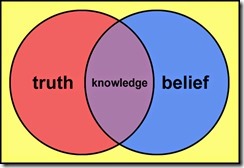
One of the often fatal flaws in human behavior is deciphering the difference between “knowing” and “believing.” The less you know, the more likely it is that you won’t know what you don’t know and that you will believe things that are not knowable. Got that?

It’s often the same with “need” and “want.” You want a cell phone, but you don’t need one. People survived for a few 100,000 years without them. You don’t need a car, you could live closer to work or take a bus or train. You choose to live where you feel you are forced to drive rather than walk, bike, or take mass transit. You choose to do work that makes you feel the need to drive. You need food, water, and, depending on where you live, shelter and clothing. You don’t need clothing if you live someplace warm, like humans did (and do) in Africa for most of our species’ evolution. There are thousands of things people in western societies imagine they need that are merely wants: entertainment, luxury, territory and wars over territory, philosophy, money and economics, education, and so on. But try living without food and water for a very short time and you’ll discover the meaning of “need” and shortly afterwards you won’t exist at all.

6791492_f1024The same goes for knowing verses believing. People often say they know there is a god and an afterlife or magic and spirits and ghosts or alien invaders from Alpha Centari who stick probes up human asses for inscrutable reasons. All bullshit. None of those things can be proven in any way. Even some of the things we know are hard to prove, but most of the things we believe are just made-up fairy tales of varying qualities and quantities of idiocy.

difference-between-knowledge-and-belief-7-728Gravity, for example, is consistently demonstrable. However, physicists have only uncovered some parts of a complete theory of gravity, regardless of how well we know it works. We know two bodies are attracted to each other in some proportion to their mass. We know there are some qualities of mass and gravity that current physics does not fully explain. Scientists act as if they believe in the current definition of gravity because it mostly provides accurate information; except in extreme astrophysics and sub-atomic examples. When a better explanation comes along, scientific belief will change to reflect that information. That is how theories work.

Biologists know that the theory of evolution is a fact. Examples of evolution in a single human lifetime have been demonstrated in viruses, bacteria, and even small animals under extreme environmental stress. There is no theory of “intelligent design,” only wild speculation based on superstition and desperation. A theory is “a well-confirmed type of explanation of nature, made in a way consistent with scientific method, and fulfilling the criteria required by modern science.” Religion meets none of that criteria in any way. Interjecting a magical “designer” into an explanation of biology or physics only throws off every inquiry based on that assumption so that all conclusions derived from that concept are demonstrably flawed. 

We may desperately want there to be a god who cares about us, individually, and it is possible that some people actually need to sustain that belief to cling to what passes for their grip on mental health. That, of course, is a perversion of “need” in the real, physical world and it may turn out to be one of the many reasons humans are not a sustainable species. Replacing the kind of insanity that comes from spiritual insecurity with the delusion of religion does not get to the core of the insanity.

a few godsThroughout human history, there have been thousands of religions and probably tens of thousands of a wild variety of gods. While most of the gods looked and acted suspiciously like humans, there were (and are) more than a few animal gods, weird multi-limbed humanoid gods, and outright fantastical things that Marvel Comics couldn’t have dreamed up. All of those gods had one thing in common, some group of humans invented them and believed in them. All of those whacky humans believed they knew how the universe worked and their religion and gods were at the core of that belief. So, pardon me if the religion of the century hasn’t impressed me any more than the ones from previous centuries.

d9f4f5636c09ad874736377df3f774a4One of the vital reasons the founders of the United States of America chose not to base the Constitution and the country’s foundations on religion is that humans have historically gone to weird and terrible lengths to sustain their beliefs. If a nation (as many have) adopts a religion as a core value, it is necessary to force everyone to pretend to believe the tenants of that religion; no matter how ridiculous those concepts may be. When the physical world contradicts almost any of the religion’s beliefs, the promoters/priests of the religion are forced to “burn the heretic” to protect the religion from reality. In many instances in history, that reaction has set back human progress, society, and security enough cause societies and countries to collapse into religious and moral decadence. It is, in fact, a clearly stupid idea.

Even being an atheist requires belief, just not as much. I cannot say I know there are no gods or afterlife. I can say I absolutely believe individual humans only get one shot at life and that what we call our being or spirit dissipates into nothingness the moment we die. Weirdly consistently, a superstitious person can say they absolutely know there is a god and an afterlife. They can say that, but without a shred of evidence what they are saying is “I don’t know the difference between knowing and believing and I don’t care.” No rational person should take that sort of person seriously, ever.

The serious aspect of people who are unaware of the difference between knowing and believing is the danger those people pose to the stability of a society and to the sustainability of the species. History has demonstrated that superstitious people will commit mass murder and cultural suicide in the service of their delusions. So, while their beliefs are nothing to consider seriously, their threat is very real and constant. People driven by belief are dangerous to all life on this planet.

9/24/2018

Begging for Respect

In a recent Atlantic Magazine video-article, titled “Why Don't Democrats Take Religion Seriously?” Emma Green asks, "Why haven’t liberals tried harder to reach the broad percentage of Americans who identify as religious?' Democrats in Washington often have trouble speaking in religious terms, and they reflect a broader liberal culture that doesn’t take religion seriously.'" The answer lies in reality. Liberals/educated people don’t take all sorts of silly shit seriously. We argue about exposing our children to Santa Claus, the Easter Bunny, ghosts, vampires, zombies, talking animals and inanimate objects, along with various gods and semi-gods like Jesus and Mohammed. We worry about the slippery slope of letting kids believe in “harmless nonsense” when they are young enough to imprint on that crap. The upside to believing in nonsense is so small it appears to be immeasurable. The downside is immense.

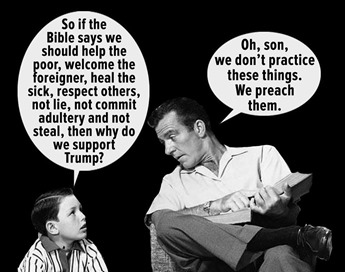
dissentIt is absolutely true that the Civil Rights Movement was driven, mostly, by religious conservatives like Martin Luther King. That was then, this is now. Today, religion has joined forces with the opposite view. Evangelicals and other so-called Christian groups have thrown their hat in the ring with Trump and the Republicans who are trying to turn the US into an oligarchy. Not that this is news, but from the Catholic Church to evangelicals to more traditional Protestant churches, sex scandals, financial scandals, and political wingnutery abounds. For the most part, the practitioners of religion have abandoned any pretense of moral character and its priests have turned religion into a poorly-disguised money machine; just like Republicans.

god warsThere is a reason liberals don’t take religion seriously, it is not a serious thing. It’s dangerous, it holds the whole society back, but it is not a subject for serious philosophical consideration.

Just to sum up the argument, you believe that there is a just, kind, jealous, vengeful god who randomly punishes little kids and other innocents with disease, starvation, war, and general mayhem for “mysterious reasons.” You believe that when Jebus comes back you will rise up from the grave (in prime condition, not the rotting mess your physical body became in the grave or the pile of ashes your kids were supposed to preserve) and go to a heaven that is designed to be ideal for every person (with a god who looks exactly like you). Belief is a funny thing. However, no matter what you believe the universe operates on the laws of physics and could not care less about your faith.  

Ijust practicet’s not the delusions or the superstition or even the arrogance that puts off many liberals, intellectuals, and generally sentient humans, it’s the celebration of death. Not just of death of the self but of the whole world. All of the Abrahamic religions have cults that believe the end of the world will be the beginning of Nirvana or whatever they’ve named their Big Rock Candy Mountain.  Christianity, as it is practiced in the US, is particularly driven to end life on this planet in the hope that the “faithful” will drift up to the sky and sit at “the right hand side” of their god for eternity. With the usual poor math skills exhibited by conservatives everywhere, I suspect they haven’t bothered to visualize how remote a position they are likely to have with the billions of believers stacked up on that side of the god’s throne.

If Christians were able to settle on eliminating themselves, leaving the rest of the planet to get along without them, the aversion to their belief wouldn’t be nearly as strong. Fundamentalist Christians appear to have a weak grip on their “faith” so, in case they are wrong and the whole Rapture thing doesn’t happen, they seem to be convinced it is important to turn the planet into a smoking husk before they drift off to where ever they will be going. That is the reason liberals and other rational thinkers are hostile to religion. If you want to Jim Jones yourself into oblivion, please be our guest. If you want to take the rest of us with you, get ready for a fight.

1/29/2018

Free At Last

Listening to comedian Rory Scovel on the January 20th Live from Here show, I realized that he’s right: the freakin’ world is gonna end with Trump in charge . . . and that is, weirdly, a good thing. During the show, John Prine even did a song with a lyric that emphasized that thought. They’re both right, we’re free, we’re finally free. Nothing matters any more. Everyone is going to die at pretty much the same time.

The religious right made it clear to anyone who knows anything about traditional Christian theology that the only remaining Christian “value” is the Supreme Court interpretation of the first amendment that exempts “churches” from corporate or personal income tax. That’s it, for them. End of moral discussion. Nothing else matters. Yeah, they babble about “right to life” in their 13th century hustle to get women back into the kitchen and delivery rooms, but that yak has been going on since the first European immigrant wet-backed into “New England.” The right to an abortion is one of the first marketing ploys the "New World” promoters used to con women into risking the wilderness. Face it, Republicans don’t care about any lives but their own and the Koch brothers’.

For decades those two groups, Republicans and faux-Christian evangelicals, have held the high ground in the cultural war’s labeling and marketing game; with phrases like “family values,” “Christian values,” “American (‘merican) Values,” “traditional values,” and so on. Now, thanks to Donald John Trump, those days are long over for several reasons. The first would be that the evangelicals and the uneducated and the self-appointed moral guardians of “conservative values” elected Donald John Trump; a vulgar, hedonistic adulterer, a sexual and economic predator, self-aggrandizing narcissist, a child-molesting, serial bankruptcy con artist, and all around near-perfect anti-Christ. If they can vote for him, nothing they’ve ever said about morality has meant squat.

Guys like me, who used to think it was polite to save “special” words for the garage and basement, have been cut loose. George Carlin would be amazed. All seven of his “words you can’t say on television” are now on television almost every night. Just from the language Donny John has let loose on the public, all bets are off. “Fucking,” “motherfucking,” “fuck,” “shit,” “shithole,” “shithouse,” “pussy,” “son of a bitch,” “bullshit,” and pretty much any other collection of words that used to be considered obscene and unfit for public use are now spouting from the President’s tiny pursed mouth. Boorish and bigoted behavior is now the model we’re showing to the world from the White House, But if you think Trump’s language is mean and obscene, you ought to hear what his minions are saying.

The only words Donald John Trump seems to think we all need to avoid are “vulnerable, entitlement, diversity, transgender, fetus, evidence-based, and science-based.” Who knew what “obscenity would be in 2018? George Orwell would be writing a whole new 1984 if he’d lived to see Trump’s America.

But the real gate-buster is the fact that, not only are we all likely to die while Donny John is President, but that we are all going to die at very nearly the exact same time! Think about how liberating that knowledge is. One of the disgusting values most liberals hold dear is “What kind of world are we leaving for our children and grand-children?” Republicans, pseudo-conservatives, and fundamentalists of all stripes and denominations never worry about the future: they either don’t care or they and their death cults sincerely hope that we’ll all die soon. Well, we’re leaving those kids absolutely nothing, which means we don’t have to worry about their struggle and suffering from the mess we’re going to leave them. We won’t be there to slut-shame and they won’t be there to do the slut-shaming. We’ll all be dead!

Isn’t that awesome? Seriously.

I’m not kidding.

We’ll all be dead, every one of us within a few seconds of every other: barely time for the last ones left on the planet to say, “Oh, shit!” And we’ll all be dead and gone and, afterwards, there might not be much left of the whole planet’s ability to support life.  At the literal least, when Donny John is done, it will be at least 100-200 million years before the alligators, crocodiles, rats, cockroaches, bottom-of-the-ocean amphipods and echinoderms and foraminiferans, and/or houseflies evolve into something capable of being pissed off at us for blowing up the world. 

How is that not liberating?

We might as well legalize practically everything that isn’t directly and intentionally murderous: only because we don’t want to short anyone out of their 1-3 years max life-expectancy. Drugs, all of them, all of the recreational ones, anyway, get legalized. Screw waiting for lazy, incompetent Republican congresscritters to get around to shutting the door on the DEA. This is a states’ rights issue. Just legalize anything that can get us high and make federal law enforcement stay in Washington, D.C. (where weed is already legal). We’re good with the totally bonkers right-to-lifers; everyone dumb enough to get pregnant gets to be a mom just in time for both mom and the kid(s) to be blown to bits! What’s the worst thing that can happen to new moms? 1-2 years max and your troubles are over. Of course, drug manufacturers get to sell their latest male and female sterilization and birth control drugs without any sort of FDA approval process. Over-the-counter, for crap’s sake. Who wants to be pregnant or a new dad if the odds are lousy that the kid will even live long enough to be born?

Nothing you can say, nothing you can do (excepting the murderous boundary), no words are obscene, no sexual behavior, and no financial crime matters. Because we’re all going to be dead in the same moment. And it’s going to be soon!

Obviously, if someone doesn’t want to wait for Trump to poke his “really big red button” with his tiny little fingers, they should have all the resources necessary to take an early exit. Pfizer and the companies that make sodium thiopental should get to be as rich as they can be in the 1-3 years they have to sell death-row drugs to the general public. When someone does manage to off themselves, relatively painlessly, we’ll be done with dreary, teary funeral ceremonies. We should celebrate that kind of skill and research. Most likely, we’re all going to fry in a blast of several-thousand degree evaporated atmosphere and radiation. Who knows? Trump’s apocalypse might be incredibly painful and the successful suicide will seem like the smart choice. We should all be jealous, rather than selfishly-sad. Every death will be cause for one of those drunken Irish wakes where at least another half-dozen mourners get killed on the way home from the party. Life will be like non-stop frat parties, which we’d think was irresponsible and shortsighted if we thought there was going to be any sort of future to worry about.

So, I say it’s time to celebrate the Age of Trump. We’re all going to be guilt-free and that’s no easy thing these days. In fact, if Trump doesn’t kill us all, the smart move will be to follow Trump with President Rock or Nugent. On their first day in office, either one of those two drunken nitwits would stumble into the Oval Office and fall on Trump’s “big red button.” Otherwise, our kids and grand-kids are really going to hate us for the mess we’ve left them and we’ll probably live long enough to hear about it.

12/09/2016

They Are Not Like the Others

The 2016 Minnesota redneck vote tells a lot of people more than what they needed or wanted to know about the culture in an area. When someone is thinking about starting a business, today the old “location, location, location” rule can have a completely different meaning. A location that has drive-by visibility and access is less important in a society that is driven by convenience (internet access), customer service (tolerance and people skills), loyalty (product lifestyle identification), and originality.

Voting red is a loud and clear indication that a community is neither tolerant, loyal, or creative. Goodhue County, in southeastern Minnesota, has a lot of the qualities that could be incredibly inviting to a 21st Century business. Red Wing, for example, is a transportation hub of sorts, at the intersection of US 61, US63, MN 58, and several well-maintained county roads plus there is an actual functioning Amtrak station. The city is hot-wired with fiber optic internet service almost everywhere in the city limits with IP service up to 1Gbps speeds. There is even public transportation in the city and it is a fairly inclusive service with three routes and regular service from 6AM to 6PM Monday through Friday, and 7AM to 5PM Saturday and Sunday. Housing is reasonably priced and there is no shortage of vacant industrial space. All that is good news. The bad news is that Goodhue County voted strongly for Trump and a Republican House candidate reasonable people assumed should have been unelectable. The Goodhue County Commissioners have tossed up random obstacles to prevent a “zip rail” system to Rochester and high speed rail along the Mississippi River cities. A surprising number of creative people are not drivers or even car owners, choosing to spend their commuting time doing something useful with their time. Easy and quick access to the Cities from the River Cities would be a biog draw to a lot of potential job-creating residents. The City and county officials appear to think Trump or some other con man will be able to return the country and world to the 1950’s, including that period’s social system and hierarchy (income inequality, racial isolation, and white supremacy). While there is a comedic appeal to the “back to the 50’s” drivel, change only goes backwards during catastrophes. Making “America great again,” as in somehow reviving a world where the US is the only major economic playground and white men are the only important players, is not an option.

Creative people are often odd ducks, like Steve Woziniak, Bill Gates, Warren Buffett, Elon Musk, Terry Gilliam, Robert Rodriguez, Amy Pohler, John Stewart, and pretty much any other artist, geek, or inventor you’ve ever heard of. Many (or most) of those people have experienced all of the bullying, intolerance, racism, stupidity, and backwards thinking they’re likely to be willing to put up with by the time their skills become productive. The statement Red Wing and Goodhue County are making with the election and opposition to technological and social change is “we don’t want your kind here.”

Creative people are attracted to other creative people and environments that encourage variety and tolerance. Mostly, that is a selfish preference because they will only thrive and survive in that kind of society. Intolerance, on the other hand, is an unattractive trait that repels creative people and inhibits everyone else. Diversity, that politically-correct concept the alt-right and blue collar middle-aged white men hate most of all, is a creativity driver. Creativity is not a conservative characteristic, either, assuming by “creative” you mean “moderate, careful, restrained, keeping with traditional, opposing change.” It’s pretty obvious that with that list of qualities, conservatives are disinclined to look for new solutions.

Currently, human knowledge is doubling every 12 months and that rate is accelerating. With knowledge comes change and change-drivers are always young, educated, and creative. Any community actively doing things to repel that demographic is doomed. Most of Middle America has been in severe decline for 30 years or more. The smartest kids leave, the dumb ones stay and reproduce more dumb kids with fewer outliers of intelligence every generation. That is not a formula for economic or social success in any vision of the future.

3/23/2015

#102 A Most Irrational Animal (2004)

All Rights Reserved © 2004 Thomas W. Day

Humans are exceptional strange animals.  We are the only animal capable of imagining that we are so special that we're going to a life after death.  And we're the only animal that is terrified of death. 

I know, you've watched the Discovery Channel and you've seen terrified prey fleeing predators, so you think all animals are afraid of death.  That might be an interesting theory if those same animals didn't give in so quickly once they're captured.  When a deer gets snagged by a lion, the deer usually quits fighting and waits for the end to come.  I've interpreted that not as a fear of death but of pain.  Once the pain is in process, the animal wants death to end the misery as quickly as possible.  Humans, on the other hand, seem to be considerably less afraid of pain than of death.  We'll submit ourselves to all kinds of pain to stave off even a few seconds of life before death.

The exceptions to this rule of humanity are martyrs.  Martyrs are either confident that their faith is correct and that they've been "on the side of God," or that their cause is right and they are willing to sacrifice their lives to improve the lot of those that live after their deaths.  The majority of humans may pretend to some kind of faith in a life after death, a benevolent god, or the cause of king and country, but they know better.  Deep inside, they know once they are dead, they're dead. 

With industrial age medicine, we have provided ourselves a way to prolong life and pain in exchange for putting off death.  Since the first medicine men appeared, humans have tried to hang on to a few more moments of life even if those moments are full of pain and suffering and incapacity.  We're not doing this to prevent our loved ones from suffering.  Our suffering and disability makes life much harder for them.  We're not hanging on to life so that we can take advantage of the opportunity to rectify the wrongs we've done when we were young and vital.  Most folks simply return to their old life without even thanking the doctors and nurses who gave them the additional time.  This is a purely selfish and faithless act and, as such, it's interesting.

The majority of educated humans do not actively participate in religious activities.  Churches are finding themselves mostly loaded with low-brow fools who desperately want someone to tell them what to do next.  That's a pretty ideal market for what churches have to sell, but it does limit the intellectual future of those organizations.  Today's religious "expert" is the intellectual equivalent of the ordinary layperson of 200 years ago.  A business or a country would be panicked at this kind of brain-drain, but religions have always catered to a baser audience so they, mostly, don't notice the loss of intellect.  Certain sects are probably discovering that it is easier to find dumb kids to molest, but, otherwise, the majority of their patrons are the same dumb, unquestioning folks they have always been. 

All this beings us back to the point of today's rant; the human fear of death.  It ought to be obvious that anyone who is afraid of death is a person who understands the finality of that event.  A "true believer" would look forward to leaving this existence and moving to the promised land.  The rest of us know that dead is dead and that spirituality is just an exercise in socializing a relatively unsocial animal.  Spirituality has mostly been unsuccessful exercise, based on human history at a macro or micro level.  Simply entering a hospital is an act of unfaithfulness.  Submitting yourself to major surgery is downright atheist. 

I don't have a disagreement with atheists.  All available evidence points to the fact that the universe is not designed to promote life and that there are no gods hidden in the ether to protect us from obsolescence.  I do question the sanity and honesty of folks who act faithlessly and pose among the faithful.  You either know that this is life your one and only shot at existence or you believe you're going to heaven to enjoy 22 virgin white grapes (or salamanders or human females) for eternity.  Having it both ways is an act of disbelief and, you'd think, that would be a major sin in the eyes of most gods.

12/30/2013

#32 What if the Twentieth Century Really Likes Us? (1999)

All Rights Reserved © 1999 Thomas W. Day

We're approaching Y2k as I sit at my computer and hack this Rat out. Three days away from the turning over a big one on the calendar's odometer. As I wait, almost perfectly unprepared, for all the disasters that the really paranoid types (as opposed to my own mostly paranoid state) are sure will mark "the end of the world as we know it," it struck me that this could turn out a lot differently than we all expect.

On a cosmic, geological, or cultural level, Y2k is as arbitrary a disaster marker as a pothole sign on a New York City street. Year 1 wasn't declared until the sixth century, and that was based on a sloppy calculation made from biblical dates and the estimated origin of the Roman Empire. All of this makes the precision of this date something like a really sloppy statistical calculation, like an economic prediction. Even more foolish is the fact that we've decided that a date system invented by a religious leader of a cult that represents less than 5% of the world's population is some kind of benchmark for the entire universe. Europeans are nothing if not arrogant.

Then there are the nitpickers who claim there was no year zero, therefore, somehow that proves that the millennium doesn't actually start until 2001. And you're not really a teenager until age fourteen and you're not in your forties until you're 41, by that precise, but boring, logic. Let's get past all that by admitting that we're no longer a world controlled by events and religion and that we've "moved on" to digits and sophisticated stuff like computer glitches that can cause international calamities due to shortsighted programming and buggy operating systems. The world's odometer is about to roll up three zeros and that's what matters. No computer on this planet will give a flying damn about 2001, so why should we?

So, having resolved that important philosophical argument, I want to move on to the really important concept that just snapped into my mind after downing my usual late night Jack Daniels tranquilizer: what if the Twentieth Century doesn't want to go quietly into history?

Think about it. Of all the dumb things humans have animated and anthropomorphized, the century that produced the largest growth in human knowledge (by a factor of several bazillion, by my last count) ought to be at least as sentient as your average straight-ticket Republican voter. And if that brain-dead logic works for you, consider this; why would the Twentieth Century go out without a fight? Based on the amount of money put into defending our public utilities, communication systems, personal computers, IRS data, and VCR clocks that always flash 12:00, someone thinks Y2k is a serious danger to all the things humanity holds dear, or manages with a remote control device. Consider the possibility that there is a government conspiracy to keep us from finding out who is really in control of this planet's calendar.

So here's my scenario: January 1, 2000 arrives and all that Y2k programming turns out to be a waste of effort. All of the world's computers start the Twentieth Century over again, date-wise. After a few months of wrestling with the hopeless task of forcing the world's computers to admit to the year 2000, humanity gives up and starts the 1900's over again. After all, we are the generation that can't make change without instructions from a cash register, the dumbest of all computer systems. How could we ever hope to defeat the efforts of the really smart computers, like PIII's and Gameboys?

The downside is, for a couple of decades, all of the working class will be negative years old, sort of the reverse of vampires; the walking unborn. That will create a momentary ethical problem for the government, who may be accused of taxing . . . something less than fertilized eggs? A pre-gleam in a father's eye? Whatever. Governments can always find an excuse to tax their victims, so that won't be much more than a blip on the radar of the repeated century.

The upside will more than make up for this little ethical hitch; no one gets to retire for another 65 years. All those deadbeats currently hanging out in Florida and Arizona will be put back to work. The Social Security system will be "saved." Even the military and government employment retirees will be forced off of the public dole, most of them will have to work another eighty years to put in their "twenty." Think of the tax rebates this will produce!

Of course, the other possibility is that the "system" will simply choose to ignore anyone who is not yet "born." That would serve us Boomers right, since we once advocated not trusting anyone over thirty. That philosophy could be carried over into completely disregarding anyone over fifty, or some other totally arbitrary age (just like "thirty" was in the first 1960's). It wouldn't take more than a year or two of unemployment and digital non-existence for starvation and exposure to weed out the "unborn" and provide the planet with a clean slate for the second Twentieth Century.

The second and most importantly cool vision of a total Y2k meltdown is the possibility that the entire credit system might collapse under the weight of its own bloated and greedy butt. If any system in the world is going corruptly and ineptly into the Twenty-First Century, it's the IRS and other federal government agencies. The candidate voted "most likely to imitate the federal government" is the banking system. Here's a test: what's the interest due on a loan that won't be made for eighty years? (Hint: Excel provides you with Microsoft's infamous 'ERROR!' result for this sort of calculation.)

You can bet your sweet patootie that most of us have meticulously hoarded our banking records, in case our bank balances go into negative numbers on January 1. You can also bet the patootie and its connecting limbs that any errors recorded in the favor of banking patrons will widely welcomed without many moral qualms. The only public sector group disliked more than bankers are the bankers' trust fund babies.

Politically, a sure way to get elected in 2000/1900 will be to promote "Y2k debt forgiveness" to all those yuppies and guppies who have buried themselves in credit card debt and house payments. Add the liberal arts majors who are now paying off their college loans working as assistant managers in fast food joints and you have a landslide election triumph.

If you couple our burning desire to get something for nothing with the possible mortality allergy of our ole' friend, the Twentieth Century, and we might be living the past century all over again, number-wise. Too bad it's just a numerical illusion, I wouldn't mind being -48 again.

December (just barely) 1999

9/08/2009

Why Teaching Sucks

In a recent conversation, my daughter made a comment about how unfair it was that teachers make $40,000 a year and "only have to work 9 months" for it. For the last decade, I've taught at a private college. For about 3 years of that decade, I had the time of my life teaching. For those 3 years, I would have agreed with her, except that I was making about $7,500 a year at the time. I was, also, working 12 months a year at two other businesses that paid the bills. I wasn't teaching for money. I sure wasn't doing it because it was easier than my previous job. I was teaching because it was fun. It was fun because I'd stumbled into a school situation where my boss was a terrific person with honorable motivations and his boss was, possibly, an even better person with amazing management skills. It was fun because I was learning as much as I was teaching, if not more. 

That's not a typical teaching position in the modern United States. It didn't last long where I worked, either. Most schools are mismanaged as badly as the worst corporations. Most teachers find themselves in systems that provide no outlets for their own education. Most teachers are as unsupported in their classrooms as a National Guard foot soldier in Afghanistan. The web is jammed with articles describing the conditions teachers work under: Top 5 Reasons Many Teachers Quit, Why are So Many Teachers Quitting after 5-7 Years?, Valid Reasons Teachers Quit, Why Teachers Quit and Why They Don’t, Why New Teachers Quit, and hundreds of other articles on this subject. 18,000 California teachers quit every year. 6%, nationally, leave the profession every year. 20% quit after 3 years. Nationally, 50% of urban teachers quit in the first 5 years of their career. Most teachers are short-timers. Our national divorce statistics look better than the teaching profession. 

If the pay is so good, the hours are so short, and teaching is one of the last jobs in the country to be "protected" by a union, why is the job so unwanted after a few years of experience? The reason is that teachers are constantly exposed to the nation's dirty laundry. From both ends of the work, teachers experience disrespect, incompetence, and disregard for their work. Students are ill-equipped to be educated. Administrators are mostly failed teachers. Society can't decide if it wants a professional education system or an amateur religious indoctrination. Government involvement swings from indifference to demanding hours of dysfunctional testing and mountains of pointless paperwork. From top-to-bottom, side-to-side, and front-to-back, teachers are surrounded by factors that would demotivate a saint.

What we're often left with is the institutional dumbing-down of the career that has paralyzed small towns and the Midwest. All of the smart kids leave for the city or better jobs as soon as they can escape and all the dumb kids stay home, reproduce, and down-breed even dumber kids. The smart kids who become teachers quickly see how screwed up the profession is and get out. The dumb kids who can't find better jobs stay in teaching, infect new teachers with their incompetence, and wait to be promoted into administration jobs where they can do even more damage.

Top all this foolishness off with the national drive for "efficiency" and you have larger classes, fewer resources in the classroom, more demands on a teacher's after-class time, fewer teachers with special skills (particularly math and science), no time for class planning, mountains of No Child Left Behind paperwork, and more needy children desperately looking for a parent substitute. Getting a day off is easier for soldiers. Having a weekend free of class planning, paper grading, or required-attendance school activities is rare. Getting support from administration is as unlikely as getting an honest answer from Little Dick Cheney. Summers are spent on a 2nd job or advanced degree pursuits or class preparation.

"Efficiency," in the US, means lower taxes for the rich. This efficiency is producing a workforce that is so incompetent that practically every 3rd world nation has better educated labor. Eventually, the rich are going to find themselves surrounded by incompetence and they won't be so rich anymore. The middle class drives everything in this country, in every country, and wreaking the education system that feeds the middle class is cultural suicide.

Any reasonably intelligent person would do anything to escape from this rat's nest of a job. And they do. That leaves the unreasonably unintelligent holding down the fort. Great jobs don't see mass evacuation from the profession. Teaching is not a great job. Try it sometime. Let's see how long you last.