8/13/2022

Falling in Line

The old saw about liberals and conservatives is playing out to be uncomfortably true: “Liberals fall in love, conservatives fall in line.” Conservatives like to mouth insults like “sheeple” without doing much thinking about what those words mean and, usually, that is just entertaining. Today, not so much. After the FBI raided their Führer’s palace in Florida, Trump fanatics are threatening civil war. It doesn’t matter to the Marching Morons that Trump had illegally taken and stored top secret documents in his treasonous rat hole. They are not only fine with der Führer’s close connection to Russian dictator and international criminal Putin, they celebrate their MAGA-wing’s common cause with Putin’s invasion of Ukraine. Their designated spokesman, Tucker Carlson, has become almost as popular in Russia as he is in the uneducated white power crowd in this country. How did a group so misnamed as “conservative” become so radically anti-American?

Easy. They fell in line.

Remember the “never Trumpers?” Yeah, I barely do too. It took so-called “RINOs” about a month to decide their usual out-of-control deficit spending, internal problems buck-passing to immigrants, racism, and pro-war money-grubbing would get a bigger pass with Donny than with an actual conservative. Donny knows how to speak to morons and Republicans are on most level not that bright. But one thing they have been for at least 200 years is “desperately seeking royalty.” The people who consistently vote Republican are also people who would have been Tories in 1776 and they would rather take a knee to a king than admit that their personal problems are due to their personal failures. They imagine that living in a dictatorship or under a king anointed by priests and other royalty would, somehow, solve their problems.

Back in late 2016, our Maytag dishwasher died, the 2nd unit of this model in 3 years, and I’d written a negative review about the product and company on a couple of big box hardware store sites. A woman from Maytag’s “customer service” emailed me to setup an appointment with a repair tech, supposedly at no charge to me. The guy who showed up for the repair was a sixty-something local driving a beat-up Ford van with his business decal flapping in the wind and a call tag from Maytag. He took a special interest in our dog and the opportunity to rant about how much better off the country was going to be with Trump in charge. We, obviously, disagreed, and I speculated that the country would be going through another economic disaster like the Reagan/Bush years and the end result would be an even smaller middle class, an even more obtrusive and invasive government, and a less secure nation. Just like the Reagan years.

The goober went into full worshiping rant mode about how grateful he was for Reagan and his economic policies. They guy claimed to have been a “mechanical contractor” in San Diego during the 80s and, if you know much about construction trades from the 80s you’d know they threw their lot in with Reagan to stop the metric conversion process. Reagan made all sorts of promises to protect unions, which won their support, and he betrayed those promises almost immediately without any penalty at all. He did kill metrication, which pretty much put the stake in US manufacturing's heart, so there is that. I guess construction workers would rather fall out of the middle class, suffer all sorts of economic instability, and see their futures limited to regular downgrading than have to learn a rational system of weights and measures. It’s good to have priorities.

“Devotion” is a word that most accurately describes the fervor Reagan and Trump culters exhibit. I used to wonder how and why people would fight for a king and now I know. Sort of. I don’t understand it at all, but I’ve sure seen it enough to recognize it. So, I know people will do that stupid thing and I have met them and do not understand their motivations at all. It is, apparently, akin to religion where people want to feel that they are part of something bigger, longer-lasting than just their own lives. Of course, they are wrong and we are all just insignificant specks of dust in an infinite universe that could not care less if we live or die. Reality sucks, so I guess the alternative is make up some crazy religion, pretend a god has chosen your Führer, and if you can do that you can probably imagine that the Führer is going to carry you to heaven/nirvana with him (as a servant) when he dies. I guess the “live free or die” thing has morphed into “live on your knees and beg” for these racist, sexist, incel libertarian-fascists?

Me and the wannabe Maytag tech argued a bit about politics and reality. Being a fanatic, changing any part of his locked-down mind was impossible and any real effort was pointless. I was mostly interested in observing his attitude toward his fluffy wimp of a “fearless leader.” He literally worshiped Trump and Reagan. His eyes got all glassy and his already pasty face got whiter. Of course, he charged me $60 to tell me my Maytag dishwasher was unrepairable. A few days later, I replaced the Maytag with an LG dishwasher that has been working reliably for the past 6 years.After listening to our conversation, my wife commented, "I used to think it was only 14-year-old girls who were that gullible. Now, I realize that some people never grow up."

8/05/2022

Your Move?

Jennifer Hale on Twitter: W\hen I was a kid, 19 years old in fact, I was convinced of the message in William F. Nolan and George Clayton Johnson’s 1967 SF book, Logan’s Run, was on the money: “Don’t trust anyone over 21.” Chickenshit screenwriter David Zelag Goodman “adapted” the book to a screenplay and raised the termination age to 30 for the 1976 movie and that is about all there is to say about that subject.

However, at that young, energetic, optimistic, stupid and childish age I imagined the world was a lot easier, more simple place to “fix” than it is. I was a microscopic part of the 1968 McCarthy Children’s Crusade, the student campaigners who imagined logic, decency, and compassion would be enough to stop the Vietnam War. We had no idea how oblivious, callous, and vicious our parents—the self-anointed “Greatest Generation”—were but we would find out. There were a lot of things that we didn’t know about our home country and system of government because the history we had been fed in school was pure propaganda and corporate and white power bullshit. A lot of our understanding of physics, psychology, politics, and history could have been corrected with an understanding of “hysteresis”: “the phenomenon in which the value of a physical property lags behind changes in the effect causing it, as for instance when magnetic induction lags behind the magnetizing force." In politics and culture, hysteresis is often accompanied by violent opposition to changes in the cultural “properties.”

Unlike a few of my friends of the time, I did not go to Chicago for the ‘68 Democratic Convention, so I missed out on the Chicago Police Riots. But I did participate in a rally in Dallas that also went bad when the Dallas cops surrounded the park (Lee Park, ironically), barricading the protesters with cop cars bumper-to-bumper around the park, and swarming the place with batons swinging and gas and mace filling the air. Earlier in the day, we’d been pelted with beer cans and trash as we marched (legally) through downtown Dallas, protesting the war and waving our Eugene McCarthy banners high. Between the violent opposition to anti-violence and the Democratic Party’s betrayal of their own convention rules, resulting in the appointment of Hubert Humphry as their loser candidate, I gave up on what passes for a political system for the next 8 years.

In the 1968 election, I wrote in Eugene McCarthy and someone for VP. In the 1972 election, I wrote in McCarthy, again. In 1976, McCarthy ran as an independent and I voted for him, again. And that was the last time I wrote-in or voted for a candidate who had no chance in hell of winning a major political office. And I have voted in every election in my life since.

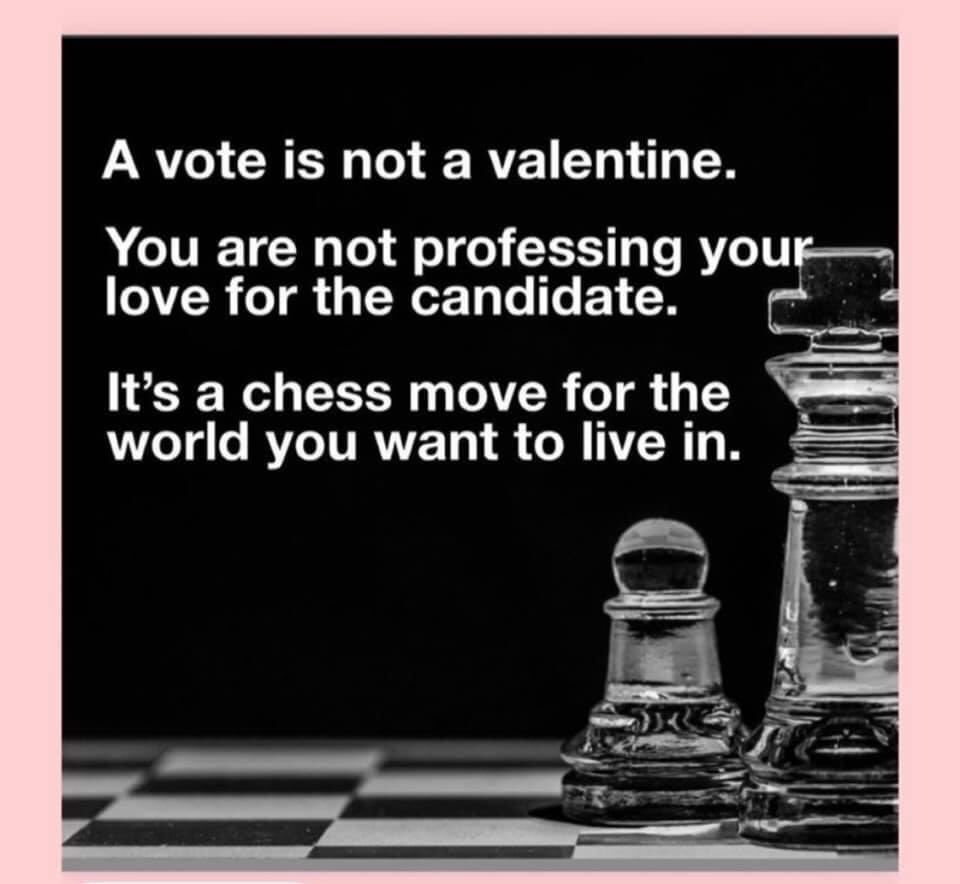
Recently, I saw a meme from a Rebecca Solnit quote that said, “A vote is not a valentine, you aren't confessing your love for the candidate. It's a chess move for the world you want to live in.” That, in a concise nutshell highlights the problem with independent candidates in a two-party political system. (You can thank Thomas Jefferson for your lack of voting options.) You can pretend to be participating in the system while not contributing to the problem by tossing your vote at a a no-chance-of-winning-anything candidate or you can play the fuckin’ game. This thought goes nicely with the old “Liberals fall in love, conservatives fall in line” truism that too often explains why the left couldn’t get Jesus appointed as Pope while the right could elect corporate shills like Reagan, the Bush’s, or, worst of all, the psychopathic, narcissistic, and demented Donald Trump to President of the United States. If you want to stare in the face of massive failure, the 2016 election/appointment (by the Electoral College) is the penultimate failure of the politics of avoidance.

If you aren’t a chess player, maybe the complexities of democracy and progress are above your head and in a world that was full of competent adults I might advise you to take your fuckin’ valentines and find a cute little clubhouse in which to play with them and the rest of your pipedreams. However, until the robots take over and apply strict logic to every decision every culture might want to make, you’re going to have to grow the fuck up and see if you can pull yourself away from your phone and Twitter/Facebook/TikToc’/blahblah and learn something about how your system works and doesn’t.

A chess game is the perfect simile for voting in a democracy. Consider this game. Let’s say my opening “gambit” is to move my 5th from the left pawn two spaces forward (called “1.e4”) and you realize that is the move Bobby Fischer called the “best by test” and my conservative approach pisses you off. So, your move is to remove your corresponding pawn from the board (exactly like a no-chance-in-hell 3rd party vote). Works for me. I move my knight from g1 to f3, which really irritates you into throwing a wonderful tantrum and you pull your Queen from the board. Now, I’m putting some money into the game and, being the kid you are you take my bet. A move or two later and we’ve got side bets of a vehicle pink slips and a house title on the line and you’re in checkmate. Sound like the 2016 election? If it doesn’t, you need to read a lot more and by “read” I do NOT mean bullshit from social medial but actual history books.

Remember, just because you don’t contribute to the system doesn’t mean your enemies are going to quit. In fact, they will not only keep regressing the country toward total chaos they will march unimpeded fully-armed and with the nutty belief that they are doing some damn god’s work.

8/04/2022

Over in a Moment

“Nobody knows anything,” is one of the many brilliant phrases from one of my favorite authors, William Goldman. Mr. Goldman created a host of phrases (and ideas and principles) that we use every day as if they have always been part of ordinary language.

Butch Cassidy and the Sundance Kid

  • “If he’d just pay me what he’s spending to make me stop robbing him, I’d stop robbing him.”
  • “I keep asking myself the same question, ‘How can I be so damn stupid as to keep comin’ back here?'”

The Princess Bride

  • “Life is pain, highness. Anyone who says differently is selling something.”
  • “When I was your age, television was called books.”
  • “Life isn't fair, it's just fairer than death, that's all.”
  • “Inconceivable!"
    "You keep using that word. I do not think it means what you think it means.”
  • "My name is Inigo Montoya, you killed my father, prepare to die!”
  • “We’ll never survive!”
    ”Nonsense. You’re only saying that because no one ever has.”
  • "Get used to disappointment.”
  • “You seem a decent fellow," Inigo said. "I hate to kill you."
    You seem a decent fellow," answered the man in black. "I hate to die.”
  • "You mean you'll put down your rock and I'll put down my sword and we'll try to kill each other like civilized people, is that it?”

All the President’s Men

  • “We’re under a lot of pressure, too, and you put us there–not that I want it to worry you–nothing’s riding on you except the First Amendment of the Constitution plus the freedom of the press plus the reputation of a hundred-year-old paper plus the jobs of the two thousand people who work there—(still building)—but none of that counts as much as this: you fuck up again, I’m gonna lose my temper.
  • “Follow the money.”

The Ghost and the Darkness

  • “Have you ever failed?
    ”Only in life.”

Magic

  • “Wow! Brains as well as boobs.”

Adventures in the Screen Trade

  • “It’s an accepted fact that all writers are crazy; even the normal ones are weird.”
  • “The easiest thing to do on earth is not write.”
  • “I write out of revenge.”
  • “A good writer is not someone who knows how to write- but how to rewrite.”
  • “You can never trust what you read.”
  • “There is one crucial rule that must be followed in all creative meetings. Never speak first. At least at the start, your job is to shut up.”
  • “One of my great breaks is that I have only done work I wanted to do.”
  • “Nobody knows anything.”
  • “But this is life on earth, you can’t have everything.”

When I was young, in my 20s if you can imagine that, anything William Goldman wrote, I read. His first book, The Temple of Gold,. came out when I was nine and I didn’t read it until I was in my 20s, but I was a 25-year-old fan by the time The Princess Bride was released, in 1973. I read that book to my daughters when they were babies and they grew up knowing the story as if it were a traditional fable. In 1987, when the Bride movie finally came out, we were all living in California and saw the movie in one of the Orange County theaters where Rob Reiner liked to first showcase his films. (We saw the 1984 premier of This Is Spinal Tap in the same theater, because my employer—QSC Audio—had provided some technical assistance for the film,) Apparently, not many people ever saw The Princess Bride in a theater, but millions or billions have seen it on VHS or DVD. For people who loved words, for 25 years years, William Goldman was a writer’s writer. It would have been hard to imagine he could be forgotten.

And that, finally, brings me to the fucking point of this screed.

Last week, I decided to do one of my semi-regular William Goldman binges and when I went to my local library organization I discovered the regional library system only owned one William Goldman book, in hard copy, and not a single one of his books in eBook format. (Have I mentioned that I have grown to really dislike paper books?) So, I read Adventures in the Screen Trade again and put as many Goldman books as I could find in the state’s MNLink system on reserve. The first of the MNLink books arrived yesterday,. Magic, and it came from the Raugust Library, Jamestown College. That’s Jamestown, North Dakota! It is a very beat-up paperback 1977 first printing copy that dramatically demonstrates how far from today’s consciousness one of the most famous American writers has fallen. Magic was described as “One of those once-in-a-generation novels that changes everything” and, today, the only copy of the book the Minnesota state library system can find is in a North Dakota college. I had to look it up, Jamestown is a 15,000 person shriveling burg halfway between Fargo and Bismarck. It is “the ninth largest city in North Dakota,” for whatever that is worth.

A few years ago, my step-sister made one of her fairly regular attempts to convince me of life-after-death. I shoulda kept it, but it was a picture of some old people practically crawling over each other in some kind of celestial ecstasy with the caption, “Wouldn’t you wish for this if you could have it?” Or something equally weird. For me, the answer is consistently “no.” As Mr. Goldman would have said, “But this is life on earth, you can’t have everything.” After you’re dead, you can’t have anything. Wishin’ and hopin’ won’t change anything about that, either. As Mr. Goldman’s fading fame proves, after you’re dead you just vanish from everything; no matter how famous, rich, powerful, or irritating you may have been in life. When you’re dead, you are not just dead, you are gone.

As an afterthought, I wanted to figure out who that North Dakota college library was named after. What I got when I tried to search for that information on the Jamestown College website was a “Page not found. The requested page was not found.” I suppose Mr. or Mrs. Raugust were North Dakota rich people, emulating Andrew Carnegie’s tactic of creating libraries all over the country to paper-over his vicious robber baron history. Even Carnegie’s massive effort is fading from history since “The USA had 1,689 public libraries built thanks to Carnegie grants. Of those, about 750 are still functioning as libraries today.” Outside of New York City, where 31 of Carnegie’s 39 original libraries are still functioning, greedy old Andy’s buildings are mostly gone or converted to other less-respectable or admirable purposes. Today, however, Carnegie’s most substantial “invention,” vertical integration (the act of controlling every step of production, promotion, and marketing an industry; aka monopolies) are well and thriving. The robber baron’s best friend, Ronald Reagan, tossed out every progressive move the country had made since Abraham Lincoln in 8 brutal, avarice years (Remember “Greed is good?”) and, today, the Bezos, Musks, Zuckerbergs, Pages, Brins, Kochs, and the rest of the billionaires who own the nation’s governments are having a field day with . . . everything.

The good news is that they will die and disappear with no more of a trace or memory than Carnegie. The bad news is that the good and great, like William Goldman will suffer the same fate.

6/25/2022

Living in A One-Sided World

The people who make the rules, the rich and powerful, are beginning to experience the world as the rest of us have to live it and they aren’t happy about it. And let’s face, it’s a pretty miserable world. The rules that most of us are forced to live by, out of necessity, are only suggestions for the rich and powerful. If you didn’t get that out of the 4 years of being mismanaged, ignored, abused, and ripped-off by the Trump 3rd Tier Elites, you will never get it. But a lot of people got it. And now that we are in our 3rd year of a pandemic that has cost this country at least 1,010,599 lives (as of June 25, 2022) and at least 6,300,000 worldwide, some people are discovering that they can use the same rules that have always applied to the idle rich and abusively powerful.

For example, if you are a skilled healthcare worker, like a registered nurse, you are in big demand today. Typically, an RN makes about $29/hour as a hospital employee. Hospital employees are historically abused and misused by their grossly overpaid and under-skilled and cynically misnamed “administration” executives. During the early days of Covid, that abuse went ballistic as hospitals’ staff were decimated by the killer virus and administrators did as little as possible to protect their employees from the disease and hostile, delusional patients. People died, people quit, and as of this writing about 20% of US healthcare workers have left the workforce and 47% of those remaining in that workforce plan to leave their “current role” or the occupation entirely in the next 3 years. One of the ways to leave the role as a hospital employee, for nurses, is to become a “travel nurse.” This article, “Why Do Travel Nurses Get Paid More | Travel Nursing,” does a nice job of explaining why a freelance nurse gets better pay, has more job opportunities and control, and is less stressed than a clinic or hospital employee. The bottom line, though, is more money and less hassle. If a hospital administrator is a pain in the ass, leave and work somewhere else in a heartbeat. Want more money? Travel nurses can make more than twice the salary of a permanent employee. Don’t like the work assignments, don’t do them and the employer’s leverage is practically zilch. Most likely, they won’t fire you because they are already way short on people to do the actual work and everyone knows the administrators don’t do anything resembling work. No patient ever picked a clinic because of the administrators.

Some friends who are retired nurse were recently marveling at the fact that people would apply for a job with Mayo Clinic, be offered the job, and not show up. The assumption was “people don’t want to work anymore,” but the fact is that in that business the odds are good that the applicant received several offers and just took a different one. Employers have been in that position for decades and when they pick an employee for a job most employers don’t bother telling the other candidates that they didn’t get the job and they sure don’t bother to tell them why they didn’t get the job. But for the last 100 years, employers have expected prospective employees to be massively more considerate than employers. No longer that world, is it?

Doctors are in a completely different and much better situation, thanks to mismanagement and Covid and the two combined. For example, pathologists are in hyper-short supply: Industry Voices—The shortage of invisible doctors | Fierce Healthcare. Where there were typically about 100 annual open positions in the country for pathologists there are well over 1,000 today and there are expected to be almost 6,000 open positions by the end of the decade. We can thank scumbags like Ronald Reagan for the current situation, since he made “work” a dirty word and single-handedly flipped a tax system that penalized idle “unearned income” into the spectacularly profitable but culturally worthless “financial services” investment income scam that has destroyed our manufacturing sector, diverted talent from all sorts of necessary functions (like medicine) to money shuffling, and set the country’s education system back at least 50 unrecoverable years. Doctors are retiring, many far earlier than they had originally planned or expected, and doctors are leaving the healthcare system. Even the moderately representative and grossly conservative AMA admits that one in three doctors are planning on cutting back their hours and commitment or leaving their practice entirely in the next three years. Doctors can pretty much go where they want to go, from research positions in the medical device or drug industries to teaching or administration jobs in completely different fields. You might think you are special with your cute little MBA party animal degree, but with an MD behind your name you are special.

And those thousands of open positions with a fraction of the necessary and critical applicants are just the tip of the “Great Resignation” iceberg. One of the longest lasting aftereffects of the Black Plague was an idea that is still growing; the rich and powerful are not as important as they imagine themselves to be. Like today’s Bezos, Musk, and the rest of that dependent, unskilled, over-valued ilk, the idle rich of the 12th Century might have been able to isolate themselves from the plague, but they couldn’t support themselves with their meager talents and when serfs realized that the penalties for walking away from the manor and the 3rd tier royalty were unenforceable, they walked. They kept walking until they created what we now consider “the middle class.” Royals have been trying to beat back that movement for at least 1,000 years, but the more education and talent is required to support a society the more people there are who can do the simple math that illustrates the inconsequential quality of idle elites. One of the key purposes of religion is to convince workers that God has chosen the idle rich for their special qualities and to question that is to question God. If you ever wanted to know why atheists' like Trump, the Kochs, Musk, and the rest toss money and acknowledgement at evangelical preachers, this is why. The priests have the same marching orders they’ve always had, “Baffle ‘em with bullshit, keep ‘em in line, don’t let them think for themselves or you’ll have to get a real job.”

As the author of “How the Black Death made life better” wrote, “With many state governments reducing unemployment benefits to push workers to fill open jobs, the aim, like England after the Black Death, is to reinstate and reinforce previous social and labor hierarchies, regardless of whose work has actually been ‘essential’ over the past 16 months.” As every competent employee in the world knows, if every CEO, CFO, COO, or any other C-word executive on the planet died tomorrow, the day after tomorrow would be no different than any day that came before it except that companies would be more profitable, more efficient, more flexible, and the stockholders would be richer. With Trump, we discovered that an incompetent and corrupt President is much worse than no President at all. And for 8 years of the worst recession in 75 years, the Republican Congress demonstrated that most of the design of the US government is so flawed that congresscritters can say out loud that their whole goal is to prevent the President from restoring the economy, rebuilding the infrastructure, and preparing the country for the future without any penalty.

For the moment, many employees are in the driver’s seat. Because humans are gullible and easily distracted, most likely this won’t last long. So, enjoy it while you can.

6/22/2022

I Get It, but That Won’t Help You

One of the many boring things I told students in my electronics and mechanical repair classes was “If you want to be any good at troubleshooting and repair work, you have to get used to being wrong; a lot.” Of course, like students everywhere and always they thought I was joking. I wasn’t and as a result I expect fewer than 0.1% of those young (and some not-so-young) people spent more than a couple of hobby years earning little-to-no-money in the business I was supposed to be helping them learn. Being wrong is a pain-in-the-ass and it’s the reason that so many shade tree mechanics are awful and destructive and that many commercial products are lemons. The predictable and repeatable result is what happens when the people involved in the repair or design of a product are trapped in the belief that they are “not like everyone else” and won’t make the foolish mistakes that have trapped humans into making bad decisions, dangerous or undependable products, and following that with cover-ups that just make it all worse. Face it, you will fuck up and when you do the best thing you can do is admit it and move on to fixing the mess you made. The longer you take to do that, the worse the mess will be. History is littered with ruined reputations, notorious products that have disappointed or maimed or killed consumers, high flying companies that went down in flames, and governments and nations that took major wrong turns and kept going in the wrong direction until they became examples of how not to govern and notes in history books.

Lots of us have people in our lives who are not really in our lives today because those people joined the Trump Cult and can’t and won’t get out. Many of those people are still so cultified that they believe Trump not only won an election that he lost, for the 2nd time,by millions of votes, but they even wish his lame, failed attempt to destroy the already weak link to democracy our ancient and obsolete republic constitution cobbled together had succeeded. Chaos, in their cult-minds, is better than giving up on the weird dream that Trump is “the fearless leader” he clearly is not. The problem isn’t that they are stupid, although they clearly aren’t as smart as they imagine. The problem is that they have lived lives where it has been easy to avoid admitting they were wrong often enough to be good at it.

In his Atlantic Magazine article, What Are Trump Supporters So Afraid Of? - The Atlantic, Tom Nichols writes, “We know from studies (and from experience as human beings) that being wrong makes us feel uncomfortable. It’s an actual physiological sensation, and when compounded by humiliation, it becomes intolerable. The ego cries out for either silence or assent. In the modern media environment, this fear expresses itself as a demand for the comfort of massive doses of self-justifying rage delivered through the Fox or Newsmax or OAN electronic EpiPen that stills the allergic reaction to truth and reason.” The wronger these people become, our once-friends and neighbors and family, the more entrenched they become in their delusion and avoidance. Nichols makes a terrific statement about how to know when you are really wrong in his article, too: “No one who truly believes they are right threatens to hurt anyone for expressing a contrary view. The snarling threat of violence never comes from people who calmly believe they are in the right. It is always the instant resort of the bully who feels the hot flush of shame rising in the cheeks and the cold rock of fear dropping in the pit of the stomach.”

That links to something I have witnessed and believed about most people who profess to be “Christians” for the last 60-some years. When my mother died at 34, when I was 9, I began questioning the “God’s wisdom and mysterious ways” bullshit. The more questions I asked, the more violent the responses became. My father, who was a relatively peaceful man, did what Christians did for several centuries to Native Americans, he tried to beat the doubt out of me. Or, as Captain Richard Henry Pratt's said in a 1892 speech to the National Conference of Charities and Correction: ‘Kill the Indian in him, and save the man.’" We used the same “logic” in our terrorist approach to Vietnam and 30 years later in Iraq. “If you don’t admit that we’re right, we’ll bomb you into the stone age.” When that approach is the only option, you can always assume whoever is making the argument is not only wrong, but they know they are wrong and can’t admit it.

Christians have never dealt well with doubters. Many Christians are so insecure in their slight grip on any part of the New Testament that they have hung, burned at the stake, drowned, starved, torn apart limb-from-limb, castrated, tortured, and banished doubters for at least 2,000 years. Of course the Old Testament pretty much gives “Christians” a clear path to any mutant, deviant, perverted violence that is at hand. The problem is, there weren’t any Christians before Christ, which points out a flaw that will regularly inspire a violent response. Even as a 10-year-old kid, it was obvious to me that “No one who truly believes they are right threatens to hurt anyone for expressing a contrary view.” And so, I adopted a life-long perspective that no one actually believes this shit and their violent reactions to doubt proves it. That goes for Mormons, Muslims, Myanmar’s violent Buddhists, and every other cult that uses violence to silence doubt.

Which brings us all back to where we started. If the problem is that humans are often incapable of admitting they are wrong, often until they are forced over some kind of cliff of no return, what are we in store for in the (hopefully) aftermath of the Trump disaster? While many in the impatient and often childish Left are chanting “lock him up” and living in the delusion that a quick trial and conviction of the head fascist-of-the-moment will put an end to the latest awful period of American (USofA) history, the slow, tedious, detailed, and legal path the Senate’s January 6th committee is taking the right path: detailing the activities of the people involved in the attempt to overthrow our elected government and send the United States of America into a spiraling decent into lawlessness, chaos, and very likely dissolution. In other words, exactly the path Putin and his Russian “friends” have been planning for the United States since the 1950s. Giving those stubborn, intuitive (as opposed to intellectual and reflective) folks the time to stare into mirrors until they slowly build some kind of new story that clears them of responsibility for what they have done and what they want to do is the only path that has a chance in hell of working.

5/30/2022

Memorial Day

For me, this is a weird “holiday.” “Memorial Day is a federal holiday in the United States for mourning the U.S. military personnel who have died while serving in the United States armed forces.” Or so says Google and Wikipedia. “Serving” in the US armed forces in the last 70 years has been an odd perversion of that word.

My father-in-law “served” in the Air Force between 1946 and 1966, enough to put in his 20 years and at a time when he mostly flew in a B52 from one US base to another pretending to be a “Cold Warrior,” but mostly drinking, partying, and making the most money he would earn in his lifetime plus a retirement salary that just kept growing until he died. My father served in the US Navy from 1942 to 1946 and saw more of WWII than he was ever willing to talk about and didn’t talk about it at all until he was in his 80s. He was mostly a confused small town kid being ferried from one end of the world to another on the credential of his college degree and officer status. He was an LST officer during both the North African and Italian invasions and saw a boat load of Marines he’d crossed the Atlantic with gunned down in the first few yards of the Normandy landing. He was never one of those guys who wore his WWII uniform or a hat full of medals and patches. When he ran into one of the guys who had spent a year with him on an LST, at a part-time summer job in the early 60s, they had nothing to say to each other.

Friends, some really good friends, were forced to “serve” in the Vietnam War and three of them did not come back and one came back so damaged that he was never functional again. That may not sound like a lot of people to you, but I have never had more than a half-dozen people I would call friends in my life. Losing four of them in a few years to a pointless foreign invasion was significant to me. Oddly and somewhat embarrassingly, I tried to join the Navy, like my father, when I was 18 in 1966 and thanks to a recruiter’s screwup I ended up being classified “1-Y” due to asthma and my Navy recruiter’s intense desire to stay out of combat.

The last two years have changed my perspective on who is serving who and who we should be memorializing. Covid hit the 1,000,000 US citizens killed mark in May of this year. “In some states, medical staff account for as many as 20% of known coronavirus cases.” The “Great Resignation” is loaded with men and women who have decided to leave the US healthcare industry because of the risk, the disrespect, and the fact that qualified and experienced doctors and nurses are more than capable of handling any job a business student might try to tackle. There is a lot more money in bullshit administration jobs than in healthcare. As of February, the estimate was that 1 in 5 healthcare workers have quit and at least one survey found that 1 in 3 plan to quit before the end of 2022. Most of this is due to crappy, over-paid and totally ruthless mismanagement. Hospitals, clinics, and insurance companies are mostly owned by large corporations with multi-millionaire CEOs and the rest of the totally useless “Cs” and while they publicly whine that they’re somehow worth the money they suck out of healthcare they are not. As a physician said in the Atlantic article, “We need to say to the next generation of doctors and nurses, ‘We got this wrong, and despite that, you’re willing to invest your lives in this career? What an incredible gift. We can’t look at that and change nothing.’” Will we? Probably not.

If Memorial Day were to mean something other than the flag-waving “moment of prayer” bullshit honoring the fools and occasional patriots who gave their lives for corporate profit and political maneuvering, we need to refocus on the word “serve” and give credit to those who gave their lives for a higher purpose and war is not that purpose. There was a brief moment, before Nixon abandoned the draft and the Vietnam War, when there was a lot of talk about expanding the concept of serving the country to everything from healthcare and public education to VISTA to the Peace Corps. Instead of only providing public service benefits to those who carried out the imperialistic plans of oil companies and the other international corporations our military has served to slavishly, the country would also honor and reward service to the country. In the 80s, California’s Alan Cranston was on a roll, trying to convince the country that broadening the range of service we honored with healthcare and education benefits when he managed to get himself tangled up in the Keating Five fiasco and prostate cancer (hard to tell which was worse) and decided to retire from politics.

For myself, Memorial Day is personal, not national. I try to remember the faces, the voices, the words, and they times with friends and family who are no longer among the living. At 74, my list is long and growing but there are term limits to how many I can lose before I’m lost. Sooner than later, I’ll be the one being remembered, if at all.

5/21/2022

Something about Idaho

Idaho NazisYou might be confused reading about the domestic terrorists infesting Idaho: the fascists, the racists, and the proud swastika waving American Nazis. How can a place so overwhelmingly blessed with natural beauty, abundant resources, and spectacular weather be cursed with the scum of the European invasion? Read a little history and you’ll discover Idaho has been cursed with these human monsters almost from the moment silver was discovered in those mountains and giant, corrupt assholes like Rockefeller, Morgan, Mellon, Crocker, Vanderbilt, Carnegie, and Hill mined Washington D.C. for free access to every penny that could be squeezed, crushed, dynamited, cut, or burned out of the western states. They did all of that damage with the help of exactly the kind of people who are waving treasonous Confederate and Nazi flags, carrying guns into public meetings, threatening “liberal” public officers, and generally crapping in the streets to demonstrate their general lawlessness and love of chaos. These are not a new sort of Idaho resident, although many of them are recent California immigrants, running from expensive California real estate and employment competition from actual human beings. Riverside County is puking up the kind of garbage people the place has been known for since it became the home of the KKK and American Nazi Party back in the Reagan years and Idaho and Texas appear to be catching the bulk of that faux-Christian vomit.

At the turn of the last century, Idaho and Montana were originally infested with exactly this kind of European immigrant. As Timothy Egan describes in The Big Burn, Teddy Roosevelt and the Fire that Saved America,  a book about the early history of the under-resourced and disrespected U.S. Forestry Department, Taft, Idaho in the early 1900’s was “a town . . . with one prostitute for every three men and a murder rate higher than that of New York City . . . You could buy the basics in Taft: a woman, a man, a horse, a place at a card table or a spin of a roulette wheel, a fat steak for $1, a quart of whiskey for $1.25, a bunk for 25 cents. One nearby shot advertised ‘shoes, booze and screws,’ and they weren’t talking about hardware.” Those were the people imported to rape and plunder the forests, mountains, and water resources of Idaho in 1900 by the infamous robber barons. Before Teddy Roosevelt, the Republican Party (like today’s Republican Party) was convinced it’s primary duty was to provide free and easy access to the nation’s natural resources to the highest bidder in exchange for some dribble-down economics. Some of the robber barons, like some of today’s Congresscritters, took a more direct path and became Senators, in the days when U.S. Senators were appointed rather than elected, so they could pay themselves for the privilege of plundering the continent.

It’s not a stretch to imagine that the kind of people who would work for Anaconda Copper (aka “The big snake”) and the other mining giants, the railroad trusts (the biggest corporate welfare recipients in U.S. history), and the logging trusts would also be of low-to-non-existent moral character and easily fired up to maintain a constant level of instability and violence to keep the misdirection going and the money flowing into the smallest number of huge pockets possible. These are exactly the people Orwell was talking about with his “four legs are better than two” sheep chants.

Nothing has changed today, corporate con artists like Trump, the Bundys, Vandersloot, McGeachin, and a collection of fake news propagators are pumping up the Marching Morons to self-destruct themselves and the state they claim to love in the interests of outside profiteers. The Bundys made their fortune poaching grazing land from the public spaces and have turned poaching into a right wing “liberty” for the few who have the guns and political power to chase everyone else off of those spaces. You have to give them some credit for having the gall to pull that one off. If you can mobilize a pack of idiots to arm up and protect your “right” to steal from those same idiots, you are definitely some kind of salesman.

Trump regularly chanted that the rest of the world is laughing at us. He distracted that attention by claiming that it was because of our immigration policies. We wish. No, the intelligent people of the world are laughing at the USA because of the number of well-armed, easily-misled, insanely violent, and grotesquely entitled “citizens” this country has created and inspired to overthrow a political system that has provided them with more freedom, resources and opportunity, and space than any in human history. For the most part, these wingnut revolutionaries are doing the work for people, organizations, and states who have been labeled “enemies of the state” since before WWII and they’re actually even waving our enemies’ flags. Now that is salesmanship.

5/11/2022

How Stupid Do You Think We Are?

I know, the title of this rant is pretty stupid. The answer is clear, “Practically infinitely stupid.” Listening to Republicans explain why an insurrection was just an ordinary protest, “Free speech at its finest,” and their beloved uneducated minions chant versions of “Four legs are better than two” has about done me in. My opinion of human intelligence is at an all time low, especially the kind of humans I’m surrounded by in the rural Midwest.

Most recently, in response to my comment that Republicans are hustling this attack on abortion rights as a racist distraction driven, as always, by power and money, some relatives claimed “I have half-black grandchildren” or “my daughter-in-law is Hispanic, how can I be racist?” They are, of course, ignoring the fact that their grandchildren have been trying to educate them about the consequences of their politics for years. The core to this argument is, “I can personal act fairly morally and convince myself I am not racist while I consistently vote for racists, traitors, and authoritarians.”

The fact that they imagine no one sees through all of that is a pretty strong statement of how stupid they think we are. Of course, it only works in their own, narcistic minds, but that is their entire world. Between their religion, their guns, and their entitlement they are convinced that the rest of us are fools or worse. What they perceive as reality is so clouded in superstition and unexamined belief that any kind of actual science or even simple news report gets perverted into nonsense by their distorted filters. And the beat goes on. Or, and so it goes, depending on which commentary on how “nothing ever changes” you pick.

A lot of people who have studied history and who watch the curve of US politics and political opinion are warning us that this is a turning point; for good or evil. An entire political party and their cult followers are bent on destroying any semblance of democracy and replacing it with a freaking combination of theocracy and fascism. We are watching history repeat itself, again. One of the more entertaining reminders of the world’s horrific past is the perverted claim that fascists are not the problem; “the Nazis were socialists.” In name, that is true: Nationalsozialistische Deutsche Arbeiterpartei (NSDAP; National Socialist German Workers’ Party, or Nazi Party). That workers’ political movement quickly turned into a coalition of fascists and conservative industrialists and the socialists left and created an actual socialist workers party; the anti-capitalist Schwarze Front (Black Front). In a similar manner, the fascists who have taken over the Republican Party are now calling the people who are traditional Republicans RINOs (Republican in name only). In 1934, Hitler ordered the murder of the founders of the Nazi Party and purged the party of anything resembling socialists. Just like Trump and his henchmen attempted to do on January 6, 2021.

If you are able to argue that the last 50 years of concentrated racism from the Republican Party is anything but that, you are an actor in the history the United States appears to be doomed to repeat.

4/29/2022

A Dog's Life

I began writing this piece on 4/19/2022. I plan to work on it until our close friend, Gypsy dies. It isn’t a journal of those sad days. It is intended to be an obituary of the most amazing non-human life I have ever experienced. Gypsy died on 4/29/2022 at about 12:30PM. In death, as in life, she did her best to be as thoughtful as possible.

This week, as I begin to write this essay, which is very likely to become an obituary, Mrs. Day and I are watching the last days of our 15-year-old best friend, Gypsy, play out. She joined our family, often as the smartest member, a little more than 14 years ago, near Mrs. Day’s birthday in September, 2007. She was a shelter dog and she and a sister had been caged convicts in a puppy mill that the Minneapolis SPCA had raided a few weeks earlier. Gypsy looked like a cross between an Australian Shepherd and a Blue Heeler, so that’s what we described her as her whole life. Her sister appeared to be a classic, black and white spotted Australian Shepherd. Both dogs were being treated well by the adoption agency where Mrs. Day found her and they appeared to be calm, friendly, and intelligent. It could have been a quarter-flip as to which dog we picked, but Mrs. Day really liked the Heeler color and markings. So, we went home with Gypsy (the name Mrs. Day gave her, not the name the shelter had given her). Our previous dog, Puck, who had lived with our daughter’s family for a few years, had died a few days earlier and Mrs. Day was convinced our granddaughter needed a dog to live with. I still hadn’t finished mourning the dog before Puck, a chow mix who had died 5 years earlier. I doubt that I would have ever brought another animal into my life if Mrs. Day weren’t so resolute that we “needed” one.

The ride home was a warning of what the next 15 years would be like. Gypsy whined, shivered, and paced frantically in the back seat of the car all the way home. As soon as the car stopped and she jumped out, she was “normal” again. For at least 15,000 miles of our lives, Gypsy put on that same show every time she was in a moving vehicle of any sort. She was terrible to travel with by vehicle. If we’d have wanted to walk from Minnesota to California, Gypsy would have been all for it.

The first day Gypsy was introduced to our household, she knew she belonged there and did not ever want to leave. We had a cat at the time, Spike. Spike was a neutered male who pretty much thought he owned the house. When we first got him, Puck was already part of our household. Puck accepted that kitten as if they’d known each other their whole lives. Likewise, when Gypsy arrived terrified, shy, and confused. Spike took a good look at her and walked away, back to his usual routine. Until the day Spike took off on us, after about a week living in our camper, they were the closest of animal friends. I am not lying here, but I wouldn’t believe it if you told this story to me: Spike would catch and kill rabbits, squirrels, and other wildlife in our Little Canada backyard and deliver them to Gypsy to devour for the cat’s entertainment. I really wish I’d have taken a picture of that behavior. Spike would just drop the dead animal at Gypsy’s feet and she’d make the prey vanish as if it had never existed. Barely a puff of fur left over, at most. When our most recent cat, Doctor Zogar, came into our family, Gypsy gave that nasty little brat the same kind of generous welcome Spike had given her. Gypsy played with both cats as energetically as if they were all kittens from the same mother, but she was always careful not to hurt them. I can’t say that care was repaid with any sort of kindness by Zogar. (Who I always called “Stinker.”) Zogar regularly spiked Gypsy’s nose and tried for eyes occasionally. I never hit Gypsy in anger, ever, but I batted that damn cat across the room fairly often when he hurt my dog.

Mrs. Day took her for a walk in our Little Canada neighborhood that first afternoon and Gypsy slipped her collar and ran off several blocks from home. Mrs. Day was convinced her $300 “investment” had run off and vanished on the first day, but Gypsy was waiting on the front porch when Mrs. Day came home. For several weeks, Gypsy didn’t want to leave the house and had to be forced out the door into the backyard to relieve herself. If we weren’t quick enough, she had decided the area in front of my office closet was a satisfactory “bathroom.” In a few days, the carpet and floor under the carpet were ruined.

We had a fenced yard, but she was unhappy inside that fence. So, I bought a “wireless fence containment system”: essentially a transmitter with a shock collar. I sent the collar to the lowest shock setting and walked her around the wireless fence perimeter, which I’d marked with flags. She freaked out at the first shock and we only stayed near the border long enough for the collar to beep after that. We did the same routine the next day, without the shock and she had it figured out. From then on, she was the smartest animal any of us had ever known. She marked out exactly the boundaries of her electronic “fence” and patrolled that area like a military guard. She did discover, much later, if she ran through the border and kept running down to the lake shore she’d either escape the shock or it would be brief enough not to be a problem. She rarely did that, though.


In December of 2011, I had a full hip replacement. I was determined to be mobile again in time for the 2012 motorcycle safety training season, which would start in mid-May for me. I had even loftier, less realistic goals for before that deadline and I was slowly failing to meet any of those targets thanks to pain and Minnesota winter. By then, Gypsy was a spectacular frisbee dog along with several dozen other amazing tricks and behaviors; including being able to jump into my outstretched arms on command, leap head-high (to me) to snag any object out of my hands in a running, flying leap, and jump on to any reasonable object around 5’ high from a standing start. One of my favorites was called “go ‘round.” On that command, Gypsy would run the perimeter of our yard full blast, which was as fast as I have ever seen any animal run. I’d seen something like that in the sheep dog demonstrations at the fair and Renaissance Fairs. My grandson helped teach her the trick by running ahead of her until she figured out the routine. Then, no one alive could have kept up with her let alone lead her. She was the dog I’d dreamed about when I didn’t even know I liked dogs. (I delivered newspapers as a kid and read water meters for the City of Dallas for 3 years. At the end of those experiences, dogs were never high on my list of interests.)

So, as I was struggling with maintaining my rehab discipline I kept up our afternoon walks and tried tossing her the frisbee. The problem with the frisbee was that I had initially trained Gypsy to drop the frisbees at my feet. We would sometimes do a kind of relay toss where I’d flip her a frisbee 15’-20’ out and she’d return it on the run, drop it at my feet, and keep running in the same direction where I’d toss her another frisbee. (I wish someone had video recorded us doing those things, but I’m the only person in my family who knows how to use a damn camera.) After the hip surgery, bending over to pickup a frisbee from the ground was close to impossible. Gypsy figured that out on her own and started handing me the frisbees about waist-high. That became a huge, incredibly distracting and enjoyable part of my daily physical therapy and, thanks to my dog, I was back walking 11 miles a day and teaching a full schedule of motorcycle classes in early May of 2012. My dog was my best, most dedicated, most sympathetic physical therapist and I can only hope I never need that kind of help again because she won’t be there to take care of me.

If you are one of those unperceptive, species-centric goobers who believes that animals do not have a sense of humor, Gypsy would have laughed in your face and you would have to be a complete fool not to know it. She had a wonderful laugh and a smile that was, literally, ear-to-ear. Her joy in running, jumping, wrestling, and performing her many tricks/behaviors was undeniable. On my worst, darkest depressed moments, Gypsy could make me smile and laugh. As happy as she often made me, I don’t think I ever realized how sad I would be at the end of our life together. As I write this, I feel like my head is overfilling with tears and sorrow. It physically hurts as badly as the worst headache I have ever experienced. I can’t imagine being willing to go through this ever again.

Gypsy had so many tricks (“behaviors” for the politically correct crowd) and she’d taught herself most of them. Speaking of the sense of humor, one of the first things she did was when someone would say “cute face,” she’d cover her face with both paws and act shy. That unmistakable guffaw would often follow that if someone would pet her and talk baby talk at her. She had the most gregarious hand-shake of any animal on the planet. She would raise her right paw even with the top of her head and swing it into your hand to shake. It looked like she was someone almost impossibly happy to meet you. The usual “roll over,” “sit,” “lay down,” “stay,” “speak,” and dozens of other words and actions were almost naturally in her vocabulary. We had to spell words like “walk,” “hike,” “go out,” “outside,” and anything else that might imply going for a walk or she would be whining at the door, looking up at her leash, waiting to go for a walk. Like most dogs of her breed, “heel” was a tough command to obey. She could do it, but she’d much rather take off to the end of her leash and nose about. Early on, she was a plow horse but she learned that obeying “don’t pull” got her a lot more freedom. She also understood “right” and “left” even off of the leash.

While Gypsy might have been the worst traveling companion possible, whining in spectacularly irritating and painful ways non-stop for whatever the length of the car ride, she was the best camp dog imaginable. She was fearlessly protective of Mrs. Day (as seen at left worrying about Mrs. Day on the back of a horse) and kept us aware of everything and everyone who came near our campsites 24-hours/day. She slept at the foot of our camper bed, every night, and always seemed to have one eye open for threats. Once, when she was tried to the bumper of our camper, a coyote had the gall to try and cross the outside edge of our campsite and Gypsy nearly pulled the camper uphill to get at the coyote. The coyote ran away with the knowledge that he’d have been in a fight to the death if Gypsy had gotten loose. People, however, were automatically given a pass unless Mrs. Day seemed nervous. And she was always ready to go for a walk, on a leash or not, and delighted to do it.

She liked everyone and loved many. For most of her life, she was free to roam our backyard and when delivery people came into the yard to drop off packages, she was always quiet and friendly. Many of them came to like leaving packages at our home because they got to visit with Gypsy. Deer, rabbits, and squirrels, not so much. One of my favorite indoor activities was, when I would spot a squirrel attempting to mangle one of my bird feeders, I’d let Gypsy out into the yard and say “squirrel!” She’d dash into the yard, looking for squirrels, and chasing any who were dumb enough to ignore her into the trees, over the fence, or up the hill into the woods. She loved terrorizing squirrels and rabbits and would not tolerate deer or other large wildlife in her yard. Mrs. Day’s hostas will likely be substantially less lush without their guardian.

Her will to live is inspiring. As of today, April 25th, she can’t eat or drink anything without throwing it back up. Her energy is a microscopic fraction of what it was a week ago and she was a shadow of herself then. Every morning, she drags herself out of bed and walks to the back door to be let out. (Yes, she has always been smart enough to know where her home is and did not need a fenced yard or tether until the last couple of weeks.) She is mostly operating on habit, since she isn’t ingesting anything she rarely expels anything. It is very much like she doesn’t want to inconvenience us with the process of her dying. If you are one of those who believe dogs are incapable of love, I can’t imagine what I could say to you. Even when she is on her last legs, she would rather sleep on the floor near Mrs. Day than in a comfortable bed in the living room. She has a bed in the bedroom, too, but in these final days she wasn’t to be closer.

Gypsy died today, 4/29/2022, at about 12:30PM. She had a rough night, mostly waking up and thinking she was alone. She didn’t seem to be in pain. For the 2nd time in the life we’ve known her, she soiled herself last night and when I carried her outside to lie on the deck bench she was still responsive but had no strength at all. She couldn’t even hold her head up and I had to carry her like a baby, supporting her head when I laid her down. We went for our last walk 10 days ago, it that one didn’t last long due to her strength. The day before, we walked almost a mile and she was slow but still moving well at the end of that walk.

Her will to live throughout all of this miserable week was inspiring and humbling. She did not want to give up and we did not feel that we had the right to make that decision for her. She was struggling out of her bed and staggering to the back door to be let out up to Tuesday evening. Wednesday, I carried her out after she was able to get up but couldn’t walk without falling down. We stood in the backyard for a while, listening to birds and night sounds, but she needed to lean on his leg to stay upright. Thursday, she soiled herself and wet the bed overnight. She was conscious most of yesterday and responded to being touched and our voices, but we think she was in a coma most of the day.

Last night, we left her in a bed we’d made for her in the living room but at midnight, just as I was going to bed, she started whining for the first time in a week (Gypsy whined a lot, that was her “voice” for communication, so the silence over this past week has been weird.) and we laid down beside her. That was what she wanted. I carried her into the bedroom where she had a “bed” and she was fine most of the night, but she woke up twice afraid and I comforted her until she was quiet. I honestly think Mrs. Day’s snoring helped keep her calm for most of the night. Me, not so much.

She seemed to be comfortable on the outside bench and she was there for about 4 hours before I discovered she had kicked off one of the blankets and died. She had been alone for about 5 minutes. I guess she was being considerate to the end.

Life is short, precious, and painful. And if you are as special as our dog, when you go your loved ones will miss you desperately.

4/18/2022

That Top-Down Problem . . . Again/Still

For more than 40 years, I’ve argued that everything is top-down; ethically, competence-wise, and functionally. Both as a manufacturing manager in the 70s and 80s and as a consultant in the early 2000s, I unsuccessfully tried to convince CEOs and other pointless and unproductive upper mismanagement types that the example they set with their own ethics and productivity filters down to every person in the company. That, obviously, clashes with the Harvard MBA career development motto, “push blame down and pull credit up,” and it was not only not received well it wasn’t even acknowledged. A good friend, who had recommended me for the consultant job in her firm, eventually gently, kindly, and very firmly told me that “Today’s executives want to be told they are right, not that they should be doing something right.” The posterchild for that kind of mismanagement today is Elon Musk who not only needs to be constantly spoon-fed congratulatory Pablum but can’t tolerate any injection of reality into his self-promoting world. So, I left mismanagement consulting (a turning point for this blog, which was once a consulting website) and did other things for the last 18 years of my career.

Like our declining, decaying, and mostly obsolete  manufacturing sector, the US has suffered a long string of incompetent, corrupt, and dysfunctional presidential administrations beginning with Eisenhower and Nixon, continuing with 8 years of Reagan’s corruption and outright stupidity, almost two decades of moronic Bush shenanigans, and peaking (so far) with the dumbest, most corrupt, laziest, least competent President in the history of the United States; Trump. (Ending that sentence with Trump’s identify is only there for you Qnuts, everybody else knows how stupid that man is.) The dribble-down moral effect is pretty obvious.

You can find dozens of articles about the the dumbing down of America (including Canada, unfortunately) along the lines of “Why the Past 10 Years of American Life Have Been Uniquely Stupid.” The argument that we’re getting dumber and heading for an Idiocracy is not only not new but coming from all directions: right, left, and center. Even stupid people think the country is getting dumber. Of course, 65% of Americans think they are of above average intelligence and, obviously, more (white) men think they are above average than women, mostly proving that Americans suck at math and statistics. The Dunning Kruger Effect is in full bloom.

The combination of top-down stupidity and corruption is the cause of practically ever breakdown in the country. For four depressing years, we suffered an administration full of corporate criminals, the 3rd tier of our 1% elite who are too dumb and too useless to work in a real administration, and some outright low life mobsters. (Yeah, I’m talking to you Giuliani.) Now, every unemployable deplorable in the country has been empowered to gun down anyone they don’t like, steal anything that isn’t nailed down and chained to a metal pole, and run wild in the streets pretending “this is our 1776!” [It was, by the way, conservatives’ 1776 and just like the last time they lost another war. In 1776, conservatives were called “Tories” and, just like today, they were on the side of an authoritarian theocratic government.] The amoral right wing have loudly claimed the various gods are on their side, including the freakin’ godless Russians!  In possibly the most arrogant example of Orwell’s double-speak since Trump’s last sputtering Russian Deputy of the State Duma Vyacheslav Nikonov (a grandson of Vyacheslav Molotov) claimed, "In the modern world, we are the embodiment of the forces of good. This is a metaphysical clash between the forces of good and evil . . . This is truly a holy war we're waging and we must win.”

In other words, just when you think life can’t get crazier, insanity doubles-down and lowers the bar even further than you imagined it could fall.

It’s going to get a lot worse before, if ever, it gets better. Americans are, by nature, conservative and uncreative and they whole idea of “the American Experiment” makes most of us uneasy. “Experiment” means trial-and-error and using logic like the scientific method to determine the success or failure of any part of an overall experiment. Admitting failure is tough even for scientists, but it is apparently impossible for the average American citizen. That means the failures of our national experiment have to rise to the level of the great depressions of the 1890s or 1930s before Americans will make any adjustment to the terms and assumptions of the experiment. 2007’s Great Recession was not enough and the unnecessary deaths of more than 1,000,000 Americans in Trump’s Plague didn’t even put a dent in the direction conservatives want to take their perversion of the country’s ideals. If we ever decide to make a correction in our experiment’s assumptions, it will require the collapse of the dollar in the world financial market (which is most likely going to happen in my lifetime), at least 20% unemployment, massive inflation at the Mexican or Venezuelan magnitude, and/or much worse.

The best argument most people can give for doing something they way they do it is, “We’ve always done it this way.” For most questions, that is the dumbest possible answer. When it comes to trying to hold back change and cling to historic “values” in the face of a raft of evidence that those false values are based on superstition, ignorance, and prejudice, the obvious result will be some kind of catastrophe.

If it happens before bankruptcy, this is the kind of disaster required for corporate reform, too. My favorite example is Ford Motor Company in the 1980s. In the early 80s, most of us in the manufacturing sector assumed Ford was heading for the dustbin of history like Packard, Studebaker, Rambler/American Motors, and the rest. In 1980, Ford lost $1.5 billion dollars. Those useless talking heads who had been the media darlings, like Lee Iacocca, had thoroughly trashed Ford with a collection of wrong-headed product and marketing decisions and grossly inflated executive salaries. By 1980, having done their worst, Ford’s executive staff were jumping ship like the rats they were. The last man standing was Donald Petersen, the head of Ford’s truck division and an actual engineer instead of the usual MBA, sales/marketing, or accounting refuse who had populated the CEO’s office for too many years. Petersen listened to engineers, including the company’s long-ignored quality and manufacturing engineers, and turned the company around in less than a decade. Those were the “Quality is Job One” years, a slogan that actually had the weight of action behind it. The company is still living on the standards created during those years.

Likewise, the 1930s Great Recession created a national economic disaster along with the challenge to democracy, capitalism, and decency provided by Hitler/Mussolini/Stalin forced the citizens of the United States to put up or shut up. The country came (mostly) together and created a collection of New Deal reforms that took Republicans and other regressive forces 40 years to destroy. We can only hope to survive the next challenge as successfully, but it will take a disaster to force responsible action and that means the outcome is totally based on luck: good or bad.

4/17/2022

When “Owning” Isn’t Enough Different from Renting

This is pretty funny, “How the pandemic housing market spurred buyer's remorse across America." I’ve been predicting this almost from the moment house buying became a trendy thing to do. Looking at those lines of young people stacked up in front of some obvious “fixer-upper” provided me with many moments of entertainment in the last couple of years. The couple interviewed for the start of this article said, “Every time something does come up, I say to my husband, 'Maybe we should be renting.' Like, if only we were still renting, then the landlord could deal with this." Go figure, houses need maintenance and a generation who have spent much of their time complaining that every other generation had it easier while living in their parents’ home are discovering what every other generation knew early on, “Life is hard, then you die.” In the middle, there is maintenance.

I get bored sometimes and start prowling Zillow, almost randomly. Today, I decided to look up my parents’ first house in Dodge City, Kansas, an 800 square foot place built in 1950 that they moved into when I was 3 (’51). I believe they paid about $5,500 for it. Dad’s teaching/coaching salary at the time was $2,200/year plus he had various summer jobs that probably added another $300-$350 to his annual salary, at best. The minimum wage was $0.75/hour then and most jobs, especially part-time jobs, paid that. Supposedly, that house is worth $75,000 today, although the only house for sale in the immediate neighborhood is selling for $60,000 and has been on the market for more than 100 days. Asking price and selling price often differ in rural areas. The house is for sale is larger place with a larger lot, so it’s probably worth at least $10,000 more than my parents’ first home. The “rich family” in our neighborhood, lived diagonally across from us in a 1930’s 1100 square foot, 4 bedroom, 1-bath house and there was a small “park” in the lot next to us (it was a corner house). Our rich neighbors had the first television I ever saw. We didn’t have a TV in our family for another 5-6 years.

The cool, interesting thing I found today was the official Dodge City “rich family’s” house is for sale now. The family that owned this place had been in large scale construction since the 20’s. They built this place in 1938 (according to Zillow). I was in that house once, sometime around 1970 to repair a television set. I was still in tech school, but my instructor had recommended me for the job. I don’t remember how that played out. I’m sure it was a tube set. Odds are good that the repair was fairly simple. 

When I left Denver in 1996, there must have been 10,000 houses being built that were bigger, fancier, and more expensive than this Dodge City mansion, just around my neighborhood in Parker. My daughter used to give me crap for owning a “tiny” 1,400 square foot house. I thought the place was ginormous, especially when I had it all to myself.

I also did a price search on Minneapolis, the most expensive city in Minnesota and found a lot of perfectly nice homes (800-1100 square feet, like my current house) and my parents’ house in Dodge for sale at well-under $200k, some close to $100k and a few under that. With today’s microscopic interest rates, a $150k house is about a $550/month Zillow-estimated monthly home cost.

I think the problem most young people have is that they want to start off where previous generations ended up and they keep spinning fairy tales about how easy earlier generations had it. Having worked my way through to a degree, nights and weekends, I’m not particularly sympathetic to kiddies who think their over-priced but worthless liberal arts degree/party animal school debt should be paid off by the rest of us and I really doubt that these kids are going to do well with managing and maintaining a home if they manage to buy one. Even when their parents’ do all of the up-front financing and work, these snowflakes will be overwhelmed by homeowning responsibility.

The characters who bought our house in Little Canada are good examples. When we were selling it in 2015, a realtor told me that the trick is to make it look as if nothing needs repairing. “The house should look like a ready-to-move-in apartment and a blank slate so they can imagine their own stuff in the spaces.” So we emptied the place out, painted almost everything white, and polished every surface so that they looked totally unused.

I had some doubts about selling the ready-to-move-in aspect of the 2 1/2 acre lot that came with the house. I mean, how can you make a small farm look maintenance-free? The realtor said, “Don’t worry about that. It’s part of the dream.” She was right. The buyers and their goober “inspector” nitpicked all sorts of silly stuff in the house, most of which I ignored, but they didn’t ask a single question about maintaining the large yard and several gardens. Stupidly, I left them a riding lawnmower and a shed full of lawn and garden tools. A year later, one of our ex-neighbors was visiting and among their many stories about our home buyers were all sorts of hilarious bits about those kids wading through waist-deep grass in the backyard, finally asking another neighbor to mow the lawn for them because they couldn’t figure out how to start the one I left them (the battery was in the garage for winter storage). They even rented a large lawn tractor, but couldn’t figure out how to get it off of the rental company’s trailer. Again, that same neighbor bailed them out. Six years and a divorce later, they sold the house to another young couple who immediately asked their helpful neighbor, “I heard you take care of the yard in front of our house?”

My own kids are also good examples, unfortunately. One of them moves when the dishwasher drain needs cleaning and the other will literally go without a functioning kitchen sink rather than either fix it or pay to have it done. Even maintaining bicycles seems to be a family disability. Clearly, I suck at leading by example.

There is a “1% home maintenance budgeting rule” that few people want to acknowledge. (The formula is something along the lines of “Annual maintenance costs will run about %1 of the value of the house.”) From my experience, that number is conservative for landlords. Renters are destructive, often entitled and spoiled children, and sometimes outright crooked. I don’t think I ever escaped paying only %1 maintenance costs on the two rental properties I owned. 5% was probably closer to the real number.

Obviously, I know a few young people who are doing fine with all of the adult life stuff, but none of them are bawling about how hard their lives are compared to earlier generations. They buy “starter homes,” fix ‘em up, and trade up when they have some equity; like most everyone did before them.

Yeah, I know the major cities are expensive, especially in the ‘burbs and the desirable urban areas. And they always have been. In the 80s, I could barely afford a 750 square foot, 2 bedroom apartment in Huntington Beach, California on $80k/year ($1600/month no utilities included when I left in 1991). That is why I left, among other unaffordable things. Just like every generation in the last 150 years, young people want to get out of the country and move to the cities where there is stuff to do and jobs to pay for the stuff. With an additional 100 million people in the country, from 1983 when I moved to California, there is a lot more competition for city housing everywhere. As someone recently said, “Housing prices in coastal California are almost comical.” Finding a house that costs less than $1M almost anywhere urban along the coastline from San Diego to San Francisco might be impossible. Just like it has been my whole life, everybody wants to live in California, even the rubes who pretend they don’t (because there is no way in hell they ever could).

Not even a little bit surprisingly, it costs a lot less to buy a house in a small town and there is no shortage of rural housing. Also, there are a lot more ways to make a living in those places; even Kansas! So the argument seems to be “It’s too expensive for me to live where I want to live in the kind of luxury I expect.”

Well isn’t that sad?

Life does suck for unskilled minimum wage workers, especially the ones who imagine they deserve better; the theme song for white entitlement. My aunt, my mother’s younger sister, lived in Minneapolis in the 1950s with her 1st or 2nd husband. They were both restaurant/bar employees, and that was her “career path for life.” All she remembers about Minneapolis was being cold all the time. They lived in a drafty apartment, barely able to keep the lights and heat on and always scrimping to get by. I don’t think they were in Minneapolis a whole year before they retreated to small town Kansas and she didn’t leave her hometown until she remarried in her 60s. Minimum wage in 1950 was $0.75/hour ($28/month at 40 hours).

I moved to Dallas in 1967 and the minimum wage was $1.40, but my department store job wasn’t covered by minimum wage and I made $1.10 ($41/week) as a drug department manager. Ms. Day and I lived in a very small, single-car garage “apartment” that cost $10/week for the first year we were together. $10 for rent, $10 for my tech/computer school tuition, $10 for food, and $10 for taxes, transportation, and everything else was a budget I will never forget. The first time we had a meal in a restaurant together was a half-dozen years later, in Hereford, Texas. A friend who had a field service job with one of my ex-employers would come through Hereford and take us out to dinner at a hotel restaurant, on the company dime. (They wanted to hire me back.) That was roughly when our first, Holly, was born in mid-1971. That restaurant meal was a big deal for me, although Robbye’s family (military and government jobs) were pretty used to travel and restaurants. She married way down and I was way out of my league. A few years later, we were dining out at McDonalds, Burger Chef, and the occasionally truck stop restaurant once a month at most.

We bought our first house in 1973 for about $8,000. It was a ramshackle, two-story 1920s frame house in Central City, NE. I was making a red hot $126/week at 40 hours, but I worked 80-100 hours a week. So, with overtime, I was usually bringing in close to $200/week by 1976. Our house payment was probably about $70-80/month but the place was a wreck and I rebuilt it from the plumbing in the crawl space to the 2nd floor bedroom ceilings; or from below-ground-up to the roof. About my only real memory of the place was holding ¾” sheetrock up to a sloped 2nd floor ceiling with one hand and pushing nails into the sheetrock with my right hand thumb, followed by driving them in the rest of the way with a hammer I gripped in my teeth. Today, I can barely drag a 4’x8’ sheet of 5/8” into the basement by myself . Mostly, I slide it along the floor.

You could buy that Central City house for $35,000 today and we sold it for $16,000 in 1976. Our next house cost $20,000 in ‘76 and when the ag floor collapsed around 1980, we sold it for $20k. However, I had to give the “buyers” $5,000 under the table so they could fund the down payment. Between cost of materials, sweat equity, and an actual $5,000 loss, I don’t want to think much about how much economic damage home ownership did to us then. We moved to a small town in northeastern Nebraska where a friend rented us a ramshackle 1900’s 2 bedroom house for $80/month plus bills. That house had actual “central heat,” a large natural gas stove in the middle of the house that barely kept that room and the kitchen from freezing. The windows on our bedrooms, the bathroom, and the mud room regularly had a 1/4” layer of ice on the inside panes. I replaced our washing machine pump several times when the room froze and split the pump and hosing. 

I didn’t have a shot at owning another home until I moved, as a single guy, to Colorado in ’91. Denver, as is usual for that town, was the first to crash in Reagan’s recession, crashed the hardest, and was among the last to recover (lucky for me). I bought a home that was built in 1981: 1400 square foot “3 bedroom,” two bath, single car garage house for $71,000 (It sold for $180k new, a decade earlier.). I put the 3 bedroom in quotes because one of the bedrooms was sized about right for a dresser, a lawn chair, and a military cot.

I desperately wanted to keep that house for the rest of my life, but we moved to Minnesota and I tried renting it for several years. After being a landlord, it’s pretty tough for me to generate much sympathy for renters, though. All three sets of mine were given a lot of latitude and all they ever did was shred the property and whine. The characters I was stuck with for renters wrecked the house badly enough that I gave up on it and sold it in 1998 for $108k. I had zero luck finding a Denver rental manager who wasn’t a total deadbeat and crook.  Supposedly, that house is worth a half-mil now, but the house and the neighborhood are dramatically improved now. It has gone through a few owners since and I suspect I’d have given up on it in the Recession for lack of rental income, the low quality of rental candidates, the long-standing problems with lack of active policing in the area and the resulting squatters/vandals/meth cooks, and the fact that I was marginally employed in those years.

I almost owned the place, when I sold it; having made double and triple house payments for the 5 years I lived there and putting all of the rental “income” straight into the principle for the next 4 years. Even getting screwed, as usual, by realtors I came out of the sale with about $70k in cash. As much as I liked the house and regardless of how well that area of Denver has done in the last few years, I did even better with the investments I made with that $70,000. Denver is so overgrown, under-resourced (especially water), and crowded I wouldn’t want to live there now, anyway.

Over the several houses I’ve owned in my 70 years, I’ve learned a lot about home ownership, maintenance, and unanticipated problems and costs. None of it has been painless, most was expensive and time-consuming, and a little heartbreaking. Homeowning, like life, “is hard, then you die.”

3/11/2022

Conservative Consistency

For most of my life I’ve been baffled and annoyed by what I believed was a conservative distain for consistency. Republican responses to Russia’s invasion of Ukraine have cleared up a lifetime of confusion. The Vietnam War was the first place I witnessed, up close, the odd inconsistency my parents’ demonstrated with their professed “pro-life” positions and completely uncritical view of our government’s invasion of a 3rd world country that posed no threat to the United States. Since the 60’s, I’ve watched conservatives form up behind US invasions of Grenada, Panama, Afghanistan, Iraq, Syria, and Libya. We’ve mindlessly and pointlessly bombed cities and civilian populations all over the world, with and mostly without, the support of a few other nations. There was a lot of talk both in the US and the rest of the world that G.W. Bush and his cronies might be prosecuted for war crimes under the conventions established in Geneva and Hague Conventions and such US law as the War Crimes Act, the Anti-Torture Act, and federal assault laws. But Republican and conservative voters and talking heads ignored all of that criminal behavior under the guise of “patriotism.”

Today, most of the country appears to be somewhat upset that Putin has decided to overturn a neighbor’s democratically elected government under the pretense of defending a minority Russian population in that country. The argument ought to be familiar. Eisenhower justified dipping into the Vietnam conflict after extracting the country from another unpopular war in Korea by claiming “the loss of Indochina, of Burma, of Thailand, of the Peninsula, and Indonesia following… now you are talking really about millions and millions and millions of people. The possible consequences of the loss are just incalculable to the free world.” “Free” meaning corporate (US corporations, at the time) control of resources, people, and property. As a justification based on the US retreat in Korea, Kennedy said, “Now we have a problem in trying to make our power credible, and Vietnam looks like the place.” Johnson said, ““I am not going to lose Vietnam. I am not going to be the president who saw Southeast Asia go the way China went.” The military mental-midget, General Curtis LeMay, was one of the first to threaten to “bomb them back to the stone ages” and almost no one even winced at that viciousness. And Nixon followed that with the words of an international war criminal, "I refuse to believe that a little fourth-rate power like North Vietnam doesn’t have a breaking point." —National Security Adviser Henry Kissinger All of that to justify spending as much as the nation has invested in infrastructure in the last forty years.

When the US decided to mindlessly dive into the Vietnam War, based on a phony excuse provided by the CIA and the , there were warnings that this was a classic over-reaching-empire miscalculation, “I believe this resolution to be a historic mistake. I believe that within the next century, future generations will look with dismay and great disappointment upon a Congress which is now about to make such a historic mistake.”—Senator Wayne Morse (D-OR) Even a Republican voiced as rational a policy as was possible when he advised Johnson to “Declare the United States the winner and begin de-escalation.”—Senator George Aiken (R-VT) And South Dakota’s Senator, George McGovern stated the obvious, “We seem bent upon saving the Vietnamese from Ho Chi Minh, even if we have to kill them and demolish their country to do it. I do not intend to remain silent in the face of what I regard as a policy of madness which, sooner or later, will envelop my son and American youth by the millions for years to come.”

Conservatives were, predictably, all-in on the Vietnam War and regularly labelled as “traitors and cowards” antiwar protestors, war opposition candidates, draft evaders (including those who went to prison for their beliefs), and anyone who didn’t fall in line behind the military effort and propaganda. Likewise, during the propaganda build-up for invasions of Grenada, Panama, Iraq, Afghanistan, and the rest, conservatives were immediately all-in on war. [That is, likely, a big part, or all, of their opposition to what they call “revisionist history,” which is nothing more than an honest look back at the country’s history without the propaganda filters.]

The same characters have followed the “love it or leave it” script for every US foreign invasion from Korea to wherever-the-hell our military, CIA, and NSA are screwing around today. If there is a war or an opportunity to squash democracy anywhere on the planet including the US, they want to be in on it and if there is money to be made doing that, all the better. And there is always money to be made creating misery and destruction.

Today, all of this kind of talk is rampant in Russia’s media both in Russia and Russia’s spokes-characters in the US. “I’ll stand on the side of Russia right now,” Joe Oltmann. Fox News, Tucker Carlson is a regular contributor to the state-owned Russian media as are more than a few other Fox and NewsMax squawking heads. The Q-Nuts and, of course, Putin’s pet, Donny Trump (I and II), and more than a Republican politicians regular Russian cheerleaders. As usual, follow the money. And that propaganda has been at least as effective in Russia as it has been in the US. "58% of Russian people approve of President Vladimir Putin’s invasion of Ukraine, while 23% oppose it, according to a poll taken by independent survey research organizations last week. That result is flipped for young people aged 18–24. In that group, 39% oppose the operation, and 29% are for it." I’m not sure “flipped” is the right word, with 29% of the younger group all in on the Russian invasion, but those numbers are pretty typical of the propaganda effect in the US’s history, too. Older people are more gullible and since they are unlikely to be asked to make any real sacrifices in war they are more likely to buck the party line.