Showing posts with label city government. Show all posts

1/25/2023

STP–The Canaries in the Coal Mine

Back in 2014, when we first moved to Red Wing, we joined the local YMCA. It’s a fairly nice facility for a small town and it seemed to be welcoming. That was typical of my experience with Minnesota Twin Cities (YMCA of the North) organizations. I had been a downtown St. Paul YMCA member, transferred to the Roseville facility, since we moved to Minnesota in 1996 and, as of 2013, my Medicare health insurance Silver Sneakers benefit began to pay for my membership. So, it seemed logical to transfer my membership to my new residence. The paperwork went smoothly and in late November we began to enjoy our new facility . . . for about a month. In late December, the Red Wing YMCA quietly announced (louder for those of us who were effected) that it would no longer accept Silver Sneakers payments and even acknowledged that it was the only YMCA in the state to make that move.

At least in our situation, the only real benefit to the Red Wing YMCA was the swimming pool. We have a small gym in our basement, complete with an excellent treadmill, stationary bicycle, weights, and resistance bands. We have no reason to leave our home for those things, which I discovered by transferring my Silver Sneakers membership to the local Anytime Fitness where I used it a couple of times and let it lapse.

For a bit, I attempted to carry on a dialog with the Y’s management (Tom Burke, Martha Harris, and Mike Melstad) and a member of the board (Barb Haley) who all claimed to have a solid, demonstrable financial reason for the Silver Sneakers decision, but were all completely unable or unwilling to produce any of it. I suspect when they learned I have a background in manufacturing accounting, ROI justification, and quality management they decided to keep their “secret calculations” secret. I was supposed to believe they’d done a thorough financial analysis which had provided justification for their decision. I am rarely inclined to trust any kind of management decision logic, based on my long history with incompetent, lazy, uninformed, overpaid, and mostly-useless management types.

This past December, the Red Wing YMCA management decided to re-evaluate and reverse their Silver Sneakers decision. They were pretty quiet about it, but I lucked into the inspiration to ask on January 1, 2023 and discovered they’d be allowing Silver Sneakers compensation starting the next day. While I was either getting registered, watching my wife get re-enrolled, or watching a half-dozen other old farts get signed up under the new policy, I heard the same pool-schedule spiel fed to each of us: the best time to swim and to avoid crowds was between 2PM and 4PM. So, I’ve been taking advantage of my new membership fairly regularly for the last 3 weeks. Yesterday, I showed for for my routine and discovered, thanks to a tiny sign printed on the door to the pool (after changing and showering) that the pool hours would be limited 4:15 to 8:30PM. I wasn’t the only surprised bait-and-switch victim, as there were two other new members in the dressing room who were at least as pissed as me.

I thought about bitching about yet another snow-job experience from the Red Wing YMCA, but I decided it is no longer worth it to me. Mrs. Day and I have been discussing the pros and cons of staying in Red Wing and Minnesota for the last couple of winters and I’m just going to put the local YMCA in the “cons” category and let someone else worry about it. “Fixing” systems, organizations, and processes was my career for 50+ years. I’m retired and don’t care enough to fix much of anything now.

This all reminded me of a conversation I had with the Washburn quality manager in 1991, during my 30-day moment of unhappy employment with that company. I wrote about this in a 2015 essay titled “Quality in A Disposable World” after a similar conversation with a Red Wing Southeast Technical College instructor. In that essay, I wrote, “Like a lot of small business people, my instructor was under the delusion that customers will naturally complain if they are disappointed with service or product quality. Many larger companies are equally happy to pretend that they are getting 100% ‘compliance’ from dissatisfied customers. The fact is that most customers simply log their dissatisfaction and tell themselves they will remember to never buy that particular company’s product or service again. Most company executives are perfectly happy with that outcome.”

The Washburn service manager explained to me that the company’s complaints system dealt with customers fairly ruthlessly (efficiently?). He said, “the company shipped product with a known 50% defect rate, based off of the internal random inspection data from a few years back (Since they quit inspections after a few months, product quality had probably gotten worse.). From a suspected 50% defect rate, about 1% of the company’s customers complained, expecting some sort of warranty response. If they stonewalled that first complaint, about 1% of the first 1% would come back for more abuse. No special inspection was done for warranty replacement instruments, so at least 50% of the replacements were also defective out-of-the-box. According to the manager, that 1%-of-1% routine applied to warranty replacement complaints.” So, with a known 50% defect rate, Washburn only provided some kind of warranty service (the first time) on 0.5% of shipped product.

In a similar vein, someone who was once involved in Red Wing’s city management explained how the city’s civil service bureaucracy blew off citizen comments and complaints with an acronym, "STP = same three people.”  The arrogant, simple-minded idea was that the few members of the public who contested or complained about the top-down city management decisions could be dismissed with this delusion. Red Wing is a very small town, 16,000 people and steadily shrinking (especially in average incomes), with a huge budget and a voracious appetite for insane growth through mindless annexation (41.41 square miles, so far). Minneapolis, with 425,000 residents, is contained in 57.51 square miles. Red Wing city management also has an outsized view of the “value” of city employees, based solely on what the city employees can get away with (often by ignoring the STP). Xcel’s Prairie Island Power Plants are the city’s main property tax contributor and those plants are likely to be phased out in the next decade. Eventually, that unrestrained spending will result in exorbitant local taxes and a rapid Atlantic City-style evacuation of the area by everyone who can afford to take a loss to find a more secure place to live. (Remember the rule, the first rats to leave the ship are the ones who can swim.)

Like the Washburn quality manager and the Red Wing YMCA management, the Red Wing city bureaucrats labor under the delusion that the 3 or 4 citizens who regularly comment and/or complain about the city’s services, expenses, or decisions only represent themselves. In fact, that small group is very likely representative of at least half of the local residents. They are consistently the “canaries in the coal mine.” The poor treatment they receive from the bureaucrats likely keeps the rest of the locals from voicing their opinions, until they vote with their feet and give up on the city. Red Wing’s growth has been anemic, at best, for the entire 163 year life of the city, falling far behind the national population growth and that of the state’s major cities. That failure isn’t for lack of natural resources,opportunity, or even representation in state and federal government.

9/04/2022

Rural and Old

An interesting aspect of my McNally Smith College of Music experience was the fact that a small city, St. Paul, attracted an outsized population of rural students. I don’t think I ever heard any statistics from our marketing/recruitment department, but I would be surprised if more than 10% of our student body came from cities of more than 10,000 people. Unfortunately, the school’s recruiters went hard after a fair number of inner city victims/students and while their tastes were at least 21st Century they mostly couldn’t afford either the “education” or the business. The music business has long passed the moment when ordinary people can hope to earn a living either as a musician or a technician.

The point I’m hoping to make here, though, is that rural people fairly consistently live in the past; often a fantastic non-existent past. The kids who came into that music school were almost universally 1960-1980 music fans, what should have been their parents’ or grandparents’ music genre. Weirdly, they are not even aware of how strange that is.

Having retired to a rural small town, I’ve discovered that people from my own generation in this area are fans of their parents’ or grandparents’ music genres; mostly really old country music or 1940s and 50s pop crap like Frank Sinatra or worse. Weirdly, they are [also] not even aware of how strange that is. [Remember, retiring to some place is exactly the same as picking a place to die. Nobody with a lick of sense in my age group expects to see the next decade and that makes for very short term planning.]  I have never been around so many people my age who know almost nothing about 1960s pop music. When they play a popular song from their own youth, they play it like it is an act of either defiance or extreme hipness. There is nothing hip about 60-year-old music. I often feel like I’m surrounded by reincarnations of my parents’ generation.

When liberal politicians talk about closing the gap between rural and urban voters, they are either dreaming or have a plan to dumb-down urban voters. Part of the attraction to rural areas is the lack of competition, low tech job demands, and a “more simple life” (read dumber and lazier). It is, literally, impossible to make silk purses out of sows’ ears and you can’t invent an education system that will thwart the low standards, superstitions, and fears of rural parents. In the 1950s and early 60s, the federal government made a strong push toward encouraging teachers to go to less desirable communities; rural and poor urban areas. The result was improved test scores, more of those kids finding their way into higher education and professions, but the push-back was fierce. A surprising number of parents do not want their kids to live better lives than their own and a high percentage of those parents are rural.

Today, we’re going the opposite direction. Rural and red state education has become an oxymoron as teachers abandon rural schools and many are closing or shortening their hours. “Teaching to the test” has been the state of K-12 “education” since Bush II’s “No Child’s Behind Left Unmolested” and the tests are getting dumbed-down every year. The complaint that “Half of U.S. adults can’t read a book written at the 8th-grade level” does not include the fact that the 8th grade level reference point has been slipping for 40 years. The average American reads at the lowered 7th to 8th grade level, which means they might be able to read a “young adults” book if they really concentrated. These are Trump’s beloved “uneducated.” A pitiful 12% of Americans are “proficient” readers; meaning people who could be useful employees or even business owners and professionals. This is the “demanding” criteria for “proficient”: “Click to the second page of search results from a library website to identify the author of a book called Ecomyth.” The top category, Level 5 and the most literate 2% are able to “Identify from search results a book suggesting that the claims made both for and against genetically modified foods are unreliable.” Holy crap! We’re toast.

Keep in mind, these are the people, the lower 88% for whom Republican politicians are making their MAGA pitch. They couldn’t make a 1st grade classroom great, or even slightly more intelligent, if their lives depended on it. When you read for the bottom, you don’t have to work very hard to accomplish your goals.

11/18/2021

Woe Is Rural America (and it’s well-deserved)

Greater Minnesota” is just a politically correct phrase for “rural Minnesota,” which is everywhere in the state except Minneapolis, St. Paul, Rochester, and . . . that’s about it. Duluth is a wannabe city, but that northern industrial area is just a black hole for development tax dollars with little-to-no possible return. St. Cloud is even less likely to stage any sort of economic comeback. Rural everywhere has suffered a brain and skills drain since the turn of the last century. “How you gonna keep ’em down on the farm” was a popular song in 1919 and popular music has never been great at spotting trends early. Back in the 60s, Larry McMurtry explained what had happened to rural Texas with “The kids who stayed in the country tended to be dull, lazy, cautious, or all three; those with brains, zip, and daring were soon off to Dallas or Houston.”

Red Wing and Goodhue County, for example, has suffered a steadily declining population since 2000 and regular property tax increases that make the area less and less attractive to anyone with the math skills to know what will happen to residential property taxes when Xcel closes the nuclear plans in the next decade. $15/hour or about $30,000/year is not a living wage in a town where even a serious fixer-upper costs more than $150,000. Area property values have increased by 37% in the last decade and wages by less than 3%. The city’s “average commute time” is 19.8 minutes, which means a substantial number of the area’s workforce is working a good distance from the city (mostly in the Twin Cities). Almost 14% of the city’s residents live in poverty, with women between 55 and 64 the largest demographic in that group. One quarter of the people employed in the area are over-65. The average resident’s age is 42.7 years, 6 years older than Minnesota’s average, and 41% of the City’s residents are past retirement age.

So, filling those local jobs means competing with employers from outside of the area with wages, benefits, decent management, and advancement opportunities. And that is for a rural city only 50 miles from the serious competition. Cities and businesses further from the state’s economic hub have to be shedding young talent like my sheepdog loses her winter undercoat when spring hits. Red Wing is pretending/attempting to shift to a more tourist-friendly destination, but noise and air pollution and a lack of recreational resources (other than the river) and a serious lack of city development talent has turned that effort into pointless and ineffective construction and economic flailing and rapidly growing property taxes. A short look at the rural area’s economic and demographic situation would make any reasonable person suspect it is not sustainable. The city has at least a half-dozen massive development failures in its recent history, a downtown that is being rapidly abandoned by businesses and customers, an excess of empty commercial buildings and, even, more than a few empty housing units, a decent infrastructure but large and expensive municipal and county services, and an aging population that is less able to finance the “if you build it they will come” city government’s delusional attitude.

An unrealistic attitude is a rural problem, too. Much of rural American believes it is full of strong, independent individuals who are more able to take care of themselves than “city folks.” That couldn’t be much further from the truth. Rural areas and states receive an outsized investment relative to their contributions to the GNP and tax base. Rural areas need cities, but cities are steadily less dependent on the goods and services produced by rural areas; to the point that this has become a loud “taxation without representation” issue for cities that have had their education systems, infrastructure, and services scavenged for the benefit of declining rural areas. Rural areas, mostly, imagine themselves to be indispensable and their anger and outrage in the face of facts drives them to the Fox and Republican propaganda machines, which isolates them even more.

There is a lot of data supporting the argument that the keys to economic success are tightly linked to diversity, inclusion, and openness. It is incredibly rare to find any small town that exemplifies any of those attributes. 50 years ago, Mr. McMurtry also had a pretty strong and accurate opinion of the kind of people who live in outstate “cities” and rural areas, “Lubbock, Amarillo, and Wichita Falls are the three principal cities of the Texas plain—cities that I find uniformly graceless and unattractive. In summer they are dry and hot, in winter cold, dusty, and windswept; the population is rigidly conformist on the surface and seethes underneath with imperfectly suppressed malice." The vaccine paranoia, anger and resentment, and self-destructive “rebellion” against science is a great example of that “imperfectly suppressed malice.” And an obvious result is the mass exodus from those areas by healthcare professionals. “Toxic individualism” is the media’s phrase for people who grossly over-estimate their own intelligence, knowledge and capabilities, and distrust anyone smarter than themselves; which is often practically everyone outside of their narrow and sheltered society. Attracting talented young people, or retaining them, into that environment is an impossible task.

3/04/2019

Gratitude, Don’t Leave Home without It

Twenty-five years ago, our youngest daughter suffered dozens of critical injuries in a car crash. Luckily, she was quickly rescued and treated by some of Denver’s most dedicated and talented police, firefighters, EMTs, and doctors. After she had been released by the hospital, Denver General, and was on the road to recovery, I began an effort to thank the people involved in her rescue and recovery. My motivation was not as self-inspired as I wish. When we were waiting for our daughter to regain consciousness in Denver General’s brand new ICU, I noticed a picture of a young man on crutches stuck to a post in the middle of the sparkling, hyper-busy, multi-million dollar ICU. It was an unprofessional photo in a cheap 8x10 plastic frame with a small note from the parents of the young man, thanking the medical personnel for their dedication and for their son’s life. After reading that note and seeing how special it was to the people who worked in one of the country’s busiest and most sophisticated hospitals, I started bringing in pastries every morning while our daughter was in the ICU. For several years afterwards, I sent the Denver General ICU a picture of our daughter with an update on the life they had given her and a box of artery-clogging pastries from one of our favorite Denver shops.

That got me into a cycle of trying to identify everyone involved in my daughter’s rescue so that she and I could thank them. What I learned from that was that of the three million people living in the Denver area and however many thousands of people rescued by first responders, almost nobody felt particularly grateful when they or a loved one was rescued, kept alive, brought back to life, and/or returned to good health from near death or terrible injury. The chief of the fire department that cracked open my daughter’s demolished pickup, extracted her from the wreckage, and delivered her to the helicopter the moment it arrived at the scene (14 minutes after the crash) had been with the Denver fire department for 40 years. During his career, the only time a citizen had contacted him about any of the thousands of rescues he’d been involved in was a lawyer delivering a lawsuit summons.

The same goes for the citizens who take on the responsibility of running our cities, counties, states, and the federal government. At the lowest level, it’s a thankless job that sets up the office holders for disrespect and abuse without much return on the time and energy investment. At the highest level, as we saw in the 2016 election, the more service and committment a candidate has given to the community and the country the worse that candidate is treated by both the media and the voters. There is a price for creating a society where greed, ignorance, and narcissim are valued characteristics: that price is best described by “we get the government we deserve.”

A recent editorial in my local newspaper, “Thank Our Elected Officials,” was a timely and decent reminder that we can disagree with our elected officials while still respecting them and appreciating their service. There is no such thing as a successful non-participatory democracy and Americans better either step-up to the responsibilities of maintaining that form of government or we’ll have to relearn that, as disorderly and inefficient as democracy is, it is far better than the alternatives.

10/08/2018

Facing Red Wing’s Reality

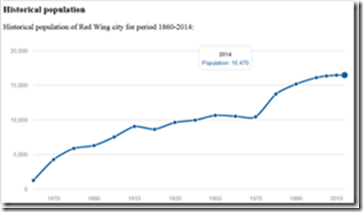
clip_image002What is often called “optimism” is often delusion. In the case of the city of Red Wing, Minnesota the city’s historic planning for spontaneous, prosperous and strong growth has been a city delusion almost since the city’s founding. The Prairie Island Nuclear Plant went online in 1973. As you can see by the city’s population history, the city’s population jumped by about 30% between 1970 and 1980; mostly fueled by the power plant employees’ inflated salaries. The two reactors are slated to go off-line in 2033 and 2034, since Xcel has no plans to renew the 60 year licenses. The Treasure Island Resort and Casino opened in 1983, which provided another smaller spurt in the city’s population. Since 2000, the town’s population has been, essentially, flat at about 16,000 people and the city only added about 1,000 people between 1990 and 2000.

However, the city’s optimism has been fueled by drunken sailor optimism since the city’s inception in the 1850’s. In 1995, the city built a 222 acre high school complex capable of housing a lot more than the current 1,000 8th-12th grade students. Current demographics and population growth trends indicate that considerably less of the facility will be needed or used in the next few years. The city just finished “investing” $3M in the Sheldon Theater, a show place that has no more chance of providing taxpayers a return on their investment than Donald Trump has at competently reading a teleprompter. This past year (2017), the city council voted to add a 2nd fire station to the west side of town, where it is desperately hoped the city’s growth might happen due to the minuscule commuter advantage to the Twin Cities. Over the past two decades, there have been several attempts to encourage some population growth on the west side of town with minimal results. You would think that a growth plan would assume and encourage some kind of mass transit to the Cities, like rail, but the city and Goodhue County both assume similar or increased car traffic in spite of obvious trends away from single-passenger vehicle commuting. When the Prairie Island power plant begins to shut down, it is reasonable to expect that a population roll-back similar to the 1970’s growth will occur and the city will be stuck with several expensive, oversized facilities and a drastically reduced tax base.

New Picture (1)In an effort to reel-in as much property tax as possible, this tiny town has incorporated 41.19 square miles of the Mississippi River valley. As Google Maps aptly illustrates, very little of the City of Red Wing is “city.” About 6.6% of the city is water and at an average of 475 inhabitants per square mile practically a ghost town. If the city were as dense as the Twin Cities, one of the least dense cities in the nation, we’d be at around 1,800 people per square mile and would need only about 9 square miles of that 41.19 square mile city; which means at least 32 square miles is largely unoccupied but still requires the city services and resources.

All of that acquired territory was gathered when a small portion of that real estate (Prairie Island) brought large tax revenues. Fairly regularly, Xcel and the NRC do a little song and dance around the illegally stored spent fuel cask inventory and nuclear facility re-licensing. Some part of that dance routine occurs every seven years, with the latest one in 2015. Xcel does an ROI analysis at each approval, inspection, or maintenance interval with political, economic, and risk assessments at each turn. Renewables are becoming a large part of the company’s income with considerably less downside at risk. It shouldn’t be a surprise to hear that Xcel decides to begin to decommission Prairie Island rather than invest the millions necessary for the next refueling. The company has clearly stated that it “has no intention” of asking for another NRC license extension in 2033. Somewhere between now and 2033, 40-70% of Red Wing’s property tax base will vanish and with it a fair number of the highest paid residents in the area. Unless there is some miracle replacement for that revenue, property taxes will either skyrocket or Red Wing’s city services will take a huge hit along with the higher-than-typical city and county employee salaries.(Update: Looking at the 2020 Red Wing Salary Compliance Notice, you can choke on that evidence. ". . . effective January 1, 2020: City Council Administrator $148,616, Administrative Business Director $121,326.40, and Public Works Director $121,326.40." The Minnesota governor's salary is $127,000. It is more than safe to assume there are several >$100,000 salaries downstream for those top three.)

Red Wing Population At the risk of being accused of being alarmist, I think Prairie Island’s closing is going to be an unrecoverable hit to the city of Red Wing. Based on the city’s sudden growth when the power plant was first installed, this chart is my estimate of what will happen to the population of Red Wing, Minnesota; depending on when Xcel decides to start shutting the plant down. This estimate only considers the effect on the city if just Prairie Island closes. (If you have Excel, you can play with my data on this spreadsheet.) Odds are, as the city’s tax base gets kicked in the ass by the largest property taxpayer the city will first try to shift the burden to other local industries. If that happens, more than just this one critical employer could vacate the premises. If that happens, those nasty looking downturns beginning around 2022, 2029, or 2033 will look a lot worse. If Xcel is followed out the door by BIC, Red Wing Shoes, or any of the other major employers the city could even be forced into bankruptcy.

Atlantic City PopulationThanks in part to our current Bankruptcy King/President, we have a model of this kind of community catastrophe. In 1930, Atlantic City had a population of 66,000 citizens. In 1976, the voters legalized gambling. By 1990, the city had lost 28,000 citizens and after a brief faux-boom the city’s casinos (including Trump’s) began to close their doors, declare bankruptcy, and default on owed property taxes. Residents were left holding the bag and many of them were forced out of their homes by the city’s attempt to avoid defaulting on local government pensions, reducing costs, and downsizing the bureaucracy. If you don’t think Atlantic City tax-ratethis could happen to Red Wing and you are a local resident, you will keep your eyes tightly closed and wish for a miracle. If you are a realist, you have to be worried about the county and city’s extravagant spending habits and exorbitant civil service wages (and the resulting pension expenses).

What kind of “miracle” could prevent this small town exodus and economic downturn? I can’t think of an industry that could replace Xcel and Prairie Island, but it’s not hard to imagine a combination of Red Wing’s strong infrastructure, mass transportation, and internet entrepreneur-ship that could at least stem the tide. Red Wing has affordable 21st Century internet service, which is unusual for Minnesota and the upper Midwest. There is still a train station and AMTRAK service to Red Wing, although it is too unpredictable, slow, and infrequent to be considered much more than a placeholder until (and if) real infrastructure improvements happen.

The real miracle would be a sudden burst of realistic thinking by the City Council, school board, and local residents. The current thinking is “spend it while we have it,” but that’s not what’s happening. The city government is spending a whole lot of money it doesn’t have as most of that spending is financed with bonds and debt and there is little-to-no municipal or county savings for the rainy days that are sure to be coming. It’s easy to imagine that if Red Wing began to build up a reserve of cash for the future, current residents would whine that if the city can afford reserve funds it can afford to reduce taxes. Americans, especially faux-conservatives, are really lousy when it comes to acting fiscally conservative. We are the most timid nation on the planet when it comes to science, rational thinking, education, foreign relations, and pretty much anything that might take more than a sentence to explain, but we are fearless when it comes to long term debt. I can’t decide if its because many Americans either think their gods will save them or if they just don’t care about their offspring; or both. Whatever the cause, it’s not a good trait over the long haul.

6/27/2018

Incentives Are Everything

A few years ago, I was asked to be part of a “This I Believe” presentation at the Unitarian Universalist Society of River Falls (WI) society. If you know me at all, you know that was a tough subject because I'm not much of a "believer." I found a few things that turned out to be more core to my belief system than I'd suspected and among that small list was "incentives." The study of economics has been pretty much a waste of air until the last few decades. For most of my life I've been in agreement with John Maynard Keynes who supposedly said, “Capitalism is the astonishing belief that the nastiest motives of the nastiest men somehow or other work for the best results in the best of all possible worlds.” Our current executive branch is consistently demonstrating that fact and the last four decades of American economics ought to be enough to put the last nail in most of capitalist theory. Market-driven capitalism tacks on a giant list of poorly designed incentives which work to damage democracy, decimate the ecology, limit personal liberty for all for a tiny percentage of wealthy and powerful bad actors, and promote illiteracy and ignorance in the general population. The mythical “free market” libertarians and traditional feudalists argue so irrationally for is just not a sustainable or just economic system.

What doesn’t work for business works just as badly for government. In our current irrational and poorly functioning “representative” system, unjustifiably powerful groups like the police, prison system employees, military, and government employees are isolated from their customers—the rest of us—by layers of union protection, political clout, and outright terrorism. When cops murder unarmed citizens, the only defense we have is the civil lawsuit. Convicting a cop of any crime, regardless of the evidence, is nearly impossible but getting a violent crime conviction requires all out magic. With that kind of insulation from responsibility and the soaring cost of police departments and their pension funds, cities are going broke trying to pay off the multitude of police misconduct lawsuits. “Dallas civil-rights lawyer Don Tittle says the increased availability of camera footage and shifting attitudes toward police are affecting cases. ’Up until recently, when it came to civil lawsuits, there were two groups that had a distinct advantage, where you had to knock them out to win. And that was doctors and cops. But with the advent of video, and the changing perception of society, I don’t think police are held in the same regard.’”1  Suddenly the cost of maintaining abusive police officers is turning into a major city budgeting problem.

P1-BU305A_LIABL_16U_20150715161211With the city government budgeting systems as they exist, that problem is unsolvable. For example, the Alberquerque, NM police department is the most expensive, lawsuit-wise, department in the country and has been under federal investigation and oversight often in the last few decades, but appears to be completely impossible to rein-in. New York City, between 2010 and 2014, spent $601M dollars settling police misconduct lawsuits. In 2015, New York City paid out $228M for police misconduct lawsuits. In 2017, New York paid $302M for the same kind of crap. That city’s 2018 police department budget is $5.6B or a little more than $101k per employee (~55,000 employees). Small towns aren’t immune to this kind of idiocy, either. "In Sorrento, La., for example, a newly hired cop in 2013 slammed into another car on a highway after going on a high-speed chase to catch a separate driver who was speeding. The driver who was hit sued. It was later revealed that the officer was already one of the town's most zealous issuers of speeding tickets, hundreds of which were later thrown out in court. That incident, combined with other lawsuits against the police department serving the small town of 1,500 people, prompted the city's insurer to drop its coverage. The town disbanded its police department shortly thereafter."2

The fix for this is to change the incentives, not to shield bad cops with even more anti-democratic police state Republican stupidity like the unconstitutional and anti-democratic House bill grossly misnamed the “Protect and Serve Act.” New York City covers the cost of those lawsuits out of the general budget, shifting all of the responsibility from the cops to the taxpayer. That is an example of a mindless system with no feedback loops to reinforce decent behavior or to inhibit misconduct.  The solution is to move the cost of settling these cases to the departments that caused them. If, for example, the NYPD had to pay $302M out of its budget to settle misconduct cases, that would result in roughly 3,000 fewer employees (at that $101k/employee cost). If it is true that the cops involved in misconduct cases are “a few bad apples,” the many good apples (if that turns out to be the case) would start cleaning up the department before their own jobs are on the line.

Like I said, incentives are everything. You just have to design them to serve a better purpose.

1 https://www.wsj.com/articles/cost-of-police-misconduct-cases-soars-in-big-u-s-cities-1437013834

2 http://www.governing.com/topics/finance/gov-police-misconduct-growing-financial-issue.html

11/30/2016

The Price of Being A Nation of Assholes

One of the few terrific management books of the last 100 years is Robert Sutton’s 2007 The No Asshole Rule: Building a Civilized Workplace and Surviving One That Isn't. In case you are a typical American and don't have the mental capacity to read a book, Sutton offered two tests for identifying assholes:
  1. After encountering the person, do people feel oppressed, humiliated or otherwise worse about themselves?
  2. Does the person target people who are less powerful than him/her?
Sound familiar?
To provide guidance to the generally clueless sort who make corporate decisions, Sutton also gave us a dozen identifying asshole behaviors, he called them The Dirty Dozen:
  1. Insults
  2. Violation of personal space
  3. Unsolicited touching
  4. Threats
  5. Sarcasm
  6. Flames
  7. Humiliation
  8. Shaming
  9. Interruption
  10. Backbiting
  11. Glaring
  12. Snubbing
Thanks to the Electoral College and the ultimate American asshole, Alexander Hamilton, we are about to experience a federal government totally staffed by assholes. Outside of the 61,900,651 confirmed assholes who voted for Trump (as of November 8, 2016) any normal person would recognize all 12 of those behaviors as Donald Trump’s prime personality markers.  From my own personal experience in this past election, those characteristics are core pseudo-conservative principles, too.

What does it mean for the future of the country when half of our voters idolize assholes? Keep in mind that, on average, the least educated portion of the country voted overwhelmingly for Trump, demonstrating why Trump and Republicans “love the uneducated.” For one, it means our media will continue to become more mean spirited, less fact-oriented, more focused on profit and less on public service, and society in general and public service will be less inviting to decent, intelligent people. I’m a firm believer in the FACT that incentives are everything. When society rewards politicians’ bad behavior far more consistently than decency, manners, intelligence, and competence, people with those qualities will find other places to commit their time. Eventually (as in January 20, 2017) our federal government will be almost fully-staffed by the worst, most selfish, least capable people in the country. The country is about to experience at least two years governed by all assholes. I don’t think this is going to work out the way these voters expected or hoped.


8/31/2016

What’s Inside the Sausage?

For some perverted reason, I decided to put myself on the ballot for one of Red Wing, Minnesota’s city council seats this fall. Part of that citizen-penance has been to attend city council meetings, especially this fall’s budget planning sessions. There I was reminded, again, that humans are incapable of learning from past experience. If you have ever been part of a corporate budget planning session, especially for a manufacturing company, you wouldn’t be able to recognize the civil service version. Instead of presenting a best-case/normal-case/worst-case revenue budget figure, so the city’s representatives can decide what gets done and what doesn’t, the city’s “finance officer” presents the happiest scenerio possible without any presented data to support his optimism. As usual, the more I learn about how my municipal sausage has been made, the less likely I am to want to eat sausage.

A new-to-me  term titled “tax capacity” was introduced along with a really depressing chart that described how city property taxes could be increased over the next decade. “Tax capacity” is the city finance officer’s best guess as to how much the city can raise tax rates before “something bad” happens. That undefined bad thing would be when the city raises taxes and the cost of services so high that even the current retirement community in the city and the small-to-large businesses are motivated to leave.

The problem with optimistic budget plans is that optimism is not often justified. In the case of Red Wing there are many looming financial difficulties and, by leaving them completely undefined and unanticipated, the city is setting itself up for failure. Here are just a few of the likely bumps in the road in Red Wing’s future:

  • The country elects another borrow-and-spend Republican President and, this time, the House and Senate are also Republican. After a brief bubble in a variety of recently “unregulated” sectors, the economy crashes into a real depression when all of those previously-regulated gangsters and con men crash the house. Housing values fall, businesses fail, tourism vanishes, people move away looking for the few jobs that exist in the rest of the country, and the tax base collapses for loss of population and local income.
  • The Prarie Island Nuclear Power Plant is either decommissioned (as planned) and 6-10% of the city’s revenue vanishes overnight. The city is not only left with a huge hole in the budget, but clean-up costs at the nuclear power plant fall on the city and county as Xcel “bankrupts” out on the obligation, as they have repreated across the country. Thanks to the revenue from this facility, Red Wing has over-built its school system, police and fire departments, city management, and services. The cost of maintaining these facilities and personnel without Xcel’s tax revenue could push local taxes high enough to cause rapid population loss.
  • Prarie Island has a Three Mile Island-level event, which not only forces the plant closed “unexpectedly,” but causes the city, county, and state to spend massive amounts of borrowed money to hang on to something resembling a community. Since there has been no planning for this event, the city moves quickly from prosperous to bankrupt when the bonds/debt comes due.
  • The obviously aging Red Wing demographic takes a jump in years and tax revenues fall when one or two major manufacturers decides to leave the area. What little attraction there was to the city for young families vanishes and they evacuate Red Wing for the Cities.
  • The same “aging Red Wing demographic ” continues to increase in years, allowing more Minnesota residents to take advantage of property tax allowances and the aging Minnesota demographic votes itself a better deal on property taxation in general. That shifts the municipal tax burden to younger families and to a lesser extent on local business. Of course, that provides incentive for the younger citizens to leave the area.

These are just the top of my list. I could add at least three or four more bad news scenarios and I’m sure you can think of a couple I would miss. Even without a significant catestrophic event it is likely that the overall US economy will continue the generally downward path it has been on since the late-60’s and all those bills we put off for a more prosperous future generation will come due on our children and their children. The time to solve those problems is now, while there is still some money available to work with.

When a competent business (a rare organization today) makes an annual budget, one part of the planning is examining all of the good and bad things that could effect that plan. During the Red Wing budget process I heard far too much about how much additional tax capacity the city would absolutely have for the future. I’m not picking on Red Wing here, either. I suspect that my little town is no different than 99.999…% of the country, including counties, states, and the feds. Civil servants are not the right people to be in charge of the budget process. Either citizens, both elected and not, tell their government how to manage the community or the process is out of control. As I’ve said at least a couple hundred times this summer, there is no such thing as a successful non-participatory democracy. The only way to actually find a fix for the looming problems of Red Wing, Goodhue County, Minnesota, and the United States is for citizens to be actually involved instead of pretending to be patriots on-line and in preaching-to-the-choir bar conversations with like minded friends. It’s dirty work and no one wants to do it, but you always get exactly the government you deserve.

nuclear closingsRed Wing and Goodhue County’s golden goose, the nuclear power plant, Prarie Island’s operating license expires in 2033-2034 and Xcel Energy has and will continue to explore shutting the plant down early. Fusion nuclear plants are expensive to maintain and alternative energy is becoming cheaper, more reliable, We are likely near the tipping point for a variety of technologies that will make nuclear even more unprofitable and undesireable. In not more than a dozen years, Red Wing and Goodhue County will lose a huge source of municipal income. There appears to be no local concern or plan to address that drastic change.

The questions that should be asked today, while there is some time left to work toward solutions are: How much of the city’s future debt is covered with savings? Is the city pension fund (or funds) fully covered? Does any new city hire automatically trigger increased savings in the pension funds? Are new hires and capital expenditures justified with the anticipated future population and demographics?

DemographicFor example, in 1995 the city built a new high school complex that includes “a full size greenhouse and one of its kind Minnesota Department of Natural Resources-licensed Aquaculture Facility play host to plant science and agricultural courses. The Hovda Auditorium seats 732 people and supports concerts and community events. The Black Box Theatre allows seating for 250 and hosts smaller productions. . . The sports complex includes a football stadium, eight tennis courts, three baseball fields, four softball fields, soccer fields, a nine-lane all-weather running track and field event areas. The district also owns both of the city's indoor ice arenas: Prairie Island Arena and Bergwall Arena.Minneapolis DemographicThis is a facility that educates about 1200 students. As you can see by the age demographics chart at left, Red Wing’s population is pretty much the same as the rest of Minnesota. However, if you compare that to Minneapolis’ demographics the picture is more than a little scary. Red Wing’s population “hump” is solidly in the 25-64 territory with an obvious hole in the 18-24 age group. Adults in the 18-44 age groups are highly mobile and will evacuate quickly, especially if they are skilled, if the local economy tanks, if local taxes makes the city unlivable, or if the quality of life declines. An empire as substantial as the Red Wing High School could quickly become a major economic drag on the city with even a 10% drop in high school age students. With current trends, it’s not hard to image a much small school age population in the next decade. Those 1990’s high expectations for Red Wing’s growth were likely driven by delusions of grandeur that have not been realized by the city.

At the budget meeting I heard several recommendations from city bureaucrats that the council approve hiring consultants to do work I would have expected the city employees to be doing. That reminded me of some of my consulting jobs where management wanted close evaluation of low paid employee activity when that same examination of management and executive effectiveness would have produced far greater returns. So, with that in mind I’d like to know who evaluates the effectiveness of city employees? With all of that consultant money being spent on things that should be at least partially researched and evaluated by the existing city employment, why not hire a management consultant every few years to evaluate the efficiency of the city’s employees including all levels of city management? In fact, that should be in the city’s charter that such an evaluation is the first thing an incoming City Council undertakes.

Instead of allowing city employes to speculate on corrosive and unproductive concepts like “tax capacity,” I’d like to see city employees refocused on business concepts like “value added” service to the community, customer service, and data-driven customer satisfaction. Obvious and tested business concepts like “return on investment” with the return being value provided to the taxpayers would be core to a well run city. I have no idea how to get this conversation started and history, unfortunately, shows that Americans want entitlements, wasteful spending, and incompetence reduced; just not the entitlements, wasteful spending, and incompetence that benefits them. Personally, I think catestrophe is the only thing that successfully motivates human beings. We are, by nature, stodgy conservatives afraid of change in any form and Americans are more conservative than most 1st world nations.