9/24/2018

Begging for Respect

In a recent Atlantic Magazine video-article, titled “Why Don't Democrats Take Religion Seriously?” Emma Green asks, "Why haven’t liberals tried harder to reach the broad percentage of Americans who identify as religious?' Democrats in Washington often have trouble speaking in religious terms, and they reflect a broader liberal culture that doesn’t take religion seriously.'" The answer lies in reality. Liberals/educated people don’t take all sorts of silly shit seriously. We argue about exposing our children to Santa Claus, the Easter Bunny, ghosts, vampires, zombies, talking animals and inanimate objects, along with various gods and semi-gods like Jesus and Mohammed. We worry about the slippery slope of letting kids believe in “harmless nonsense” when they are young enough to imprint on that crap. The upside to believing in nonsense is so small it appears to be immeasurable. The downside is immense.

dissentIt is absolutely true that the Civil Rights Movement was driven, mostly, by religious conservatives like Martin Luther King. That was then, this is now. Today, religion has joined forces with the opposite view. Evangelicals and other so-called Christian groups have thrown their hat in the ring with Trump and the Republicans who are trying to turn the US into an oligarchy. Not that this is news, but from the Catholic Church to evangelicals to more traditional Protestant churches, sex scandals, financial scandals, and political wingnutery abounds. For the most part, the practitioners of religion have abandoned any pretense of moral character and its priests have turned religion into a poorly-disguised money machine; just like Republicans.

god warsThere is a reason liberals don’t take religion seriously, it is not a serious thing. It’s dangerous, it holds the whole society back, but it is not a subject for serious philosophical consideration.

Just to sum up the argument, you believe that there is a just, kind, jealous, vengeful god who randomly punishes little kids and other innocents with disease, starvation, war, and general mayhem for “mysterious reasons.” You believe that when Jebus comes back you will rise up from the grave (in prime condition, not the rotting mess your physical body became in the grave or the pile of ashes your kids were supposed to preserve) and go to a heaven that is designed to be ideal for every person (with a god who looks exactly like you). Belief is a funny thing. However, no matter what you believe the universe operates on the laws of physics and could not care less about your faith.  

Ijust practicet’s not the delusions or the superstition or even the arrogance that puts off many liberals, intellectuals, and generally sentient humans, it’s the celebration of death. Not just of death of the self but of the whole world. All of the Abrahamic religions have cults that believe the end of the world will be the beginning of Nirvana or whatever they’ve named their Big Rock Candy Mountain.  Christianity, as it is practiced in the US, is particularly driven to end life on this planet in the hope that the “faithful” will drift up to the sky and sit at “the right hand side” of their god for eternity. With the usual poor math skills exhibited by conservatives everywhere, I suspect they haven’t bothered to visualize how remote a position they are likely to have with the billions of believers stacked up on that side of the god’s throne.

If Christians were able to settle on eliminating themselves, leaving the rest of the planet to get along without them, the aversion to their belief wouldn’t be nearly as strong. Fundamentalist Christians appear to have a weak grip on their “faith” so, in case they are wrong and the whole Rapture thing doesn’t happen, they seem to be convinced it is important to turn the planet into a smoking husk before they drift off to where ever they will be going. That is the reason liberals and other rational thinkers are hostile to religion. If you want to Jim Jones yourself into oblivion, please be our guest. If you want to take the rest of us with you, get ready for a fight.

9/13/2018

Double-Down or Half-Down?

A well-known local American motorcycle gear company is, like everyone in that industry, experiencing a severe down-turn in the business. Motorcycles are not looking like the wave of the future right now. In fact, if I were forced to bet one way or the other I’d have to bet that motorcycles will be solely for recreational use by 2030 with no or limited access to public roads and with almost no affordable options for liability insurance. It’s that serious. Many of the companies that have wallowed in easy money for the last 30 years are now struggling to maintain any sort of visibility or customer base. As the last of the Boomers moves from a Harley or BMW to electric wheelchairs, motorcycle sales is drawing down fast; especially in the high end market. In my Geezer with a Grudge column and blog, I’ve been predicting this decline for at least a decade and if I weren’t a motorcyclist I’d be happily saying, “I told you so.” I did (tell you so), but I’m not happy about it.

jacketsI’ve been buying expensive commuting and touring gear from my friend’s company since the early 1980’s and, mostly, I’ve been a huge fan of the gear this company makes; even though they are almost always the most expensive equipment in their market. Today, with all commoditiesof the Chinese-made ROW-marketed similar-to-equal motorcycle equipment available it is getting harder to justify spending the extra money for made-in-USA gear, simply because it is made in the USA. There is only one thing that can make a company stand out from the pack when the pack is large, well-funded, and quickly becoming a commodity. That thing is customer service.

retail-pricing-perspective-9-728[2]Unfortunately, mismanagement often takes their eye off of the customer service ball too early in the competition game. Like quality, customer service shouldn’t be a profit center subject to simple accounting measurements. Quality and customer service are items that are as hard to quantify and appraise as design and originality. Unlike labor, materials, manufacturing equipment and facilities, the sales force, marketing costs, and management structure and personnel, customer service is one of the intangible things that customers use to assign added value to the products they purchase. Many of the once-great companies in recent history have risen and fallen with their commitment to customer service. People will pay a premium for a product they can assume the manufacturer and dealers will stand behind and they will expect extreme discounts on products without that support.

While company executives often whine that customer loyalty no longer exists, the evidence that it does is overwhelming. The problem is that corporate loyalty is even more rare. The key to loyalty is that the people who most benefit from it have to give the most of it. What a company gets from customer loyalty is the ability to price goods and services at a price that provides a decent profit. What they have to give to get that privilege is beyond-the-expected customer service. Without that expectation, customers view practically every purchase they make as a commodity: a good or service that has many equivalents and deserves no regard to who produced it. Once you are in that bracket, the only thing you have to offer is low cost. Getting back out of the commodity market is thousands of times harder once you’ve dropped into that category.

clip_image004I created this illustration in a lame attempt to get across this point. The basic concept ought to be pretty obvious, but it isn’t to most executives. A zillion years ago, I taught quality courses for the Phil Crosby Quality is Free–based “Quality College” training program. One of the examples we used that I’m going to have to make up the numbers for (because I can’t find this reference anywhere today) related to the restaurant business. The rule is something along the line of “it takes $5 worth of advertising to attract a new customer, 5 seconds of poor service to send them away, and $5,000 in advertising to get them to try you again.” If you look at my illustration, you’ll see there are several nodes where that “5 seconds” thing can happen and what happens next is that your customers will try everyone else before they give you another shot.

For example, I recently paid as much to have some of my gear repaired by the local company as I would have spent on a new Chinese-made equivalent. When the repaired gear arrived, I discovered a good bit of the equipment was in worse shape than it was when I dropped it off for repair. I spent a couple hours  repairing the repair. If I have to buy similar equipment again, I won’t be able to forget that experience. That’s 40 years of customer loyalty possibly blown up with a single half-hearted repair job.

9/10/2018

What American Medicine Does and Doesn’t Do

A recent article in a terrific reoccurring physician’s column in the Duluth Reader titled, “14 Lies that Big Pharma and Their Academic Psychiatrists Teach Medical Students” that details the many fables and fairy tales Americans believe about what the FDA does and doesn’t do. (Hint: What it doesn’t do is insure drugs and devices are safe for use.) This particular article is about the delusions Americans regarding the safety and effectiveness of the drugs and devices approved by the FDA. Americans are weird in that they distrust their government for the easy stuff and are as gullible as newborn babies about the hard stuff. Dr. Gary Kohls article in the Duluth Reader bursts some bubbles about the FDA’s part in the mental health drug business and that is a pretty important story. He describes the lack of sophistication in the actual drug development, testing, and application while pointing out how much better Big Pharma’s marketing and politics are than their science. "The so-called Selective Serotonin Reuptake Inhibitors have been deceptively mis-named by Big Pharma because those amphetamine molecule-based SSRI drugs do NOT mess only with serotonin neurotransmitter systems! In fact, they do not actually raise total brain serotonin levels as advertised. Actually, SSRI drugs deplete serotonin long-term while only “goosing” the release of serotonin at the synapse level while at the same time interfering with the storage, reuse and re-cycling functions of the serotonin synapses that, by the way, are far more abundant in the human intestinal tract than in the central nervous system." You wouldn’t get that from any of their ads, would you?

clip_image002I have a mixed history with the FDA; the old and the current. When I worked for a pacemaker/implantable cardio-defibrillator (ICD) company in Colorado, Telectronics Pacing Systems, that was eventually closed down by the FDA and bad publicity for a variety of awful Class 1 recalls. While all that was going on, with FDA inspectors and manufacturing experts roaming the halls of our company, many of the company’s engineers were saying, “Thank God there is an FDA,” because the British Pacific Dunlop executives would have been willing to carve the company’s patients up for meals if it meant they’d get a bigger quarterly bonus. As it was, Telectronics had pacemakers and ICDs with defective connector block seals that leaded body fluids into the electronics and caused sudden and unpredictable device failures and leads that included a “forming wire” that would poke through the leads’ insulation and carve chunks out of patients’ atrium walls. Yes, that would often kill them.

Telectronics’ product failures were eventually exposed when an autopsy of a young woman who died from the atrial carving revealed a piece of wire sticking out of the atrial “J” wire’s insulation. The pathologist, a friend of the cardiologist who performed the pacemaker implant, described the wire to the cardiologist; assuming his friend had accidentally left a guiding stylet in the atrial wire. The cardiologist was absolutely certain that wasn’t the case and asked for further investigation, risking his own reputation in the process. The resulting investigation eventually involved the FDA investigators and the discovery that several similar incidents had occurred in the past, with no certain knowledge of how many such failures had resulted in patient mortality and morbidity. That knowledge and the discovery that the company had covered up the knowledge of both types of failure brought the full attention of the FDA. At that time, Dr. David Kessler was the commissioner of the FDA and he took the job very seriously. Appointed by Bush I and replaced in 1997 by Clinton, with practically nothing of substance from then on, Dr. Kessler ran an FDA that was both active and patient-oriented. After Kessler’s FDA, American patients have been pretty much on their own as far as anything resembling federal regulation of food and drugs.

One of the experiences I had with Telectronics was in a team of folks who were writing the clinical trial plan for the company’s ICD products. I got to study chemotherapy and cardiac therapy drug trials and their methods and results. The results were every bit as interesting as the methods, since the results were so ambiguous that I don’t know how anyone could conclude either of those drugs worked worth a damn. Statistically, every clinical trial we looked at demonstrated that the state-of-the-art drugs were inconsistently the equivalent of placebos. Sometimes, the drugs were slightly worse. As Dr. Kohls explained with his, “Myth # 3: ‘FDA approval means that a psychotropic drug is safe long-term’” In fact, FDA approval means nothing. Drugs and devices "are usually only tested in human clinical trials for a couple of months before being granted marketing approval by the Big Pharma-conflicted FDA. " FDA approval is just a stamp applied to practically anything the medical industry wants to foist off on patients and medical providers.

The next train wreck, I mean medical devices company, was CPI/Guidant. When I first applied, it was still CPI, the company that invented the ICD. CPI had a reputation for being “conservative,” in the real definition of that word. Their devices (pacemakers and ICDs) weren’t tricky, but they were reliable, had long battery lives, and had only the features necessary to do the job well. CPI was acquired by Eli Lilly corporation in 1978 and Lilly added a pile of medical devices company to its portfolio until 1994 when it spun those companies off into Guidant/CRM and the rest of the mess that became Guidant. I interviewed  in 1995 and early 1996 and by the time I started work in March of 1996, Lilly had separated itself from Guidant and the retirement and pension package I’d been promised vanished without anyone bothering to tell me about it. Since Telectronics was being pulled to pieces for the patents and valuable employees, it probably wouldn’t have made a difference, but it would have been nice to know what I was getting into.

What I was getting into was a carbon copy of the situation I’d just left. Guidant eventually collapsed under its own avarice and incompetence. To make a long, painful story short, one “Quality Committee” meeting illustrated the company’s philosophy perfectly. When a team of quality assurance engineers presented their analysis of a defective device that needed to be notified on, the executives in the committee asked, “How will that affect our bonuses this quarter?” Since the device failure was a life-threatening malfunction, no one had done the necessary research to determine how that would affect executive compensation. Imagine that.

Eventually, and after hundreds of patient injuries and a few deaths, a few doctors began to suspect their corporate beneficiary was less than benevolent. Even weirder, a couple of those doctors did the minimal research necessary to discover that even their own small group of patients had been affected multiple times by Guidant product failures. I had collected more than 600 such failures for one of the products I monitored and I waited for more than a year for one patient-oriented cardiologist to ask me, “Have you ever seen this before.” Never happened.

When Guidant died, 95% of the company’s products were under FDA Class 1 recall, but the FDA deserves little-to-no credit for uncovering the company’s many problems. Like the physicians profiting from selling these defective products, the FDA’s attitude was summed up by something an “investigator” said to me not long before I quit medical devices, “We don’t care what kind of product problems you have or how many patients you kill as long as we don’t read about it in the paper first.” As long as the FDA wasn’t embarrassed by being shown up by a media investigation, they will let Pharma and Devices do whatever the hell they want with patient safety and therapy effectiveness. To them, patients are nothing more than “lab rats who clean their own cages.”

9/01/2018

Parents or Not Parents?

June 3, 2014

It’s summer 2014 and I’m getting Facebook, Twitter, and email bombed with “we’re having a kid” notices from ex-students and friends. I guess I’m supposed to be happy for them, but if that’s what they expect they don’t know me very well. Do they?

I’d offer a general rule of thumb (with the original definition of that rule intact) for prospective parents: If you would have hated to be your own parent (think during ages 13-25) you will be a lousy parent and will raise a terrible kid. Sure, there are a tiny number of exceptions to that rule, but they mostly prove the rule.

Remember, even alligators care for their babies as does about every species on the planet, but humans need care, feeding, nurturing, patience, investment (emotional and financial), training, and protection well into young adulthood. Babies are the easy part and if you have never cared for a baby I recommend you put in some time doing that before you consider reproducing. Of course most people aren’t considering reproducing at the time of conception, anyway. They are just fucking. After they discover what fucking leads to, they pretend they wanted to be a parent all along because they’re too lazy and cowardly to hunt down an abortion clinic. Not long after that, a kid is born and lousy parenting ensues.

Still, it’s all easy and somewhat fun and games until the little brat turns into a teenager. Then it all goes downhill fast. The kid turns into a fair reproduction of the parent at that age. The “parent” loses patience with the mirror reflection of him/herself and the kid continues the cycle with another kid; or ten.

And don’t forget, if you reproduce you have to pretend to care about your kid’s future. You can fake-pretend by joining a religious cult (all religions are cults) that absolves you of responsibility for the environmental, economic, and social disasters you’ve left for your kid to suffer and clean up, but that’s just avoidance. Every generation in front of us did the same damn thing and that’s why much of the ocean’s surface and bottom are covered in plastic and human waste. It’s why we stumble from one war to the next, each one driving society closer to total war and global annihilation. It’s why our species and culture gets dumber and dumber, because smart people do not reproduce (or do in small numbers; ie. less than 2).

Of course, you could actually care about the next generations’ futures and try to do something right for your children and your children’s children. But if that’s the kind of person you are you probably didn’t meet the criteria I started out with in the beginning of this essay.

8/28/2018

And God Said

The gods don’t do a lot of talking, except to crazy people and other “prophets.” Nature, however, is pretty communicative; if you bother to listen. Early human religions were slightly more realistic than the clown shows we’re stuck with in modern life. Humans used to pray to the sun, the moon, the winds, rain, and good or bad weather. In other words, they begged nature not to kill them or their families. If you are going to be begging some greater entity for survival purposes, you probably ought to at least aim your questions and requests at something semi-real. Of course, even the most deluded theist or deist knows that nature does not give a damn about the existence of individual humans or even the entire species. We are just one lifeform, out of many, that has accidentally through evolution managed to turn into a marginally sustainable species. If we manage to kill ourselves off through stupidity or viciousness, nature will crank out another attempt at sentience (or not) in a few million years.

So, to an outside non-superstitious observer, what does all of the praying to various representational gods look like? It looks silly as hell, that’s what.

Re-imagine this, “Do not add a thing to what I command you nor subtract from it, so that you may keep the commandments of the Lord your God that I am delivering to you. Then the Lord said to Moses that same day” with “Do not add a thing to what I command you nor subtract from it, so that you may keep the commandments of nature that I am delivering to you. Then nature said to Moses that same day.” Nature is never that wordy, so maybe that line will have to be left to the comedians.

How about this one re-written for sentience, “Then nature told me about some men from Anathoth who were threatening to kill me. They had threatened, “Stop prophesying in the name of nature or we will kill you!” That one is pretty much what Trump and the Trumpanzees are saying to the EPA, National Parks Department, and NASA. Maybe this biblical revisionism has a future? Even though humans probably don’t.

I sort of like this one, too: “The law of nature is perfectand preserves one’s life. The rules set down by nature are reliable and impart wisdom to the inexperienced.  Nature’s precepts are fair and make one joyful. Nature’s commands are pure and give insight for life.  The commands to fear nature are right and endure forever. The judgments given by nature are trustworthyand absolutely just. They are of greater value than gold,than even a great amount of pure gold;they bring greater delight than honey,than even the sweetest honey from a honeycomb. Yes, your servant finds moral guidance there; those who obey them receive a rich reward.” If a society made this substitution and practiced it, humanity might have half-a-shot at sustainablity. And I might have a dramatically higher opinion of my species.

We could add “the environment” to “nature” and really get some value from bibles. “But you who remained faithful to nature and the environment are still alive to this very day, every one of you. Look! I have taught you statutes and ordinances just as nature told me to do, so that you might carry them out in the land you are about to enter and possess. So be sure to do them, because this will testify of your wise understanding to the people who will learn of all these statutes and say, ‘Indeed, this great nation is a very wise people.’” Indeed, that would be a great nation full of very wise people, instead of being a brainless pack of morons driving headlong into oblivion.

8/27/2018

Who’s the Asshole?

The “No Assholes Rule” is a pretty good goal post for a sustainable organization or any sort. There are all kinds of ways to define assholes, but the problem is too often who is doing the defining. If, as is often the case, an asshole is a founding douchebag lucked into the right combination of people to run the business before he decided to wear the CEO hat, it will be tough to enforce (or create) anything resembling a structure that could support “no assholes.” In fact, I don’t see how it can possibly work.

I have, unfortunately, worked in the more typical American “trashcan full of assholes at the top” corporate structure far more often than anything resembling the ideal. A motto I’ve observed to be true is “two things float: cream and shit.” In the sewage pool that is most American corporations, cream is by far not the lightest material in the mix. I’d go so far as to say if you try to keep cream in that stew of garbage it will disolve into the rest of the digested material before if ever has a chance to get to the top of the pool. In fact, real cream seems to be pretty good at avoiding those containers altogether.

The basic terms of the No Assholes Rule is “don’t work with (or associate with) assholes.” A good business rule is “never do business with anyone you don’t like,” which would have saved a whole lot of people from losing their jobs, fortunes, and businesses doing business with Donal Trump. In fact, if you haven’t figured that out by your second or third job, you’re probably an asshole.

8/20/2018

A Disorganized Party or Country?

This weekend, I helped campaign for a local Democrat running for the US House against one of the most corrupt, decadent, incompetent, and dishonest Republicans in the House; and that is saying something in this current pack of do-nothing right Republicans. Standing among the crowd of campaigners waiting for a parade to start, I had a variety of conversations with traditional and less traditional Democrats and was constantly reminded of Will Roger’s quote, “I am not a member of any organized party — I am a Democrat." Like Rogers, in some ways I am proud of that position. Democrats don’t tend to fall in line as do their docile Republican counterparts. Democrats argue because they think, they have independent opinions, they sometimes realize the complexity of the problems the nation and their community face and the fact that some problems have many possible solutions. Those are good things.

foot shootThe down side of Democratic disorder is that an awful lot of people who drift into the Democratic Party have simply wandered to that place driven by their dislike of the monotheistic Republican doctrine of worshiping the rich and powerful. Their grip on the actual issues is so base and simplistic that they might as well be Republicans. The complexity of real solutions just frustrates them and they degenerate into bickering factions easily defeated by the conservative Marching Morons.

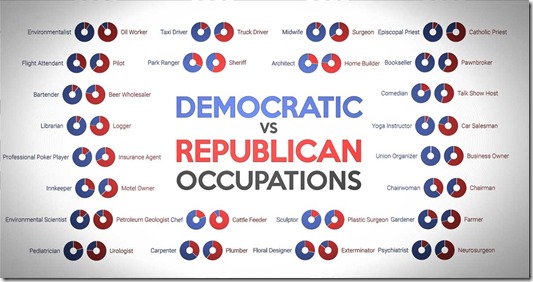
dem_vs_rep_prof_vignette_1200_630For instance, there was a pair of conflicting groups at this rally: labor and environment. Two of the new Democratic members were from the steel workers union and they argued that the party needs to focus more on labor if it wants to win, especially in the rural north where people are backwards, uneducated, and completely dependent on outside investment for any sort of occupational or economic activity. So their big issues are the major polluting and high carbon construction projects like the Enbridge Energy Line 3 oil pipeline and the PolyMet copper mines near the Boundary Waters. It should be obvious that these are both corporate welfare projects with minimal long term employment opportunities for Minnesota and it should be even more obvious that they are both projects with the potential for massive negative environmental impact. It should be, but it isn’t to the labor faction and pressing that issue is likely to drive them back to the Republican hoards. Hearing that “we have plenty of environmental protections in place to protect the environment” from a union guy who clearly could care less about the environment, as long as he got a union wage for his part in destroying it, was pretty depressing. I know someone who was in the EPA during the short period it was allowed to actually protect the environment and I suspect the two union guys at the rally would do everything possible to avoid hearing how limited and powerless the EPA has become, even before Trump castrated it with an oil company promoter.

civil warRogers also said, "You've got to be optimist to be a Democrat, and you've got to be a humorist to stay one." For sure you have to have a well-developed sense of humor, at least. With Trump and a perfectly corrupt Congress full of bought-and-paid-for Republicans and not a few equally completely owned Democrats, you’d think this would be the traditional mid-term election where the party in power loses its grip. I wouldn’t count on it. Democrats and “progressives” have shown an ability and willingness to snatch defeat from the claws of victory in all situations. Part of that comes from the “purity test” mentality and part comes from true fact that all issues are infinitely complex and hard to grasp and a bigger part comes from the fact that America is no longer anything resembling a collection of United States. Humans, as a species, have never shown much will toward creating a better future for our offspring but modern Americans clearly would eat their own children if it came to that or missing a meal. I think we should get ready to accept the possibility that this mid-term election might signal the end of this collapsing empire.

8/13/2018

Locally Smocally

An acquaintance in our little town is trying to promote a “buy locally” program that is loosely based on variations of the food co-ops and small business crowd-funding. It’s a pretty hard sell pitch, which always puts me on guard. On top of that the argument that “the national system is rigged against the small investor, so you should really like investments that you can talk, personally, to the owners and employees” has a scary, familiar ring to me.

Talking to a small business owner is pretty useless, information-wise. I’ve worked for a half-dozen small businesses and what I learned from that experience is that con artists don’t limit themselves to Wall Street. That’s where the Big Cons live, but for every Big Con there are thousands of Little Cons and most of them work their scams in small businesses of a wide variety: from home improvement contractors to car dealerships to investment councilors to small town banks. The thing they all have in common is that they don’t report to anyone until they are on their way to jail or bankruptcy court.

Not many years ago, an acquaintance from high school demonstrated this too well for me when his “investment company” was discovered to be nothing more than a Ponzi scheme and a large number of investors discovered they were broke. I’ve been a low-key investor since the late 1970‘s and I’ve had more than my share of ups-and-downs over those years, but I have never lost everything with any of the mediocre-to-not-awful big brokers I’ve worked through. Merrill Lynch was pretty terrible back in the 1980’s when their “advisors” were steering small investors into whatever heavily discounted piece of crap their executives were shilling for, but it has never been difficult for me to ignore financial advice from people who are not rich. The one decent tip I got from my Merrill Lynch broker was Marvel Entertainment, when that company went public in 1986. We didn’t get out of the Reagan years without a collection of recessions and stock crashes and my Marvel stock didn’t do any better than most of the rest of the economy. I dumped it to help finance a house in Colorado in ‘91 and I’m not sure which “investment” would have done better. I did fairly well with the house. Marvel stock really hit the trashcan in the mid-90’s.

MSCM dumpsterI was in some kind of management capacity in every small company I worked for, except the last one; McNally Smith College (which suddenly, but predictably, went broke in late 2017). By then, I’d decided that I wouldn’t make another nitwit into a millionare and that I’d never again try to manage people in a dysfunctional organization. (The top levels of mismanagement at McNally Smith College was a colection of dysfunction that would have embarrassed Trump. I knew associating closely with that crowd would be self-defeating.) My experiences at the other small companies were relentlessly discouraging; from outright corruption and misrepresentation to the usual series of fairytales designed to keep employees from bolting to more secure or better-paying employment. From the inside of all but one of those companies, no one who worked there would invest a penny of their own money regardless of the promises made by ownership. I didn’t even trust most of those employers to honestly manage 401k funds and my IRAs are the reason I’m retired today. My employer funds consistently lost money, even the Fortune 100 employer IRAs were mediocre investment vehicles.

kickstarterSo, “investing” at the local level rarely gets past the level of “crowd funding” or panhandling. There is no SEC, as weak as that organization occasionally becomes, to make even a haphazard effort to monitor company finances. There is no good reason to imagine that a small business owner would disclose bad news to potential investors. The “investment” is not liquid in any fashion, as I can attest to since I still own some weird and obscure portion of one of my past employer’s business that I’ve been unable to cash out of in 40-plus years. In the end, it’s just crowdfunding/electronic-panhandling and I can always think of better places to put my contribution money than small businesses. It’s not like our government is doing such a good job of protecting democracy, providing a safety net, ensuring “liberty and justice for all,” or even managing national security that there are no more important causes so I might as well try small business crowdfunding.

8/11/2018

7/30/2018

Sweet Dreams

I recently connected to an old friend who I haven’t seen or talked to in at least 30 years. He spent his entire life, outside of vacation travel, in Nebraska and most of that in small town Nebraska. I could have easily led that life at one time, but economics, chance, opportunity, and restlessness ended up sending me to a lot of places I would have never expected to see and experience. In one of many conversations with my friend and his wife, we touched on the dreams we’ve had that carried emotion, meaning, and resonance to our lives. My friend and his wife are religious and the dreams they described had to do with that subject. My dream was very different and their perspective and ideals reminded me of that near-spiritual dream that I still occasionally have.

After my decade in medical devices, I was a mental train wreck. Being asked to help the richest people I’ve ever known cover-up device failures that had killed patients, tortured even more patients, and bankrupted many others caused me to lose the ability to read for almost half of a year. In retrospect, I realize that some part of my brain decided that if my consciousness wasn’t going to do the right thing the next best thing was to incapacitate my ability to do the wrong thing. Many people imagine that becoming a whistle-blower is either some form of treason or is as easy as going with the flow and doing what the higher-ups demand. It isn’t and if you have never had the skills or talent to be in a position to be pressed to consider having moral backbone to blow the whistle on corruption and evil in high places you have no basis with which to compare your situation to that miserable place. This essay isn’t about that dilemma, but if it were it would be longer, sadder, and more revealing that I am likely to ever be in this blog. This essay is about the dream that signaled my release from that situation.

About three months after I quit Guidant, a St. Paul medical devices company and my last corporate employer, I had the dream that turned out to be an important part of my release from the hell that had become my employment “contract.” I was mostly unemployed, living on savings and some meager self-employment and contract tech work, the economy was in free fall because of the 9/11 attacks, and my future as a 52-year-old mid-tech technical writer and engineer was totally in doubt. I still could not, yet, read and comprehend the captions below pictures in newspapers. My sole dependable income was teaching motorcycle safety classes on weekends and, occasionally, weekdays. That particular early morning, I would be teaching my first classroom in this new career. To that day, studying the materials I had to absorb to become an MSF instructor had required that I read a list of 132 questions and memorize the course-accepted answers. Because of my reading disability I had spent hundreds of hours staring at the study guides and instructors’ manuals to get to the point that I had the gist of those documents memorized. The chance that I might have a clear moment and would be able to read the test questions to my students was too much to risk, so I memorized the test. That evening I had spent six hours just going over the test questions and I could spout “What is important to know about a convex mirror?” and when #19’s time came or when I heard “#39” my kneejerk response was “List the three-step process to shift to a higher gear.”

The last thing that I remember from the fleeting moments of sleep the morning of the day I regained my ability to read again was an incredible feeling of well-being as I rode my motorcycle from my garage into the street and in every direction I saw “suits” hanging from every telephone pole down my Little Canada street, along Little Canada Road to the I35E freeway entrance and all along the freeway to the Century Avenue exit on I694. Then I woke up. I don’t remember what led to that image, if there was a story that precluded the sight of so many corporate executives getting their just deserts. The dream was more a release from the self-torture I’d subjected myself to as a consequence of working for one of the many entirely self-serving, psychopathic, and outright evil corporations this greed-loving country has spawned. There wasn’t much of a story behind that grand sight, as I remember it. It was just a beatific scene from a world gone wrong that had self-corrected.

I had that wonderful dream repeatedly for about a month and intermittently for the next year or so. Then it stopped. The part of the dream I remember always woke me up about the time I needed to be getting out of bed. The feeling it left me with was always a great sense of peace because “truth, justice, and the American way” had been restored in my world. Sometimes, I suspect that there is a lot of French in my English and German heritage because the revolution I most empathize with is the French Revolution. Being a savage US citizen, I see the 1% being hanged from telephone poles rather than guillotined, but the end result is the same.

Of course, none of that will ever happen here. We’re a nation of serfs who love to serve and obey our masters while they misdirect our anger and violence toward other members of the 99%. The chances that Americans will rise up and throw off the shackles of failed and corrupt capitalism and its bedfellow, fascism, are about as good as are the odds that we’ll figure out space travel before the next ecological catastrophe wipes us from the earth: zero-to-none. But . . . damn! That was one sweet dream and I go to bed every night hoping I’ll get to experience it again.

7/23/2018

Students Strike Back!

I was pretty much a “career student” for the first 40+ years of my life. After a dismal Midwestern K-12 and community college experience, I pretty much gave up on education by the time I was 19. I loved to Dallas, Texas for a computer programming school in 1967 and after that experience and investment turned to crap, I ended up attending El Centro Community College in downtown Dallas, mostly to clean up some disastrous grades I’d received when I dropped out of my awful hometown college to go on the road with a rock and roll band. For the first time, I experienced overwhelmingly competent and well-versed college instructors and I was hooked. From 1968 until 1991, I attended evening classes in community and 4-year colleges everywhere I lived; from Texas (2 schools) to Nebraska (3 schools) to California (4 schools) plus two correspondence schools. 

As a “non-traditional student,” (someone who does not attend school full time and during the day) I was subjected to a wide range of educator talents. The absolute worst was a Calculus I & II instructor at the University of Nebraska, Omaha who was a native German who learned to speak English as an adjunct instructor in Pakistan. His whole classroom plan was to copy the formulas from our textbook to the blackboard. His tests were so old that the mimeograph (remember those) contrast was pretty much slightly darker blue on light blue paper. That didn’t matter to the Offutt cadets or to the frat brats because the instructor hadn’t changed his tests in at least 10 years so they knew all the answers before they entered the classroom. Most of the Air Farce guys just wrote the answers on their papers and didn’t even pretend to know how to display their “work.” But the best instructors were people who made a mark on my life forever, both from the information I received in their classes and from the role models they provided as leaders and classroom managers.

By the time I got to California and discovered that transfer credits are something that is arbitrary as the weather, I needed to become more efficient in my course and instruction selection. Because I lived and worked fairly close to Orange Coast Community College in Costa Mesa, I decided to reboot my attempt at obtaining bachelors there. I quickly discovered that the range of instructor quality was all over the place; from amazing to depressingly, amazingly awful. Since I lucked into a friendship with one of the great instructors and a business relationship with one of the decent instructors, I started milking those sources for information about who is who at OCCC. That was helpful, but even more helpful were the opinions of the better students I met in my classes. By the time I transferred to Cal State Long Beach (CSULB) in 1988, I had a process for selecting instructors and courses:

  1. Late in the semester, I began asking classmates and other students about instructors and courses that were “possibles” on my next semester’s class schedule. I documented those opinions so I wouldn’t have to refer to memory when it came time to register for classes.
  2. As part of that student opinion gathering process, I created my own course/instructor evaluation questions, since the questions the schools ask are designed by instructors to obtain minimal criticism and to keep the answers meaningless and neutral.
  3. I shopped for academic advisors, looking for someone who might actually be honest about classes and instructors. This was marginally useful, but sometimes not totally worthless.
  4. Whenever possible, volunteer to be the student proctor for course evaluations. That allowed me the time and access to see what other students said about a class and instructor I’d just experienced. That allowed me to weight the opinions I would receive from Step 1.
  5. Finally, and most importantly, I let my gut drive my participation in a class at a level I have never before or since allowed. Initially, because of the cost (money and time) of school, I made my whole decision to stay or leave from the first day of class. Since CSULB the add/drop date and the associated financial penalties were pretty lenient up to the end of the 2nd week of class, I sometimes held off making that decision to that last moment. However, if I disliked the instructor or the material on the first day, I dumped the class like a wet handful of poison ivy. In my last year, CSULB instigated an Undergraduate Withdrawal Limit that was punitive (now it is a total of 18 units over the course of a CSULB student’s undergrad career) and I got stuck with a couple of instructors and courses that were among the worst I’d ever suffered.

Today, there are options other than all of the work I put into my course and instructor selection. The best—and most reviled by academics—is RateMyProfessors.com/, a website born in 1999 and still barely known to or used by college students. College instructors are all over the map on whether they think those reviews are “fair” or not. Of course, their biggest bitch is the loss of control. Faculty unions do everything possible to protect incompetence and corruption among their ranks; proving, again, that self-regulation is a libertarian wet dream. It never works. In an Inside Higher Ed essay, “How To Fight RateMyProfessors.com,”James Miller wrote, "The cure for bad information is better information." He followed that with "There’s a lot of unhappiness among college faculty members about RateMyProfessors.com, a Web site containing student ratings of professors. Many college students use it to help pick their classes. Unfortunately, the site’s evaluations are usually drawn from a small and biased sample of students. But since students usually don’t have access to higher-quality data, the students are rational to use RateMyProfessors.com. Colleges, however, should eliminate students’ reliance on RateMyProfessors.com by publishing college-administered student evaluations."

Instructors who read this typically replied with snarky nonsense like this brave and anonymous prof's whine, "The only person who rated my outstanding colleague was a whining, lazy, slow-witted student who thought the professor was too demanding in requiring her to show up to class and to be prepared for class. The professor's many bright, good students have too much respect to post comments, good or bad, on a shoddy, inadequately managed, and poorly designed whine post for weak students. The professor now has a very low score, thanks to maintaining some modicum of academic standards. Any reputable study or survey would require a minimum number of subjects or sources before publishing data. Letting one sour apple tarnish a fine professor's reputation online is irresponsible, unethical and dishonest!" There is obviously so many “irresponsible, unethical and dishonest” delusions in this response that is probably ought to be republished with the instructor’s name.

In my last decade at McNally Smith College, our Faculty Committee had so watered-down the student evaluation forms that they had become useless to any instructor who wanted actual student input to future class work. For one semester, I re-introduced my own course evaluation from almost 30 years ago. It didn’t seem appropriate for me to directly review the results. I am fairly good at identifying handwriting and style and that defeats the whole concept of anonymous student course reviews. Ideally, instructors would receive a summary of the evaluations and wouldn’t be allowed near the actual forms. The fact that most students already do not trust the course evaluation process (and shouldn’t) means that most students just check the boxes and leave the comments sections blank. A not-insignificant percentage of students don’t even check the boxes for fear of being identified. Characters like “another southern prof” would be fine with that, “TMP is whining about how I was unfair or boring and nasty personal comments (which are taken off, while the numerical ratings of those who did this are left up). &#*@ RMP.”

A New York Times article, titled “The Prof Stuff,” postulates, “But like many online experiments, Rate My Professors has turned out to be a companion to nothing. It is its own world. Sure, hot, easy teachers get the laurels traditionally denied them by tenure committees who have that fetish for credentials and scholarship.” Actually, an adult (non-academic) reading of the reviews would demonstrate that many students are more concerned with getting value for their education dollar, rather than easy grades.

However it is absolutely true that, "The top professors on Rate My Professors, after all, are not the top professors in the nation. Rather, they’re the top professors on RateMyProfessors.com." Unfortunately, there is no other way for students to rate prospective course and classes and, by design, no useful way for school administrations to evaluate instructors. The usual rubric is “student retention,” a measure of how much money the instructor puts in the school’s bank account by being fast and loose with grades, attendance, and participation. Otherwise, most school administrators would just as soon not be bothered with the “classroom crap.” They are busy inflating their salaries and padding the departments with layoff fodder.

One article on this subject, “Should We Stop Asking College Students to Evaluate Their Instructors?”, was so irrationally biased and uncritical of academic corruption that it was hard to decide if the article or the whining profs were the least sympathetic. “If this sort of customer satisfaction survey works for your car insurance salesman, why wouldn’t it work for a teacher? For a long time, many academic researchers thought that these evaluations were a good thing; by the 1970s, evaluations were widespread in academia. Surely, the argument went, students could distinguish between a punctual and prepared professor, and the chaotic and disorganized instructor. . . research showed that teachers could increase student evaluation scores by simply smiling more or being more enthusiastic.” In other words, if an instructor is interested in the subject manner and creates an environment friendly to active learning, that instructor receives "unfair" preference from students. Amazing. Students can be so shallow. Worse, "More recent research showed no consistent pattern and many studies showed that student evaluations were riddled with biases." Those damn students are like every other human being on the planet? Unacceptable.

Someone called the NUWildcat wrote, “The easiest way to get high marks from the students is to give them good grades, regardless of their actual performance. The effect of that is that the students, getting good grades, think they are really proficient in that course. By inflating their grades, the students don't have the face the reality that there are some areas where they are weak and perhaps should change their majors.” It’s easy to make a claim like that, but difficult to prove. Lucky for profs, they can get away with claiming silly shit and call it “proof.” Another equally prof-biased Chronicle of Higher Education article, “Why We Must Stop Relying on Student Ratings of Teaching,” claimed, a "study also showed that ‘a male instructor administering an identical online course as a female instructor receives higher ordinal scores in teaching evaluations, even when questions are not instructor-specific.’ Kristina Mitchell, one of the study’s authors, summarized its findings in Slate last month and concluded: 'Our research shows they’re biased against women. That means using them is illegal.'" Typically, no real evidence was provided, other than a minimal study description, to justify that claim. Of course, the study does not prove that student evaluations are “biased against women.” It might prove that students (male and, possibly, female) are biased against women, though. Careful analysis might even find that women are less likely to approve of a woman instructor than are men. What do you do with that information? The next thing a reasonable person might ask would be, “Is there a reason students are inclined to be biased against taking classes from women?” Mitchell’s response falls solidly in the “shoot the messenger” category. Most of this propaganda is academia trying to protect itself from quality standards. I can not generate much sympathy for that.

There was one area from the Chronicle of Higher Education article that I totally agree with, “Student evaluations have also become less reliable over the years because most institutions have switched to online systems. In 2016 the American Association of University Professors released a comprehensive survey of faculty members about teaching evaluations. which found that . . .  the rate at which students were filling out evaluations has gone down precipitously in the electronic age.” Not just students, but everyone.

Tools like SurveyMonkey have allowed data collectors of all sorts to delude themselves into believing the are collecting useful information. As I said earlier, from the first day I started teaching at MSCM I begged my students not just to review my classes on RateMyProfessors.com but to add as much good and bad information about my class materials and presentations as they felt might be useful. Over 13 years, I had a total of 3,000 students in my classes. That total and regular promotion and nagging got me 33 RateMyProfessor reviews. As a member of the faculty senate, when I attempted to survey the faculty about issues as important as salary, required hours of instruction or office hours, or curriculum changes, I was lucky to get a 10% response from the faculty. When the Minnesota Motorcycle Safety Center went from paper reviews handed out while the license paperwork was being handled to emailing a SurveyMonkey link, responses dropped from 100% to less than 20%. The problem isn’t that student reviews are marginally complete and useful. The problem is that electronic surveys need to be tied to something the reviewers want and/or need.

During that short period in the early 80’s when American companies still had the vitality to manufacturer products and the management capability to do that, a basic rule of quality management was that “any paperwork generated has to benefit the people who do the paperwork.” If colleges and instructors are ever going to be responsive to students’ needs and interests, it will be because there is a feedback system from students to instructors and academic mismanagement. Obviously, the worst instructors want that system to be totally under their control. Administration bureaucrats are also mostly driven by their laziness, so their motivation to improve the educational quality of the facilities they mismanage is tempered by the fact that doing so would require work from . . . them. That leaves students with one remaining outlets with which to provide unwanted, unread feedback to the schools stealing their time and money and a warning or recommendation to future students: RateMyProfessor.com. Until that changes, teachers will continue to whine (and even sue!) and students will probably continue to be too lazy to use the only resource they have for avoiding lousy instructors.

7/22/2018

7/18/2018

Your Russian Representatives

How do you know if your politician is a Russian plant? Easy, he or she is a Republican. How do you know if your personal issue lobbying organization is a Russian front? Easy, is it the NRA? If it is, you are giving money to an organization that already has plenty of cash, mostly rubles.


7/16/2018

Parent Propaganda

Recently, a young woman on LinkedIn.com wrote about the pleasure she is deriving from her childless life and how other friends and family don't believe her. Her problem isn't that she is delusional. Her problem is that misery loves company and is intolerant of happiness. Many people have been coerced into parenthood through guilt and social pressure and have discovered it isn't a fraction as positive an experience as advertised. Once the little darlings become teenagers, the last of what pleasure existed vanishes; leaving only the desperate hope that some sort of adult compromise will end the wars.

kidhappySome people are naturally smart enough to see through the breeder marketing, but that won't save them from guilt trips and myths and propaganda. A few of us realize that having a family is a choice that eliminates a host of other possibilities. People who are successful in business or who become expert in a field of study or who master an art form are not multitaskers. Parents are primarily multitasking amateurs for at least 18 years; mastering nothing except, ideally, their own tempers and lowered expectations. If having kids makes us so “happy,” it must be really hard to explain the repeated results of marital satisfaction surveys that demonstrate just how unhappy kids make their parents (see the survey chart attached to this paragraph).

In one of his many excellent routines on the human condition and delusions, Jim Jefferies asked his audience to “put up your hand if you truly believe you have a stupid child.” Seeing no response, he yelled, “None of you? Well guess what? It is statistically higher than that!” He chased that down with, “You child isn’t stupid. Your child has a ‘learning disability.’ That’s the definition of stupid. If you have difficulty learning, that’s what stupid is.” Humans desperately want to imagine that their offspring don’t fall into the 50-something-percent of below-average nitwits (and “average” isn’t an improving characteristic in our dumbed-down society). The only way to cling to that delusion is to keep the little nitwits in constant motion through sports and other activities so that the school system will value them mostly because of your participation in functions that would otherwise require teachers of school administrators to manage alone. As someone who spent a dozen years teaching at a for-profit college that, eventually, dumbed-itself-down to catering to momma’s little rejects, I can tell you that many of your children couldn’t outsmart a pet rock. And if that is not an unfulfilling way to spend your life, I don’t know what is.

But your mileage very definitely may vary.

Recently, I have decided there are a couple of categories that people fall into: 1) people who have something to do with their lives that obliterates all other options and 2) people who have unfocused and scattered interests and who just need stuff to burn up their time and years. If you are the first, having a family will slow you down or defeat you in your life’s purpose and you will burn up your years searching for that mythical “balance” bullshit that is no more real than fiction’s “true love.” If you are the second, you will fill your life with kids, pets, trivial activities, and lots of friends who share these likeable non-passions.

In saying this, I am not making a value judgment. If everyone were the focused and driven type, the species either wouldn’t reproduce or reproduction would always result in either the single-parent or the distracted parent model (No, they aren’t substantially different.) People who are not driven to accomplish some specific thing in their lives make good parents, committed pet owners, family member caretakers, and community contributors. Those are among their best qualities and activities. At the other end, the undriven are often called “slackers,” but the driven are just as likely (or more) to end up burned out young and useless thereafter.

The thing most humans don’t comprehend is that we can’t have it all. Type 1 driven folks are unlikely to have anything resembling a happy or healthy home=life. The choices are either follow that passion all the way to the logical conclusion or flail away unsuccessfully at having a “balanced life” and fail at both hitting your goals and succeding at your chosen field while you raise unhappy and dysfunctional children and do that ridiculous serial monogamy thing every few months or years at a time. Type 2 undriven folks often want to have the money, power, and recognition that only Type 1’s ever achieve and their jealousy turns into a dysfunctional society that attempts to drag everyone down to the lowest common denominator. Very much like what is happening right now with the Trumpanzees and their Tangerine Misleader.

7/09/2018

Historic Detective Work


I just assumed everything I learned in church as a kid was based on delusion and lies.

6/27/2018

Incentives Are Everything

A few years ago, I was asked to be part of a “This I Believe” presentation at the Unitarian Universalist Society of River Falls (WI) society. If you know me at all, you know that was a tough subject because I'm not much of a "believer." I found a few things that turned out to be more core to my belief system than I'd suspected and among that small list was "incentives." The study of economics has been pretty much a waste of air until the last few decades. For most of my life I've been in agreement with John Maynard Keynes who supposedly said, “Capitalism is the astonishing belief that the nastiest motives of the nastiest men somehow or other work for the best results in the best of all possible worlds.” Our current executive branch is consistently demonstrating that fact and the last four decades of American economics ought to be enough to put the last nail in most of capitalist theory. Market-driven capitalism tacks on a giant list of poorly designed incentives which work to damage democracy, decimate the ecology, limit personal liberty for all for a tiny percentage of wealthy and powerful bad actors, and promote illiteracy and ignorance in the general population. The mythical “free market” libertarians and traditional feudalists argue so irrationally for is just not a sustainable or just economic system.

What doesn’t work for business works just as badly for government. In our current irrational and poorly functioning “representative” system, unjustifiably powerful groups like the police, prison system employees, military, and government employees are isolated from their customers—the rest of us—by layers of union protection, political clout, and outright terrorism. When cops murder unarmed citizens, the only defense we have is the civil lawsuit. Convicting a cop of any crime, regardless of the evidence, is nearly impossible but getting a violent crime conviction requires all out magic. With that kind of insulation from responsibility and the soaring cost of police departments and their pension funds, cities are going broke trying to pay off the multitude of police misconduct lawsuits. “Dallas civil-rights lawyer Don Tittle says the increased availability of camera footage and shifting attitudes toward police are affecting cases. ’Up until recently, when it came to civil lawsuits, there were two groups that had a distinct advantage, where you had to knock them out to win. And that was doctors and cops. But with the advent of video, and the changing perception of society, I don’t think police are held in the same regard.’”1  Suddenly the cost of maintaining abusive police officers is turning into a major city budgeting problem.

P1-BU305A_LIABL_16U_20150715161211With the city government budgeting systems as they exist, that problem is unsolvable. For example, the Alberquerque, NM police department is the most expensive, lawsuit-wise, department in the country and has been under federal investigation and oversight often in the last few decades, but appears to be completely impossible to rein-in. New York City, between 2010 and 2014, spent $601M dollars settling police misconduct lawsuits. In 2015, New York City paid out $228M for police misconduct lawsuits. In 2017, New York paid $302M for the same kind of crap. That city’s 2018 police department budget is $5.6B or a little more than $101k per employee (~55,000 employees). Small towns aren’t immune to this kind of idiocy, either. "In Sorrento, La., for example, a newly hired cop in 2013 slammed into another car on a highway after going on a high-speed chase to catch a separate driver who was speeding. The driver who was hit sued. It was later revealed that the officer was already one of the town's most zealous issuers of speeding tickets, hundreds of which were later thrown out in court. That incident, combined with other lawsuits against the police department serving the small town of 1,500 people, prompted the city's insurer to drop its coverage. The town disbanded its police department shortly thereafter."2

The fix for this is to change the incentives, not to shield bad cops with even more anti-democratic police state Republican stupidity like the unconstitutional and anti-democratic House bill grossly misnamed the “Protect and Serve Act.” New York City covers the cost of those lawsuits out of the general budget, shifting all of the responsibility from the cops to the taxpayer. That is an example of a mindless system with no feedback loops to reinforce decent behavior or to inhibit misconduct.  The solution is to move the cost of settling these cases to the departments that caused them. If, for example, the NYPD had to pay $302M out of its budget to settle misconduct cases, that would result in roughly 3,000 fewer employees (at that $101k/employee cost). If it is true that the cops involved in misconduct cases are “a few bad apples,” the many good apples (if that turns out to be the case) would start cleaning up the department before their own jobs are on the line.

Like I said, incentives are everything. You just have to design them to serve a better purpose.

1 https://www.wsj.com/articles/cost-of-police-misconduct-cases-soars-in-big-u-s-cities-1437013834

2 http://www.governing.com/topics/finance/gov-police-misconduct-growing-financial-issue.html

6/24/2018

How You Look at Problems Determines How You Solve (or don’t) Them

inside_the_earth_coreMy wife and I have had diametrically opposed views of how the world works for most of our 50+ years together. She is a fairly spiritual person. I’m not only not spiritual, but I dislike all forms of magical belief. For a lot of years, she was a traditional Christian followed by the Pagan/Gaia thing followed by something all her own now. I’ve been atheist my whole life, at least since I was a kid. For her, it is a motivational issue, I think. For me, it is a practical thing.

For example, we were talking about the global warming issue this morning. We somehow got into the whole “we’re killing the planet” conversation, which I do not believe is likely. Sure, if we managed to fiddle around with black holes and create one that gets out of hand (Can a black hole be “in hand?”) we might figure out how to destroy the planet. But if all we manage to do is raise the planet’s average temperature a few degrees the planet will survive just fine. Or we fire off all all 89,012 trillion tons from our 14,175 nuclear weapons, 92% of which belong to the USA and Russia, we might vaporize the atmosphere. The planet will still have a molten core and the ability to attract ice asteroids and other resources to rebuild its atmosphere. The planet will survive until something damages the core or, in about 5 billion years, the sun burns through its current supply of fuel and that calls it quits for our solar system. I think the key point in the global warming discussion should be not that we’re trying to “save the planet,” but that we’re trying to save our species. Now, I’m not a big fan of humans and absolutely believe that at least 90% of everything humans do is shit, but if humans want a target to shoot for it’s our own survival not the planet’s survival.

Ideepcarbonquf you look at this cutaway of the planet’s construction, it’s pretty obvious how little effect our fucking around will have on the life of the planet itself. We can certainly screw up that thin layer we live in, but the planet is totally unaware of our existence; let alone the universe.

My wife believes the planet is a living thing with some, or a lot, of sentience and intent. I don’t. I think the planet is just what we see it being: a rock filled with molten rock and minerals that lucked into a few ice asteroid hits providing the planet with water and an atmosphere; which has been burned off a few times by other asteroid hits and volcanic activity in the last few billion years. Likewise, my wife still clings to the idea that humans have something like an everlasting soul. I don’t. I think we’re just one of millions of life forms on this planet and in the universe that live and die and are as inconsequential as every other life form here or there. We’re as self-destructive as army ants and about as mindful of our environment and our place in it as that most destructive insect. No soul, barely sentient.

We’re both aware that our opinions on life and the universe are just that; opinions. Neither one of us is committed to the “rightness” of those opinions. So, the argument comes in whether one opinion is more useful than the other.

My kick against spiritualism comes from practical application. I think we’d be better served if we treat the planet like our life support system; like a spaceship that needs maintenance and careful resource management. If we get careless with either maintenance or resource management, we all die. If we let things go long enough, we won’t have the resources to recover and we’ll all die as a result.

The problem with spiritualism is that humans naturally take the easy, magical way out. While English political theorist Algernon Sidney wrote the words, "God helps those who help themselves", there is nothing like that in the dogma of any religion I know of. In fact, the reverse psychology appears to be more common and that allows people to pray to their deity to "fix" their messes instead of doing the work themselves. That is true to the point that when firefighters put out a forest fire, house fire, or whatever else is burning, religious people will regularly "thank God" for doing the work that they saw done right in front of their faces by other human beings. I don't know how stupid people can get, but that is damn close to impossibly stupid.

So, our argument is about which philosophy is most likely to cause humans to behave in a way that might extend our species’ lifespan and, ideally, the other species that share this planet with us. I don’t think any form of spiritualism will ever be helpful. My wife and, most likely, you will disagree, but I don’t think it will matter because we’re not a smart enough species to care either way.

6/05/2018

Who Democrats Need to Be

"I am not a member of any organized party — I am a Democrat." Will Rogers

I’ve used that quote to define my own politics for most of 50 years. While it’s true that most of the history of the Democratic Party is full of disorder and general stupidity, it wasn’t all like that. The Democratic Party that gave the country FDR and Henry Wallace was a lot more unified and a lot less concerned with bullshit. In 1933, Roosevelt desperately needed his Iowan farmer-intellectual Secretary of Agriculture New Deal star to bring order and discipline to the country’s collapsed and desperate agricultural economy. In 1940, Roosevelt dumped John Garner after the conservative VP opposed the attempt to stack the Supreme Court and ran against Roosevelt for the Democratic nomination. Roosevelt picked Wallace for the job and the Roosevelt/Wallace ticked won 449 Electoral College votes and won the election by 4,000,000 votes. Wallace was a practical Progressive who ran as a real Democrat along with Roosevelt’s more traditional ruling elite Democrat. The party hasn’t seen that many actual Democrats since.

That, however, is the solution to the party’s current schizophrenic lack of personality. The problem with what’s left of the Democrats is “the left.” If you read the stupid crap the DNC lists on its “mission statement,” you’d think the party’s purpose is to get anyone willing wear a DNC badge elected to any office they can afford to run for: “The DLCC's mission is to build and maintain winning, state-of-the-art campaign committees through a continuing partnership with legislative leaders, professional staff, and supporters.”

What the hell is that bullshit? The purpose of a political party is NOT to get elected, but to accomplish something useful for the country. Doing stupid, selfish, greedy, useless crap is why people elect Republicans. Democrats need to quit trying to appeal to every CEO, bankster, moderately liberal Hollywood actor or rock star, or, most importantly, any aspect of the usual crazy-assed left wing of the party. Let the progressives, LBGT’s, anarchists, BLM’s, socialists, communists, and whatever else has been swept up by the disorganized party of mostly losing candidates. If any of those groups can find a home or make one for themselves, they’ll be lucky to attract the usual 1% of the alternative vote; just like the Libertarians, Socialist, Communist, Progressive, Green, Independence, and the other responsibility-avoidance distractions.

Democrats, on the other hand, need to appeal to one group and only one group, the 91-99% of the American voter pool; working class Americans. Fuck their special interests, but everything that should matter to the 127 million working adults in this country should matter to the Democratic Party. Subtracting the 1-9% of that group who represent the faux-working bunch of executives, that leaves 126 million voters whose votes should be the exclusive property of a functioning Democratic Party.

The problem the voters have is figuring out who the actual Democrats are. Nobody, right or left, wants to vote for a Republican wearing a DNC badge. Harry Truman said, "Given the choice between a Republican and someone who acts like a Republican, people will vote for the real Republican all the time." I suspect that is true for real Democrats, too.

6/03/2018

How Do You Resolve This?

Almost all of my life, Republican presidents have made incredible messes that they left for Democrats to clean up. The worst were Nixon, Reagan, Bush I & II, and, now, Trump. Nixon took a failing war and doubled-down on it along with making the USA a debtor nation for the first time in the country’s history. Nixon left the country divided, distrustful, more racist and more unjust than it was before he took office, and broke. Reagan was a knee-jerk reaction to a dose of reality President Carter administered to the nation and he set the country back at least two generations on so many levels it would take a book (The book I recommend is The Man Who Sold the World: Ronald Reagan and the Betrayal of Main Street America by William Kleinknecht.) to detail all of his betrayals, corruption, and incompetence. Reagan tossed so many trillions into the military-industrial toilet that he made the national debt an international affair in 1983. Bush I just continued the stupid policies of his predecessor, including the amazing cast of nitwits who surrounded Reagan. There was a reason Clinton’s “it’s about the economy, stupid” resonated so soundly. Unfortunately, stupid has been breeding like rats since 1992 and they can’t even spell “economy” let alone comprehend any aspect of economics.

The only saving grace regarding that trio of idiots and traitors was that my generation was not responsible for their existence and power. Bush II changed all of that. He was the worst of my generation. Every step of his life was a train wreak: personally, ethically, and intellectually. He brought Reagan’s pack of vicious idiots back to Washington, bumbled the Katrina response, fumbled the country into two endless, multi-trillion dollar wars, and deregulated the banksters until they crashed the world’s economy. Now Trump, another of the worst from my generation, is dragging the country closer to fascism every day. He has made the country a laughing stock, which could be a good thing, and alerted our allies to how divided, incompetent, and alienated the American public has become. Trump is a waving flag telling the world, “Americans are fools, we are arrogant and incompetent, we are self-absorbed, and we are unstable and dangerous.”

In 2016, I ran for local political office; for city council. There were several excellent people running for those offices (and a couple of not-so-excellent faux-conservative wannabes), including two young Red Wing citizens with big ideas about how to move Red Wing into the 21st Century. At the national level, the election seemed surreal, with neither candidate attracting much positive attention. Our US Representative race was between a nitwit hate radio Republican, Jason Lewis, and a Democrat, a woman, who had a long history of public service and competence. While Minnesota voted for Clinton, the outstate idiots in the state went Republican for practically every office. My country and hometown voted for Trump and Jason Lewis. To that point, I had no idea where I had moved, or who my neighbors were.

I lost my election, but because I spent the last two months of the campaign being far more involved in my wife’s cancer treatment than the election results I had almost no emotional connection to that “loss.” As the years have moved us further into Trump’s world of fools and traitors, I am even less attached to or interested in what happens in Red Wing and Goodhue County or even Minnesota. That is not natural for me. I have been politically active and interested since the 1960’s. Some part of me still wants to care, if just out of habit, but I mostly don’t. For the 18 years we lived in Little Canada, Ramsey County, Minnesota were considered our house and home to be the same entity. In fact, my wife and I are very fond of our house, but we’re ambiguous about our Red Wing, Goodhue County, Minnesota home. We are constantly considering flipping the place and heading west toward civilization; if we could identify an actual civilization in this declining empire.

One of my fellow failed 2016 candidates packed up his family, his businesses, and himself and left town a year after the election. He might not publically admit that the reason he left was that he felt his Red Wing neighbors were dangerously ignorant and vicious people, but that is essentially what he admitted to me. If I were in his position, I would do the same thing. If I had young children, I would not want them anywhere near neo-Nazi Trump voters. Our old home country and city overwhelmingly voted for Democrat candidates, including Clinton. We felt like we had jumped away from the table and into the stove. The majority of our old neighbors saw through Trump and Lewis as easily as though those two con artists were fine crystal. Our new neighbors fell for the con and carefully took aim and shot off their own feet and the feet of their children.

A candidate is supposed to represent all of the people in his district and the country. Republicans don’t believe this and, like Jason Lewis, they only speak to and for “their kind,” but Democrats and any elected official of good conscience have always given voice to the concept of trying to work for everyone; even if they failed or were disingenuous. To this point in my life, that would have been my intention also, but no more. Now, after Trump and Lewis, I am clinging to the barest capacity to care what happens to Trump voters. Because of that, I don’t have the slightest inclination to submit myself to either a political campaign or the misery of weekly city council meetings if I were to “win” an election in this community. This is the time in my life where I could apply what’s left of my energy and talents to working for my country and community. I just wish I had one of those that I believed in enough to make that effort seem worthwhile.

5/31/2018

What’s Real and What Wishes It Were Real

When my kids were approaching college age, we had a talk that neither appreciated.  By then, I’d spent almost 20 years on the path to my BA; 18 of those years attempting to get a EE BS and the last two settling for a Technical Writing BA with as many as possible EE classes crammed in as cross-discipline courses. I was 43 when I finally earned my BA and had been in southern California “long enough” (almost 10 years). I had to satisfy myself with a EETAS, but after a 20 year career as an “engineer” I hoped that would be good enough and it turned out to be so. My talk with the kids was about what I would be willing to help fund and what I would not. I mostly took the Jewish parent approach, “I’ll pay for any college classes you take as long as they are directed toward an engineering, medical, mathematics, or science degree. Anything thing else is a hobby and you’re on your own.” If I were a real Jewish parent I would have substituted a law degree for science, but I’m not.

Today, there is a lot of pissing and moaning from the Xgen and Millennial crowd about their oppressive student debt and I only have moderate sympathy for that, since far too many of those “degrees” were of the “studying my own navel” variety. Shriek away if it makes you feel better, but I do not believe there is a valid argument for liberal arts, arts, business, and most of what passes for vocational training costing anything near engineering, medical, mathematics, or science degrees. In fact, I think paying instructors equivalent salaries outside of those three very general fields anything near the same money just encourages foolishness. To anyone who has studied many of the “soft” fields, it’s pretty obvious that many of the most expert of “experts” in economics, literature, history, education, art, journalism, cultural anthropology, paleontology, etc are either college dropouts who are driven to learn faster than colleges are prepared to teach or hobbyists with engineering, medical, mathematics, or science degrees dabbling in the softer and easier fields. So, the downside to obtaining an engineering, medical, mathematics, or science degree is only the difficulty and effort required, which is what “higher education” is supposed to be all about.

With that in mind, a rational society trying to encourage the creation (in our case) of an educated citizenry or (in the case of actual 1st world nations) trying to maintain that educated citizenry that democracy is so dependent upon would concentrate on ensuring that anyone making the effort to obtain an education in engineering, medical, mathematics, or science would leave school with minimal debt; once that standard is obtained, we could have a conversation about the value of less necessary skills and specialties.

Academia, being the mindlessly corrupt and lazy territory of human inactivity that it is, would relentlessly try to dumb down the curriculum of engineering, medical, mathematics, and science programs to allow lazier and less competent “students” to filter into those fields and, therefore, water-down the value to the level of the fluffier academic fields. Which will be just one more thing that will have to be carefully monitored, administered, regulated, and critically considered; as it always should be. Everything heads toward entropy, including all human activities, and the harder, more complicated, more critical the human activity the more quickly it degenerates into uselessness.

5/15/2018

Letter to Jason Lewis

Representative Jason Lewis

418 Cannon House Office Building
Washington, DC 20515
Phone: 202-225-2271

As a lifelong student, even past retirement, I am skeptical about the claims you are making for vocational school training. In 1970, I attended about a semester-and-a-half of vocational school electronics training. You could claim that kick-started my career as an electrical engineer, but you’d be missing most of the big picture if you did. The “education” I was receiving in tech school was primarily focused on teaching me how to repair tube-type television sets. The part-time job I had at the same time was repairing solid state industrial agriculture electronics. The vocation “education” was about five years behind the state of the industry and if I had stayed in that program for the full two years I would have graduated into an industry and economy that would have considered me obsolete before I started my career.

One of the many problems with vocational schools is attracting instructors with current industry skills. The best most seem to be able to do is to attract mediocre instructors with even more mediocre skills. The more rural the school, the less talent it is likely to be able to attract and retain. That is only partially an issue of money, since anyone cutting short a successful career to become an “industrial arts” teacher is not only taking himself out of the state-of-the-art but if you compound that sacrifice with teaching in a rural area the instructor is, literally, giving up on being in any way current. The only people willing to make those kinds of sacrifices are those who are not able to compete in the first place, so teaching a vocational education program is the best they can hope for. It doesn’t matter how much short-term money you can wave in their faces, any sentient American knows this country does not value education in the long run. The talent needed to make a real training program work won’t be fooled by a few moments of attention paid to vocational education.

More importantly, vocation education programs are mostly incapable of providing enough of an education to start a lifetime technical career. The only key to staying employed for an extended period in technology is a commitment to lifetime learning. Vocation training is notorious for being gap-filling training, not actual education. Personally, I think the real problem is that in order to fill far too many seats in traditional colleges with far too untalented students, universities have lowered their standards to attract the largest population of customers; not “students,” because that standard would be too high. The fact that every college student, regardless of major, is not required to take and pass college-level science and mathematics classes as part of a “liberal education” is the real problem. MA’s and PhD’s are passed out like prizes in Cracker Jacks boxes to people who do not meet the most basic modern requirements for “educated.” If you want to fix higher education, bring back the 1960’s requirements for a college degree.

Thomas Day