Showing posts with label academic foolishness. Show all posts

10/10/2023

AI and LI, or HI? That Is the Question

This month’s (September 2023) Wired Magazine is sub-titled “Dear AI Overlord’s, Don’t Fuck This Up.” Obviously, the bulk of the magazine is devoted to opinions of how bad or good Artificial Intelligence is going to be for near and long-term humanity. Mostly, as usual, the Wired opinions are from liberal arts majors who have no idea what they are talking about as far as AI’s technology.

In the month’s “Dear Cloud Support” essay, the opening question is “’I failed two captcha tests this week. Am I still human Bot or not?’” The second I read that statement I realized the question missed the real problem. It is not a yes-no problem, it is a 1-out-of-three problem, at the least. It isn’t just AIBots who are the threat, it is equally or more stupid humans (Low Intelligence) and badly designed AI systems that are the threat. The battle for survival is between the LI&AIBots vs High Intelligence (HI). In the short term, the stupid people will cause the most harm. Long term? Who knows?

There are a couple of articles that delude to the idea that engineers and computer programmers aren’t up to the job of keeping AI reasonably moral. They, clearly a pack of liberal arts dweebs, imagine that, finally, the world will need the kinds of “skills” that a liberal arts degree supposedly promotes. No evidence of that appears to exist in the modern world and lots of contradicting data would argue to the contrary. For example, Steve Jobs, a liberal arts scumbag who learned from his philosophy classes which kinds of decisions are moral and which are not. So, he focused his life on always picking the amoral “what will profit Steve the most” options. There is no shortage of executives, politicians, and entertainers who disprove the idea that anything about a liberal arts education creates any sort of “better” citizen.

Not that a STEM education produces any sort of predictable outcome, either. The amoral academic environment is probably the culprit. Between the cut-throat publish-or-perish competition, the corporate shills who crank out drugs, processes, and products for companies at the expense of the taxpayers who support marginal “education” facilities, and the low bar academia sets for educator standards and skills it doesn’t matter much what a kid majors in, exposure to this environment is probably doing to do at least as much damage as it provides useful education.

right skewed

As Law 2 in the “Five Laws of Stupidity” clearly explains, “The probability that a person is stupid is independent of any other characteristic of that person.” And that includes education credentials or professional standing and accomplishment. Law 1 states “Everyone always and inevitably underestimates the number of stupid people in circulation” and Law 4 explains “Non-stupid people always underestimate the destructive power of stupid individuals.” At the least, 50% of every population is “below average” and that is assuming the distribution is “normal,” not heavily skewed-right with a really long tail as I suspect. The existence, abundance, and persistence of the Trump Cult is serious evidence that, at least in the USA, some serious down-breeding is causing our average IQ to drop dramatically. So, assuming that “average IQ of 100” might be optimistic.

If I had to put my fate in the hands of an AI system that was Open Sourced and monitored by the smartest people in the world or the random-number-generator that is, optimistically, what the Low Intelligence crowd represents at best, I’ll take AIBots and HI over anything the LI crowd can produce.

4/19/2021

What Will “Normal” Look Like?

A recent Slate article, “I Do Not Trust People in the Same Way and I Don’t Think I Ever Will Again," really struck a chord with me. The article was mostly about the anxiety many feel about going back to the office. “Workers have also seen over the past year that even when employers claim they’ll implement safety measures, the reality is often very different. Social distancing requirements often go unenforced, and many people report colleagues going unmasked without any consequences. So employees are primed to be incredulous.” All of that is absolutely valid, too. A friend recently interviewed for a job with a Minnesota medical-tech company and all of the people who met with him, except the department manger, proudly went maskless in a small room and implied that he was being rude in keeping his mask on.

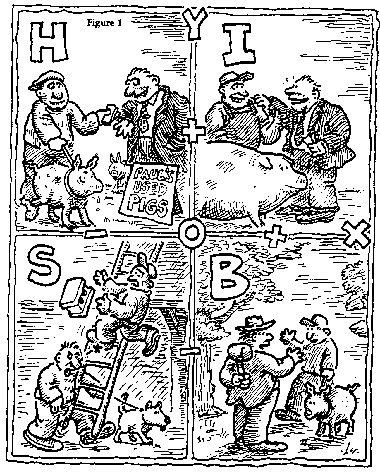
Figure 1 - The basic graphAs a spectacularly accurate recent paper on human stupidity, “The Basic Laws of Human Stupidity,” stated, “The probability that a certain person be stupid is independent of any other characteristic of that person. . . Whenever I analyzed the blue-collar workers I found that the fraction σ of them were stupid. As σ's value was higher than I expected (First Law), paying my tribute to fashion I thought at first that segregation, poverty, lack of education were to be blamed. But moving up the social ladder I found that the same ratio was prevalent among the white-collar employees and among the students. More impressive still were the results among the professors. Whether I considered a large university or a small college, a famous institution or an obscure one, I found that the same fraction σ of the professors are stupid. So bewildered was I by the results, that I made a special point to extend my research to a specially selected group, to a real elite, the Nobel laureates. The result confirmed Nature's supreme powers: σ fraction of the Nobel laureates are stupid.” (I seriously recommend that you read this paper as it contains far more human natural selection information than practically anything I’ve seen since Euell Gibbon’s survivalist books.) As the illustration from that paper aptly describes, the four basic categories of humans are: “the helpless, the intelligent, the bandit and the stupid.” (In clockwise rotation starting from the top left.)

Learning that so many humans in every field, distributed across all populations, are stupid is not a comforting piece of information. It does explain why so many self-declared or media-selected “experts” have been so wrong about so many things in the past and, specially, in the past dozen years. As our education system is dumbed-down to prop-up academic revenues, even more idiots are getting advanced degrees in fields they can barely describe. Decades ago, SF writer Theodore Sturgeon said, “90% of everything is crap.” Looks like you could accurately rephrase that to “90% of everyone is stupid.” If you don’t think even the most lauded, anointed, and prominent humans can be stupid, just look at the folks the late Bernie Madoff convinced to pour money down his sinkhole, from other investment companies and pension funds to famous entertainers to scientists. All people desperately wanting to believe that the facts could be contradicted by their desires and ignoring “if it seems too good to be true, it is.”

Stupid people are dangerous, as a few thousand stupid insurrectionists demonstrated in Washington, DC on January 6th. Learning that so many of those around us are unpredictably foolish and self-destructive and well-armed puts an edge on every interaction many of us will have for the rest of our lives. In the Slate article about losing trust the author said, “But the real problem, I suspect, is that in the past year, we’ve experienced a massive loss of trust in our institutions and in one another.” In fact, I’ve been pleasantly surprised at the people I know in this small Minnesota community who are not stupid and considerably less surprised at discovering the ones who are dumb as a post (or “dumb as a Trump voter,” the new idiom for a total fool).

That is going to be a problem for a lot of local businesses, too. In my village, many of our local bars, restaurants, and retailers went proudly mask-less and precaution-free until the state mandated those basic and obvious rules. I, for one, will not be going back to those businesses anytime soon, regardless of the state of the nation’s health. Why would I? During the last year, those businesses and employees willingly, carelessly, and arrogantly demonstrated their distain for science, decency, and their community by flaunting their politics over any other value. Why would I want to help those people stay in business in my community with my money? I’m not even a little bit alone in this decision, either. The wingnuts jabber mindlessly about “cancel culture,” but what they want is to be able to boycott any person or business or community at will for their pet peeve of the moment but when the tables turn on them they whine “that’s not fair!” Remember the Beatles after Lennon’s “more popular than Jesus” comment or Starbuck’s red Xmas cups or Oreo cookies or Netflix or Budweiser’s horses or Keurig and Roy Moore or a lot more wingnut boycotts? It’s ok when they do it, but if people with money (the educated non-MAGA crowd) do the same thing it’s “cancel culture.” Personally, some of those businesses that disappointed me locally will be missed from my pre-pandemic routine and appreciation of this little village. I do, however, hold a grudge for a long time and at this point it’s hard for me to imagine going back to the “old normal” knowing what I know of who these people really are.

All of that is going to make both the economic and social recovery complicated and there will be some-to-a-lot of fallout in the long run. When all of that “socialist” small business support vanishes as we go back to business as usual, the new usual will leave many of those places without a lot of the people who once provided a good bit of their income. Trump loved the uneducated, but most businesses need people with an income to provide their businesses with an income. Trump’s fools may be going back under the rocks where they normally hide, but we all know who many of them are now and we’ll be avoiding those rocks for many years.

12/14/2020

I’m Done with “Progressives”

I am done with “progressives” or radical left, anarchists, and the rest of the purists who insist that they either get everything they desire or they want to blow it all up and test the waters of total social breakdown. My interest in their opinions on everything from politics to economics (especially banking) to engineering (social and otherwise) has gone from minimal to zero in the last three years of Trumpian chaos and insanity. I have heard some of the dumbest, most childish things spew from the mouths of the far left without self-reflection or even the slightest bit of humility. The next some half-wit quotes Chris Hedges to me will the last time i hear anything from that person. I can not, in fact, see a significant difference between the actions and attitudes of the far left from those of the far right. The are both spoiled teenagers in mind and spirit.

From example, take this “analysis” of the current political situation, “All I read is totally gloomy, including the prospect of Sleepy Joe Stuttering Biden, Uncle Tom Obama and the Clinton’s pick for prez…what a loser who has already stated what an ongoing pal he is of Israel, and that he won’t sign a universal health care bill. Welcome to Amerika, a fucking joke of a nation!” The only clue that this was written by someone from the left might be the Israel dog whistle. Of course, it could just be a wingnut who, stereo-typically, mixed up the nation he has decided is the enemy. Any way you read that (sentence, run-on phrase, spewing of venom?), you would have a hard time knowing that it wasn’t a Trump tweet. Any time you have written something that sounds like Trump you should really consider rewriting.

Support for Israel has devolved into a mindless march to global suicide for the faux-Christian right and an equally mindless anti-Israel dog whistle for the left. The fact that Biden is the chosen “back to normal” Democratic candidate is disappointing for everyone and will, likely, be a one-term President followed either by a young Democrat with ideas or another mindless Republican borrow-and-spender. I get that we’re screwed in this election, like so many in my lifetime and the country’s meandering and decadent history. One of the fatal flaws in being a quasi-democracy is that we only get to choose between one of two evils. Most democratic nations have a parliamentary system that forces some sort of coalition between two or more special interest factions: Canada’s Liberal Party, Conservative Party, the New Democratic Party, the Bloc Québécois, and the Green Party of Canada for example. Not us. We are only willing to digest two faux-opposing political parties because we’re not bright enough to cope with more. Most US citizens are too dull-witted to even comprehend Ranked Choice Voting as a way to break out of the two-party morass.

This far-left crowd, is who we should always remember who put G.W. Bush over the top in Florida in 2000 and who elected, by default, elected D.J. Trump in 2016 with their “alternative candidate” votes. They “work” in politics, every four years, for candidates with little-to-no-hope of winning primaries, they throw tantrums about having to vote for the “lessor of two evils” and, instead, waste their vote on no-hope alternative candidates so they can pretend the resulting mess is “not my fault.” We end up listening to both sides whining about not getting what they want for 4 years and fall further behind the world in every important category from education to science and technology to economic stability and equality while the rich keep getting richer and the poor keep getting dumber.

3/16/2020

Ok, Boomer

Or is that “Ok Boomer?” Whatever. We all know it’s the clueless, snarky response of a spoiled brat who imagines that he or she has it “harder than any other generation.”Baby boomers just don't seem to get it. Millennials have it a little harder than they did. Not only with college tuition but let's look at the job market. Most jobs now, you need a college degree for. 61% of Millennials attend college compared to 46% of Baby Boomers. You need a college degree for places to even look at your resume. That wasn't the case when our parents were looking for a career. But now, not only do they want a college degree, they want you to have experience.” That’s typical of the kind of mindless drivel these children spew and they even imagine it is true. 

I’ve been dismissed a few times myself and I don’t waste my time trying to educate these kiddies any longer. I just remind myself that I’m not the jackass whisperer and move on with my life. However, I wonder if there will come a time when these old children discover how wrong they are? The author of the article I quoted above lists a collection of “boomer prices” vs today’s prices and imagines that somehow those numbers account for inflation. Of course, they do not, but math skills and, even, simple accounting skills appear to be something that has been lost in their education. It’s not like the tools aren’t there in K-12 and beyond, it’s that they do not want to waste their precious screen time learning those skills. Strangely, they imagine that my generation magically got that stuff effortlessly. “A dozen eggs for Baby Boomers” did  “cost about $0.84” and today they cost $0.99 to $1.50, for an inflation value of 20% to 50%, while the minimum wage was $1.00/hour in 1960 and today’s minimum wage is $7.25 (federal) to $15.00 (several states) for an inflation rate of 700% to 1500%. Eggs are one example and there are several examples of items (like housing) that have inflated far beyond wages. College, however, is one item that varies by state; from the worst case, California, where college tuition went from free to $138,000 for 4 years of UCLA and $15,000 in 1970 to $28,000 for 4 years at typical state colleges (like the University of Nebraska where I attended). California’s tuition rate is nearly an infinite increase, but most states saw an 85% increase in tuition over 50 years, not even close to wage inflation over the same period (the 1970 minimum wage was $1.60). 

As I’ve marveled before, humans don’t ever seem to learn anything the easy way. Two generations away from the last war fought with draftees, young Americans shrug off reality and history as if it doesn’t pertain to their situation or any situation with which they have chosen to compare themselves. For example the claim, “Most jobs now, you need a college degree for.” Ignoring, the fact that this presumably college educated kiddy doesn’t even know about dangling prepositions, that whole claim is a joke. The kinds of jobs that my generation didn’t need degrees for are often crying for applicants today, but Millennials don’t want anything to do with manual labor. I’ve been told that “we were promised great jobs if we went to college” by nitwits who were told in clear terms by a collection of experienced adults that their degree in music was worth slightly less than the paper upon which it was printed, economically. Not only did they persist in wasting money on that degree, but they doubled-down on the delusion and went for an MFA (which stands for My Fabulous Adolescence). Now, they are surprised that Starbucks asks for a degree for a coffee shop management job because every idiot serving coffee or donuts has a useless liberal arts degree. Why not ask for it? 

Housing inflation is an interesting problem. Housing is expensive in the places young people insist on living; large cities, and the quality of home Millennials insist is their right. My first house, in 1973, cost $8,900 in Central City, Nebraska. The place was a dump, but it was all I could afford. In three years, I replumbed the place, turned an attic space into two bedrooms and a sewing room, built a garage and workshop, and landscaped the place while supporting my wife and two kids on $3.25/hour and regular 80-90 hour weeks. My “vacations” were spent working on the house or working a second job (R&R bands and music equipment repair, usually). We sold that house for $16,000 and moved “up” to Fremont, Nebraska and a larger $20,000 1920’s house. I started the remodeling routine over, but in 1979 I was laid off along with 1,400 people in my company and almost 2,000 others in two other industries in Fremont and I sold that house for $18,000 and slipped the “buyer” $5,000 under the table so they could make the “down payment".” So, not counting my improvements and labor, I lost $7,000 on that house. I didn’t buy another house for almost a decade. 

Chased by the constant regional recessions of the 1980s, we moved to California where my salary was $28,000/year (with the usual 60-90 hour work weeks) and a typical middle class home was $120,000 at 15% interest. Totally unaffordable, by any math I understand; although at least one of my kids thought I was a failure and a fool because I couldn’t figure out the ladder of mortgages, second mortgages, credit cards, and third mortgages her friends’ parents used to pay for their homes. Like today’s young city dwellers, California homes were far beyond my reach in 1984 and that only got worse until I left in 1991. Just like city life, almost everywhere, today. 

However, while I lived in California and didn’t have a chance in hell of owning a home there, I bought a nice, normal, very old house in a normal town in Nebraska for $5,000 cash. Over five years in California, I took occasional “vacations” to Nebraska to fix up that house until I had it in good enough shape that I could rent it. As a landlord, I made a little money, took decent tax write-offs, invested money in the property, and a decade later sold it for $15,000. Not a terrific profit, but not bad either. I have always believed in the adage that “you never want to buy the nicest house in the neighborhood.” Usually, I’ve bought the worst house in the block or neighborhood or, even, town, fixed it up, and sold it for more than I paid for it. It’s hard to describe what I’ve done in houses as “profitable,” but at least I didn’t lose a lot and had a place for my family to live. 

That isn’t something a lot of today’s young people are willing to consider suffering with. They imagine that not only should they get to live like their parents do after decades of work (without the decades of work), but they should get to live in the city of their dreams in the house of their dreams with the stuff of their dreams. 

Good luck with that. 

I recently read a book about war, from an American perspective, that described “warriors” from each succeeding generation who imagine themselves tougher than the previous generation but who fought less risky, less demanding battles, for shorter durations each generation. For example, Civil War veterans were tougher than WWI vets who were tougher than WWII vets who were harder tested than Korea or Vietnam vets and so on. I suspect that is, on average, true. Today’s military that depends on drones to take the big risks probably feels really battle hardened, but has a terrible time with third world fighters who are throwbacks to American soldiers of at least 70 years ago. 

Likewise, today’s kids act as if they are being tortured and mistreated when they are asked to perform ordinary work tasks. They have self-directed themselves into the college path to avoid growing up or having to learn manual labor skills. It turns out that electricians, welders, mechanics, technicians, and plumbers are worth a LOT more than musicians, graphic artists, anthropologists, historians, librarians, clerks, help desk phone operators, and the rest of easy liberal arts “skills.” That was true in 1960-70 and it will be true in 2050. That 54% of Boomers who didn’t attend college often found dirty jobs doing hard manual labor in dangerous conditions for long hours and they supported their families. 

When I tell kids that they wouldn’t believe the kind of crap I did to support my family, they say, “Ok, Boomer.” Then, they expect me to feel sorry for their foolish economic decisions and general low energy and motivation. I don’t. I am not the jackass whisperer. I’m 71 and I have, possibly, infinitely more days behind me than in front and fixing the future is not my job. If it was, I’d quit.

2/10/2020

Book Review: Bullshit Jobs in A Bullshit World

I recently suffered my way through a terrible book, recommended by a retired professor friend who (apparently) hustles any book written by a fellow anthropologist: Bullshit Jobs: A Theory, by David Graeber. Graeber setup a definition of “bullshit job” that excluded his own job, "anthropologist and anarchist activist" and any other job where the occupant does not think what he/she is doing is pointless. So, being clueless and selfish at pretty much any occupation makes that job some variant of worthwhile, according to Graeber. 

I will have to disagree. 
 
One of the things I experienced working in a for-profit college for 13 years was the bullshit academia attitude of “What can I do to keep myself busy and employed without a moment of thought as to whether my class provides any value to students?” Liberal arts academics are desperate to sell their bullshit services because outside of those ivy-covered walls those “services” are pretty much worthless. With a PhD in anthropology/literature/history/music/philosophy/etc. and an ability to pour coffee into a cup and carry a plate you can probably get a wait-staff job, if you aren’t too lazy. Otherwise, what you know and can teach does not have a market value outside of the education system. If you can incorporate those fields of study into a writing career or take your “broad-based education” and turn it into a profitable hobby or convince someone that your liberal arts background makes you a viable candidate for a marketing, sales, or management job, power to you. Seriously. It happens although I don’t know why. . 

In the meantime, I’ve thought a lot about bullshit jobs and, more importantly, important and critical jobs and how our fucked up incentive programs (taxes, education system incompetence and obstacles, paychecks, and general encouragement/discouragement) are as far as getting the right people into the right jobs and getting the rest of the braindead bulk of humanity out of the way. A typical western STEM education, for example, is loaded with bullshit classes taught by bullshit experts; from "anthropologist and anarchist activists" to anthropology/literature/history/music/philosophy/etc. PhDs. There are areas of those fields that are of use to every serious adult, philosophy’s Logic and Critical Thinking, Advanced English Grammar (in the US, at least), and . . . that’s about it based on my own experience. At one time a “liberal education” required several hours of college-level math including calculus, similar hours of real science including calculus, and cross-disciplinary courses in STEM subjects. Today, a liberal arts program is designed for the lowest common denominator with inflated grades for mere participation. With that in mind, forcing a serious student to waste time with these fluff courses is practically theft. 

For a really long time, I’ve believed that management jobs, from corporate to the President of the United States and all important jobs in-between should be drafted positions. Anyone who wants that kind of job is exactly the kind of person who should never be allowed anywhere near it. On the compensation scale, the jobs a society needs the most should pay the most: scientists are probably most mission-critical in today’s world, followed by physicians of all specialties, engineers, computer programmers (especially cybercrime experts) and technicians followed pretty closely by farmers (actual farmers, not corporate farm managers) and a variety of critical jobs from water purification technician to garbage man. The easy, unimportant stuff like middle management, banking executives and hedge fund traders should be taxed into near negative incomes until no one wants to do that job ever again. Most of the rest of the jobs in our culture are likely bullshit jobs. 

A realistic definition of a bullshit job is any job that, if every practitioner of that occupation vanished tonight, would either not be missed by society as a whole or could easily be replaced in a day or two with equally unskilled labor. Doctors, nurses, scientists, engineers, mechanics, plumbers, electricians, skilled construction technicians, food farmers (not corn or soybean corporate welfare queens on tractors), and the like are real jobs. Bankers, hedge fund “managers,” a huge variety of “higher education” academics and administration doofuses, salespeople, burger flippers, wait-staff, telephone sterilizers and the like are bullshit job practitioners. And it doesn’t matter if they know it or not. 

Postscript: In these corona-virus pandemic days, it has become a lot easier to determine which jobs are really bullshit jobs. If you are sitting home now, unemployed and clearly "unnecessary," your job was bullshit. If you are fumbling around at one of the stock exchanges, gambling and guessing a whatever direction the President's latest gibberish is going to take the market, you could not be less critical to any aspect of the economy or national security. Obviously the author of this books self-exemption from the world of bullshit jobs has been proven wrong. Every anthropology prof on the planet is sitting at home hoping for extended paid leave because not a one of them is critical for any aspect of life. 

8/27/2018

Who’s the Asshole?

The “No Assholes Rule” is a pretty good goal post for a sustainable organization or any sort. There are all kinds of ways to define assholes, but the problem is too often who is doing the defining. If, as is often the case, an asshole is a founding douchebag lucked into the right combination of people to run the business before he decided to wear the CEO hat, it will be tough to enforce (or create) anything resembling a structure that could support “no assholes.” In fact, I don’t see how it can possibly work.

I have, unfortunately, worked in the more typical American “trashcan full of assholes at the top” corporate structure far more often than anything resembling the ideal. A motto I’ve observed to be true is “two things float: cream and shit.” In the sewage pool that is most American corporations, cream is by far not the lightest material in the mix. I’d go so far as to say if you try to keep cream in that stew of garbage it will disolve into the rest of the digested material before if ever has a chance to get to the top of the pool. In fact, real cream seems to be pretty good at avoiding those containers altogether.

The basic terms of the No Assholes Rule is “don’t work with (or associate with) assholes.” A good business rule is “never do business with anyone you don’t like,” which would have saved a whole lot of people from losing their jobs, fortunes, and businesses doing business with Donal Trump. In fact, if you haven’t figured that out by your second or third job, you’re probably an asshole.

7/23/2018

Students Strike Back!

I was pretty much a “career student” for the first 40+ years of my life. After a dismal Midwestern K-12 and community college experience, I pretty much gave up on education by the time I was 19. I loved to Dallas, Texas for a computer programming school in 1967 and after that experience and investment turned to crap, I ended up attending El Centro Community College in downtown Dallas, mostly to clean up some disastrous grades I’d received when I dropped out of my awful hometown college to go on the road with a rock and roll band. For the first time, I experienced overwhelmingly competent and well-versed college instructors and I was hooked. From 1968 until 1991, I attended evening classes in community and 4-year colleges everywhere I lived; from Texas (2 schools) to Nebraska (3 schools) to California (4 schools) plus two correspondence schools. 

As a “non-traditional student,” (someone who does not attend school full time and during the day) I was subjected to a wide range of educator talents. The absolute worst was a Calculus I & II instructor at the University of Nebraska, Omaha who was a native German who learned to speak English as an adjunct instructor in Pakistan. His whole classroom plan was to copy the formulas from our textbook to the blackboard. His tests were so old that the mimeograph (remember those) contrast was pretty much slightly darker blue on light blue paper. That didn’t matter to the Offutt cadets or to the frat brats because the instructor hadn’t changed his tests in at least 10 years so they knew all the answers before they entered the classroom. Most of the Air Farce guys just wrote the answers on their papers and didn’t even pretend to know how to display their “work.” But the best instructors were people who made a mark on my life forever, both from the information I received in their classes and from the role models they provided as leaders and classroom managers.

By the time I got to California and discovered that transfer credits are something that is arbitrary as the weather, I needed to become more efficient in my course and instruction selection. Because I lived and worked fairly close to Orange Coast Community College in Costa Mesa, I decided to reboot my attempt at obtaining bachelors there. I quickly discovered that the range of instructor quality was all over the place; from amazing to depressingly, amazingly awful. Since I lucked into a friendship with one of the great instructors and a business relationship with one of the decent instructors, I started milking those sources for information about who is who at OCCC. That was helpful, but even more helpful were the opinions of the better students I met in my classes. By the time I transferred to Cal State Long Beach (CSULB) in 1988, I had a process for selecting instructors and courses:

  1. Late in the semester, I began asking classmates and other students about instructors and courses that were “possibles” on my next semester’s class schedule. I documented those opinions so I wouldn’t have to refer to memory when it came time to register for classes.
  2. As part of that student opinion gathering process, I created my own course/instructor evaluation questions, since the questions the schools ask are designed by instructors to obtain minimal criticism and to keep the answers meaningless and neutral.
  3. I shopped for academic advisors, looking for someone who might actually be honest about classes and instructors. This was marginally useful, but sometimes not totally worthless.
  4. Whenever possible, volunteer to be the student proctor for course evaluations. That allowed me the time and access to see what other students said about a class and instructor I’d just experienced. That allowed me to weight the opinions I would receive from Step 1.
  5. Finally, and most importantly, I let my gut drive my participation in a class at a level I have never before or since allowed. Initially, because of the cost (money and time) of school, I made my whole decision to stay or leave from the first day of class. Since CSULB the add/drop date and the associated financial penalties were pretty lenient up to the end of the 2nd week of class, I sometimes held off making that decision to that last moment. However, if I disliked the instructor or the material on the first day, I dumped the class like a wet handful of poison ivy. In my last year, CSULB instigated an Undergraduate Withdrawal Limit that was punitive (now it is a total of 18 units over the course of a CSULB student’s undergrad career) and I got stuck with a couple of instructors and courses that were among the worst I’d ever suffered.

Today, there are options other than all of the work I put into my course and instructor selection. The best—and most reviled by academics—is RateMyProfessors.com/, a website born in 1999 and still barely known to or used by college students. College instructors are all over the map on whether they think those reviews are “fair” or not. Of course, their biggest bitch is the loss of control. Faculty unions do everything possible to protect incompetence and corruption among their ranks; proving, again, that self-regulation is a libertarian wet dream. It never works. In an Inside Higher Ed essay, “How To Fight RateMyProfessors.com,”James Miller wrote, "The cure for bad information is better information." He followed that with "There’s a lot of unhappiness among college faculty members about RateMyProfessors.com, a Web site containing student ratings of professors. Many college students use it to help pick their classes. Unfortunately, the site’s evaluations are usually drawn from a small and biased sample of students. But since students usually don’t have access to higher-quality data, the students are rational to use RateMyProfessors.com. Colleges, however, should eliminate students’ reliance on RateMyProfessors.com by publishing college-administered student evaluations."

Instructors who read this typically replied with snarky nonsense like this brave and anonymous prof's whine, "The only person who rated my outstanding colleague was a whining, lazy, slow-witted student who thought the professor was too demanding in requiring her to show up to class and to be prepared for class. The professor's many bright, good students have too much respect to post comments, good or bad, on a shoddy, inadequately managed, and poorly designed whine post for weak students. The professor now has a very low score, thanks to maintaining some modicum of academic standards. Any reputable study or survey would require a minimum number of subjects or sources before publishing data. Letting one sour apple tarnish a fine professor's reputation online is irresponsible, unethical and dishonest!" There is obviously so many “irresponsible, unethical and dishonest” delusions in this response that is probably ought to be republished with the instructor’s name.

In my last decade at McNally Smith College, our Faculty Committee had so watered-down the student evaluation forms that they had become useless to any instructor who wanted actual student input to future class work. For one semester, I re-introduced my own course evaluation from almost 30 years ago. It didn’t seem appropriate for me to directly review the results. I am fairly good at identifying handwriting and style and that defeats the whole concept of anonymous student course reviews. Ideally, instructors would receive a summary of the evaluations and wouldn’t be allowed near the actual forms. The fact that most students already do not trust the course evaluation process (and shouldn’t) means that most students just check the boxes and leave the comments sections blank. A not-insignificant percentage of students don’t even check the boxes for fear of being identified. Characters like “another southern prof” would be fine with that, “TMP is whining about how I was unfair or boring and nasty personal comments (which are taken off, while the numerical ratings of those who did this are left up). &#*@ RMP.”

A New York Times article, titled “The Prof Stuff,” postulates, “But like many online experiments, Rate My Professors has turned out to be a companion to nothing. It is its own world. Sure, hot, easy teachers get the laurels traditionally denied them by tenure committees who have that fetish for credentials and scholarship.” Actually, an adult (non-academic) reading of the reviews would demonstrate that many students are more concerned with getting value for their education dollar, rather than easy grades.

However it is absolutely true that, "The top professors on Rate My Professors, after all, are not the top professors in the nation. Rather, they’re the top professors on RateMyProfessors.com." Unfortunately, there is no other way for students to rate prospective course and classes and, by design, no useful way for school administrations to evaluate instructors. The usual rubric is “student retention,” a measure of how much money the instructor puts in the school’s bank account by being fast and loose with grades, attendance, and participation. Otherwise, most school administrators would just as soon not be bothered with the “classroom crap.” They are busy inflating their salaries and padding the departments with layoff fodder.

One article on this subject, “Should We Stop Asking College Students to Evaluate Their Instructors?”, was so irrationally biased and uncritical of academic corruption that it was hard to decide if the article or the whining profs were the least sympathetic. “If this sort of customer satisfaction survey works for your car insurance salesman, why wouldn’t it work for a teacher? For a long time, many academic researchers thought that these evaluations were a good thing; by the 1970s, evaluations were widespread in academia. Surely, the argument went, students could distinguish between a punctual and prepared professor, and the chaotic and disorganized instructor. . . research showed that teachers could increase student evaluation scores by simply smiling more or being more enthusiastic.” In other words, if an instructor is interested in the subject manner and creates an environment friendly to active learning, that instructor receives "unfair" preference from students. Amazing. Students can be so shallow. Worse, "More recent research showed no consistent pattern and many studies showed that student evaluations were riddled with biases." Those damn students are like every other human being on the planet? Unacceptable.

Someone called the NUWildcat wrote, “The easiest way to get high marks from the students is to give them good grades, regardless of their actual performance. The effect of that is that the students, getting good grades, think they are really proficient in that course. By inflating their grades, the students don't have the face the reality that there are some areas where they are weak and perhaps should change their majors.” It’s easy to make a claim like that, but difficult to prove. Lucky for profs, they can get away with claiming silly shit and call it “proof.” Another equally prof-biased Chronicle of Higher Education article, “Why We Must Stop Relying on Student Ratings of Teaching,” claimed, a "study also showed that ‘a male instructor administering an identical online course as a female instructor receives higher ordinal scores in teaching evaluations, even when questions are not instructor-specific.’ Kristina Mitchell, one of the study’s authors, summarized its findings in Slate last month and concluded: 'Our research shows they’re biased against women. That means using them is illegal.'" Typically, no real evidence was provided, other than a minimal study description, to justify that claim. Of course, the study does not prove that student evaluations are “biased against women.” It might prove that students (male and, possibly, female) are biased against women, though. Careful analysis might even find that women are less likely to approve of a woman instructor than are men. What do you do with that information? The next thing a reasonable person might ask would be, “Is there a reason students are inclined to be biased against taking classes from women?” Mitchell’s response falls solidly in the “shoot the messenger” category. Most of this propaganda is academia trying to protect itself from quality standards. I can not generate much sympathy for that.

There was one area from the Chronicle of Higher Education article that I totally agree with, “Student evaluations have also become less reliable over the years because most institutions have switched to online systems. In 2016 the American Association of University Professors released a comprehensive survey of faculty members about teaching evaluations. which found that . . .  the rate at which students were filling out evaluations has gone down precipitously in the electronic age.” Not just students, but everyone.

Tools like SurveyMonkey have allowed data collectors of all sorts to delude themselves into believing the are collecting useful information. As I said earlier, from the first day I started teaching at MSCM I begged my students not just to review my classes on RateMyProfessors.com but to add as much good and bad information about my class materials and presentations as they felt might be useful. Over 13 years, I had a total of 3,000 students in my classes. That total and regular promotion and nagging got me 33 RateMyProfessor reviews. As a member of the faculty senate, when I attempted to survey the faculty about issues as important as salary, required hours of instruction or office hours, or curriculum changes, I was lucky to get a 10% response from the faculty. When the Minnesota Motorcycle Safety Center went from paper reviews handed out while the license paperwork was being handled to emailing a SurveyMonkey link, responses dropped from 100% to less than 20%. The problem isn’t that student reviews are marginally complete and useful. The problem is that electronic surveys need to be tied to something the reviewers want and/or need.

During that short period in the early 80’s when American companies still had the vitality to manufacturer products and the management capability to do that, a basic rule of quality management was that “any paperwork generated has to benefit the people who do the paperwork.” If colleges and instructors are ever going to be responsive to students’ needs and interests, it will be because there is a feedback system from students to instructors and academic mismanagement. Obviously, the worst instructors want that system to be totally under their control. Administration bureaucrats are also mostly driven by their laziness, so their motivation to improve the educational quality of the facilities they mismanage is tempered by the fact that doing so would require work from . . . them. That leaves students with one remaining outlets with which to provide unwanted, unread feedback to the schools stealing their time and money and a warning or recommendation to future students: RateMyProfessor.com. Until that changes, teachers will continue to whine (and even sue!) and students will probably continue to be too lazy to use the only resource they have for avoiding lousy instructors.

4/30/2018

Educational Danger Signs

I just discovered that a friend who I’d worked with for ten years back in the eighties has a BS in Physics. From what I knew of his life and professional story, I’d always assumed he was a college dropout. There were lots of reasonable reasons that I’d made that assumption, but it was still surprising to find that not only did my friend attend and complete his undergraduate work, but he did it in the most difficult field in higher education.

This isn’t the first time this has happened to me. During my career, I worked with more than a few terrific engineers and researchers who said absolutely nothing about their academic life at the beginning of their careers. That might not seem unusual, unless you consider the fact that I was a part-time college student going nights and weekends for two decades and a full-time electrical engineer until I finally completed my own undergrad work when I was 43 years old. Many of my co-workers knew I was struggling my way through school and I had lots of conversations with quite a variety of people about why I was doing that and got even more advice on how to make college less painful. I had a fair list of professors and college instructors who were also personal friends and who also helped me figure out the devious path to a degree in a system that brags a lot about being “non-traditional student friendly,” but puts as little effort into that as possible.

The other end of that academic non-disclosure phenomena is the inspiration for this rant, though. During my brief stint as a college educator, I was suddenly surrounded by a wide variety of “academics”: from professionals who were winding up their careers as instructors to academics who had spent their whole lives pursuing academic credentials or leveraging those credentials into an academic career to recent college graduates with no life or professional experience. It didn’t take long to discover that the more useless and pointless an academic career had been, the more proud of that wasted time an instructor would be. I sat in course development meetings, listening to pitches for totally useless and frivolous courses from clearly awful instructors desperately trying to justify their existence in the institution, amazed at how corrupt academia could be.

An acquaintance in his mid-70s regularly feels the need to remind me that he has a PhD in one of the many trivial liberal arts self-study fields. He uses that “credential” to justify a host of marginally informed positions on everything from economics (he can’t balance his own checkbook) to science, mathematics, and engineer (with no background in any of those fields) to arguing the validity of his own field of study since the foundations of that field have been wreaked and reconstructed since he received his education fifty years ago. Literally, nothing he was told was true and incontrovertible has turned out to be fact and the thrust and direction from his former field of self-declared expertise has taken a 180o turn from when he was an active academic. None of that has any effect on his grip on his academic credentials as a weapon against all debate on every subject.

I wish this were the only time I’d run into this strange academic dychotemy. At a once-vocational school turned-academic failure where I once worked, the really obscure and mostly-unemployable academics (art history, cultural and linguistic anthropology, musicology and ethnomusicology, English and speech, and so on) became the political powerhouse in the organization and, in record time, drove the school to bankruptcy. I was blessed to get to watch the last five years of this American farce and tragedy from the distance of retirement, which took a lot of the sting out of seeing something good and productive turn to crap. However, I did get stuck attending a couple years of meetings with that crowd in the driver’s seat and it was both painful and enlightening. Their entire professional and personal lives revolved around their academic “accomplishments,” since no one had ever once paid them money for actual work or measurable productivity. Young and old alike, since their outside-of-academia “experience” was the same, these characters were convinced that their academic career was equivalent to actual work and should be regarded with the same respect as the music instructors who had actually produced products and services someone willingly bought.

I’m glad I had the opportunity to observe this weirdness up close and I’m gladder that my actual career preceeding that experience provided me with enough resources to be able to say “that’s enough of that” before it seriously pissed me off.

4/01/2018

The Face of Racism

face_of_fascismPick any one of these guys, they all appear to be the same privileged, spoiled, hate filled racist assholes. Have you wondered who they are, where did they come from, and how they ended up being such despicable semi-human beings? Some of these faces have become well-known, at least in their hometowns, thanks to the internet. The rest of us are left wondering if these people are our neighbors and that is the question we should be asking. Charlottesville, Virginia, to many of us, is the kind of place where we’d expect racism, fascism, and ignorance. It’s the South, isn’t it? To people who know the place, it’s more subtle than that.

face_of_fascismFor example, the Trump-spawn asshole front-and-center of this now-famous picture is a University of Nevada scumbag named Peter Cvjetanovic, who is now whining “I’m not a racist,” in spite of overwhelming evidence. Even when this guy speaks in self-defense and with some preparation time, he comes off no differently than his now-famous picture, “As a white nationalist, I care for all people. We all deserve a future for our children and for our culture. White nationalists aren’t all hateful; we just want to preserve what we have.” I assume he means his white privilege is the “what we have” he wants to preserve. Equally unsurprising, the University of Nevada is sticking by their Nazi student and employee. University of Nevada, Reno President Marc Johnson said, “There have been numerous inquiries about Peter Cvjetanovic, a student at our University who participated in the white nationalist rally in Charlottesville. Based on discussion and investigation with law enforcement, our attorneys and our Office of Student Conduct, there is no constitutional or legal reason to expel him from our University or to terminate his employment.” Moral values are, clearly, not part of the student code of conduct in Nevada, since that would typically give the university plenty of leeway for firing a neo-Nazi if they cared about that sort of thing.

cole whiteA little more surprising is the story of Cole White, who lost his job at Top Dog, a Berkeley, California “libertarian hot dog restaurant.” Top Dog, a downtown Berkeley restaurant, posted a sign on its door saying, “Effective Saturday 12th August, Cole White no longer works at Top Dog. The actions of those in Charlottesville are not supported by Top Dog. We believe in individual freedom and voluntary association for everyone.” Supposedly, White “voluntarily resigned” his weenie job with his weenie employer who went the extra mile to let the world know they did not fire their neo-Nazi employee. The last thing libertarians want is for anyone to think they have ethics. Just ask Paul Ryan how Ayn Rand would feel about that. I have to wonder what kind of idiot would buy a hot dog from someone who doesn’t believe the state has the right to ensure the safety of food?

Mostly, the faces from Charlottesville are unsurprising. They are the the bad guy in every Karate Kid movie. They are the spoiled, upper-middle class kids whose parents foot every bill and enable every moment of their miserable, useless lives. Unfortunately, I think calling out every neo-Nazi, every homicidal militia Klan’er, every future abusive middle-manager or cop in that crowd is going to be a thankless task. The country has been breeding for this class of creep for 250 years.

By the way, both of you know you are going to be bald by 40, right? Enjoy that pre-skinhead look while you can.

1/21/2018

Hobbies and Vocations

Possibly the title of this should be “Hobbies vs. Vocations,” but the point is some things qualify as pastime activities and some things are actual work with an intended function. Some things are necessary and some are not. Some pursuits are moderately intellectual, but if they didn’t exist, which they don’t in hard times, we’ll all get along just fine. Some jobs are just recreational and totally unnecessary, under all conditions. Some people do work so critical that if they stopped the rest of us would die in a few days, weeks, or months. The more entertainment-oriented we become, the less able we are, as a society, to tell the difference. In the US, approximately half of the population is “employed.” Considerably fewer than that are doing actual, useful work.

In a dysfunctional, disconnected-from-reality society full of luxuries and trivial pursuits, often only a few people are engaged in doing actual necessary work. For example, in the United States less than 2% of the population is engaged in agriculture, but 100% of us eat. In 2014, 0.3% of the US population was actively licensed physicians. [As an aside, you probably don’t know that 25% of US physicians are born outside of this country. If you live in a rural area, your dependence on foreign-born physicians rises to above 50%. Choke on that immigration data, farmboy. Literally, choke on it and see who comes to rescue you, if you are lucky enough to live near a physician.] In 2014, 0.76% of the US population was employed as nurses and non-physician qualified healthcare workers. 2.4% of Americans are teachers, from K-12 through higher education. Counting all engineering disciplines, from agricultural to nuclear to manufacturing engineering, 0.7% of us are engineers. 0.2% of the population are practicing electricians (and about 50% of them will be retiring in the next decade) and another 0.2% are plumbers, pipefitters, pipe layers, and steamfitters. All of these occupations, and a few more, are mission-critical to life in civilization.

On the other side of the usefulness ledger, in 2014, 3% of Americans were employed as some sort “financial advisor” or analyst or banking. 2% of us are employed in entertainment industries, from music to theater to gambling to providing specific services to those industries. 0.2% of the uselessly “employed” are “religious workers,” clergy, and other superstition promoters. The list of incredibly pointless activities is practically infinitely long. Worse, our tax system appears to be constantly undergoing modifications to encourage less and less useful output from the population. Likewise, the education system is packed with incredibly stupid hobby activities; some even degrade the whole academic process by awarding PhD's in truly ludicrous non-disciplines.

An acquaintance unintentionally inspired me to consider how much of academia is aimed at hobby activities when he asked, “You don’t think someone with a PhD in (sociocultural) anthropology, who lived with a primitive tribe of humans for a year, and who spent most of his life studying and thinking about that subject is important?” My immediate and considered answer would have to be, “No, I’d need more evidence than that.” Archaeology or biological anthropology, probably-to-yes, but socio-cultural, almost certainly no. In my experience, which is much greater than I’d like but not massive, I have yet to take a class from or talk to a cultural anthropologist who can listen to anyone long enough to learn something from them. They are almost universally talkers, not listeners. And when they talk, they talk until you go zombie. Likewise, another acquaintance with a PhD in Ministry was explaining how excited he was to be teaching a class in “Dream Work” at a local community college. My stomach turned at the thought of young people wasting their money and future on a class that barely qualifies as a novelty subject, even if there is a whole nutjob institution called the Institute for Dream Studies and a whole wacky world of chin-dribble pretending to be science or philosophy attached to that insanity.

It is certainly unsurprising that most humans would rather be doing fun, easy stuff than work. I’m totally onboard with that. However, when we lose track of what’s important and necessary and what isn’t, we’re solidly on the path to decadence. At least a decade ago, I heard a talk on one of the NPR early afternoon programs from a Stanford University engineering dean about his experience with academic politics. If I could remember who that was I could find the damn talk and link it to this essay, but I have failed, totally, in recovering that memory or any reference to its existence in the NPR library. However, the basic gist was that this academic manager came to the office with the deluded, but inspired goal of cross-breeding liberal arts into engineering and science disciplines. What he discovered, instead, was that most of the engineering and science professors were well-versed in the arts and often professional or near-professional performers or artists in their spare time. The reverse was completely untrue: the liberal arts instructors were practically stone-boilers, technically. Their grip on all aspects of science, mathematics, and technology was worse than the average high school graduate. So, he set out to change that and discovered that he had taken on an impossible task; politically and academically. Not only were the “humanities” academics uninterested in joining the 20th century, they were quick to unite in opposition to learning anything that might make them less irrelevant.

Whoever this dean was, it didn’t take him long to bail from the whole project and academic management in general. The odds were overwhelmingly against him. And they still are, “Some 45 percent of the faculty members in Stanford’s main undergraduate division are clustered in the humanities — but only 15 percent of the students.” What that means is that every committee, every budget meeting, every power struggle is overpopulated with humanities instructors who have nothing else to do but “contribute” their positions to management, who are also highly likely to be from the Liberal Arts academic community. What else do they have to do? It’s not like anyone is beating at their doors to fund their “research” or other half-baked opinion pieces. Stanford’s dean of admission and financial aid isn’t even a little shy about the goal of the school, “We have 11 humanities departments that are quite extraordinary, and we want to provide for that faculty.” Screw providing value to students, the point is to keep the faculty housed and fed. It should be obvious that when an incredibly expensive and dubious proposition like humanities education becomes primarily an effort “to provide for that faculty” who desperately want to cling to their declining position in society, the education system has a busted spoke or ten.

Face it, if they weren’t cutting off chunks of money most likely intended for science and engineering projects, they’d all be working at Starbucks or McDonald's. Literally, that is a fact. For this kind of field, to stay moderately relevant academics have to “publish or perish” in the staid, barely-critical world of academic publications: mostly subsidized by academic institutions and their publication outlets. If it weren’t for the financial umbrella provided by academic institutions, the humanities folks would have to really learn how to write and compete in the overall non-fiction area that is largely populated by hobbyists who are successful professional writers. From the shelter of academia, these hobbyists can act superior and disdainful of professional writers who can actually sell books about the subjects the academics can only peddle with the carrot of a degree attached; even if that degree is economically pointless outside of being a door into academia. Garrison Keillor once ridiculed MFA degrees as being a study of “My Fabulous Adolescence.” I wouldn’t be particularly surprised or offended to hear most graduate humanities studies collected under that childhood-extension umbrella. The arts apply, too. After all, “if you can talk, you can sing” and “paying other people to get your kicks for you” is the sort of thing expected from decadent societies.

One hilarious aspect of the shrinking humanities is in their desperation to appear relevant the courses are becoming more comedic while they try to appeal to popular culture addicts and trivia. For example, “‘Teaching Classics in the Digital Age,’ [where] graduate students use Rap Genius, a popular website for annotating lyrics from rappers like Jay-Z and Eminem. . . " One of the most repeated arguments for Liberal Arts and Humanities is “our job is to help students learn to question.” One of those questions should be, “Is this a serious subject worth spending a few thousand dollars on or is it a hobby topic that I can adequately research on my own time for free with a library card?” As humanity departments dumb-down the value and difficulty of a Liberal Arts education, in a desperate attempt to cling to a paying gig, that question becomes easier to answer. A solution would be to cost-justify portions of the education system, but that often has unintended consequences. California, for example, tried to encourage STEM-qualified K-12, particularly high school, instructors back in the late 80’s by requiring public schools to pay more for STEM graduate instructors than Liberal Arts instructors. No money was allocated to schools for this requirement, so the end result was that more expensive STEM instructors were laid-off and replaced with marginally-qualified teachers who met the minimum standard for math and science course instruction but who were not math or science grads. Mandates require tight regulation or you may not get what you hoped to get as a result.

As Harvard University professor of government Harvey Mansfield said, “Science students do well in non-science courses, but non-science students have difficulty in science courses. Slaves of exactness find it easier to adjust to the inexact, though they may be disdainful of it, than those who think in the realm of the inexact when confronted with the exact.” That is a really complicated way to state the obvious: students who have spent their lives being disciplined and working in a system that has standards and expectations have no problem kicking back and goofing off if that is all that is required.

12/16/2016

Proving My Point, Again!

I have never believed that semi-pro sports, Division I-XX inter-collegiate anything, belongs in public universities. For-profit, private Schools for Spoiled Children can do whatever they like, but taxpayer money should not be wasted on jocks and stadiums. The recent University of Minnesota scandal proves my point for the n-qillionth time. Ten UofM football players gang raped or banged a co-ed who was either drunk or stupid or both and that obviously violated the university’s bare-minimum “school conduct standards.” The rest of the team went on strike, threatening to stay away from the bowl game that would almost provide the UofM with enough money to justify paying the ridiculous salaries to the coaches and athletic director. This is what passes for taking a moral stand in sports, “Have never been more proud of our kids. I respect their rights & support their effort to make a better world!” said GoldenGopherHFC on Twitter. In the new world of Trumpdumb, this is as good as “a better world” gets.

“According to police records, a woman told officers she was drunk when she was sexually assaulted in running back Carlton Djam’s apartment by several men on Sept. 3, including some of the suspended players. She said her sexual contact with two men may have been consensual, but her contact with four of them was not. Several players told police it was consensual, and an investigator who watched a video Djam took of the incident wrote that ‘she does not appear to be upset by the sexual activity and does not indicate that she wants it to stop … and the sexual contact appears entirely consensual.’” Explain to me how any of that resembles higher education. Please!

The players are concerned for their fellow teammates/gangbangers, the quarterback Mitch Leidner said, “All these kids’ reputations are destroyed. Their names are destroyed. It’s extremely difficult to get back and it’s very unfair for them and that’s why we’re sticking together through this thing.” First, none of these men qualify as “kids.” They are overgrown, privileged young men in a culture that celebrates brawn over brain and violence over decency. If they weren’t playing football, they’d be in the military. They are not kids, children, or boys. They knew what they were doing and one of the nitwits even filmed the gangbang to give himself something to beat off to after the head injuries and age remove whatever attraction he has to women.

So, good for them. Stay on strike guys. “Three senior leaders stood in front of the group and delivered a defiant rebuke of the university’s decision, saying they would not participate in any football activities until the school president and athletic director apologized and revoked the suspensions. If that meant they don’t play in the upcoming Holiday Bowl against Washington State, they appeared poised to stand firm.” Blow both your college and your professional career making a statement that replicates the incoming federal government’s moral values and that of the 62.2 million Trump chumps who did what their Russian brainwashers (didn’t take much washing, either) told them to do and are standing proud as the nation’s security and economy is about to be wreaked by their votes.

Now that I’ve thought this all the way through, maybe sports are the only thing public universities should concern themselves with. These athletics-only college employees are absolutely representing the true moral values of 47% of the voters in the 2016 election. I guess this is the country we are going to be for at least the next four years.

6/13/2016

#168 Just Lucky, I Guess

To start the new year off, the goofy head of the University of Minnesota's Athletic Department, Joel Maturi, fired football coach Glen Mason. I suspect that most college football fans outside of Minnesota don't even know that Minnesota had a University of Minnesota football team. Mason's overall record was 64-57. His conference record was 32-47. Even more hilarious was his record against Top 25 teams: 5-27.

The chances are pretty good that any half-decent high school coach could drop into the Minnesota program and do as well as Mason, at a tiny fraction of the cost. The cost is the issue, here. Mason was grossly overpaid, $1.65 million a year, and will continue to be a cash drain to the state, $4 million in other payouts after being fired for incompetence. Minnesota's state college system, like most state college systems, has become unaffordable to anyone but little rich kids, who only go to schools

I guess this is more of academia following in the foolish footsteps of business. Executives regularly get rewarded for incompetence. In fact, there is no way to connect business success to any action or activities of executives. Corporations pay the giant, wasteful salaries of CEOs and other white collar criminals because nobody tells them they shouldn't, can't, or will go to jail if they do. Jail is exactly where a board of directors should be sent when they sign off on a huge paycheck for non-producing executives. "Non-producing" means non-inventing, non-manufacturing, or non-sales producing. A manufacturing company that pays an accountant or lawyer CEO millions of dollars is wasting money on a non-producing executive. A technology company that does the same is pretending that bean counters inspire innovation. That is simply bullshit and everyone in these companies knows it is bullshit.

Glen Mason was a boring, predictable coach who inspired mediocre performances from his organization. Anyone who watched more than two Minnesota games could guess what play Mason would call in a given situation. Most of his opponents were able to anticipate his habits, which resulted in his mediocre record. Mason's only saving grace was that many of his opponents were the same kind of overpaid, underachievers.

My wife, upon hearing the morning news of Mason's firing and the money waterfall that he would enjoy as a result of his failure, asked "what do you have to do to get one of these jobs?"

That's one hell of a question. I've sat in board meetings, surrounded by million dollar salaries and powerful men, and wondered exactly the same thing. I saw no evidence of superior intelligence, exceptional management abilities, brilliant intuition, or incredible math skills. I mostly heard middle aged men worry about how various business problems would affect their stock options and bonuses. The intellectual level of the discussion was depressingly low. Business or technical insight was totally absent. Simple, base self-interest ruled the meetings and I have a hard time imagining that many companies are different than the companies I experienced. The people are the same, sometimes exactly the same people who crush one company move on to destroy another, so why would their motivations change?

Luck has a lot to do with who gets the big bucks and who is paid less generously. The best thing a corporate exec can do is to avoid work. Real work (research, invention, design, manufacturing, project management, and, even, sales) involves risk and failure. Fake work (accounting, legal council, marketing, sales management, and administration) appears to be accomplishing something practical, while avoiding risk and failure. Accountants simply count the beans others grow. Lawyers forever "practice law," so any mistake they make they can blame on the ambiguous character of the legal system, while claiming any accidental successes to their own brilliance. Marketing departments are often a simple waste of air. Watch television for a couple of hours for all the evidence you'll need to prove this argument. Sales management and administration are non-service providing organizations that expand to fill the available space, but they rarely provide value to the people they pretend to serve and never take the blame for organizational failures, since they don't produce anything that is directly related to the organization's success. Characters from these areas of an organization often rise to the top, simply because they've been lucky. They've never been identified with a project failure, they've never directly lost the company money, and they take credit for every project that has succeeded in their general area.

In a rational world (business, political, or academic), big mistakes would carry big penalties. If a professor at the UofM lost the college a few thousand dollars, he would surely be fired almost instantly. Joel Maturi made mistake after mistake with Mason, including upping the scumbag's contract when Mason shopped himself to other institutions while still under contract with the UofM. In the end, Maturi spent $5.6 million of the state and university's money on a non-performing, then fired, coach and there is no sign that Maturi will pay any price for his incompetence. This kind of irrational behavior happens all the time in business, which probably explains why an MBA isn't ridiculed as being a "gimme degree" like FizzEd or Communications.

Money, like water, apparently flows downhill. The lower the institutional value a person represents, the more money is attracted to that person. The key to becoming grossly overpaid, and rewarded for gross failure, is to begin your career being useless and to perfect that quality. And be very, very lucky.

January  2007

3/18/2013

The Real, Really Depressing US Economic Picture

A Teatard recently tried to explain to me why it was important that we have economic royalty in the US. I had him watch this video, but the math completely evaded him. The multiple lines of stacked wealth for the 1% were beyond his comprehension and capacity and he kept trying to explain that the off-the-chart portion of the display meant a wide group of people were the richest 1%. I guess this is consistent with the fact that more than 20% of the US public believe that they are among the wealthiest 1%. We are a nation of morons, for a fact.


I agree that it's an incomprehensible situation. But the incomprehensible part is that we tolerate it, not that our system has become this perverted.

6/13/2012

How Did We Get So Dumb?

The recent spate of gladiator arena construction in Minnesota (Gopher's Football stadium, Twin's stadium, Viking's stadium, and, now, a stadium for the minor league Saints and another UofM stadium for the godawful Gopher's baseball team) has made me begin to question the sanity of the traditionally staid, conservative (not neo-pseudo-conservative, but real conservative), rational Minnesotan. Our politicians are claiming these projects are "job creators," but at best those are short term jobs that will cost jobs in the long run as they will run up local taxes and distract our already-unfocused media from important issues.

That last item is a big deal, too. Sports are welfare for the media. Any idiot can babble about football, baseball, or any of the rest of boys-running-around-in-underwear activities. It takes talent, perseverance, insight, and more than a little courage to report on business and government. None of those qualities are required to jabber mindlessly about sports. (My wife's take on sports shows is, "Two drunks at a bar.") If you get everything wrong about the Vikings, it will have no effect whatsoever on anything that matters.

Even worse, we all know this and ignore it. Sports are a useful distraction, as long as we're not dedicating serious money to it. When a state or city's budget has a noticeable portion dedicated to useless distractions, that is a sign of decadence. When a substantial portion of the budget is donated to the 1% who own sports businesses, that is evidence of cultural decay. At the Minnesota level, it looks suspiciously like a complete cultural breakdown of values and we're beyond decay and into stinking sewage. As Lincoln suspected, you can fool some of the people all of the time and, today, some equals most.

In Minnesota, we're banging from one sports arena "investment" to the next while real jobs and investment are filtering out of the state and out of the country. The debt we're piling on to our children and the state's future is enormous and the value is minuscule. The non-sports economic "opportunities" presented by these stadiums are claimed to be concerts, corporate events, and a few local events. How a city the size of St. Paul/Minneapolis can support this many huge concert venues at a time when the music business is shriveling to non-existence is baffling. Obviously, this is bullshit marketing with no more basis in reality than the bond or derivative markets.

If an educated state like Minnesota is sinking itself in the mire of sports distraction, the Walmart states must be wallowing in this stupidity. As the Greek democracy was inbreeding itself into obscurity, the nation's rulers distracted the marching morons with the Olympics and various sports bullshit. When the Romans decided they had been successful for long enough, they gave their idle masses the gladiators entertainment. The Brits created "bowls" for  for bull baiting, cock fighting, amateur athletics, soccer, cricket, hockey, and polo. We are, obviously, the next empire to decay and fall and our sports distractions are every bit as idiotic as were those of our predecessors. In retrospect, professional football, baseball, basketball, golf, and the rest are going to look pretty hilarious to whoever takes our place on the international stage.

The only upside to the United States' decline will be that what's left of us will get to watch the next international superstar fail even quicker than we did. One of the key characteristics of evolution is that as resources become scarce the evolutionary process becomes more efficient. The Greek empire flourished and lasted for 400 to 600 years, depending on how you define those terms. The Roman empire had a 500 year run before being drained by human entropy. The Spanish, Portuguese, Brit, and Dutch empires were all good for about 250-300 years before they sucked the life out of themselves. We're about done at a little more than 200 years and all that's left is how we're going to draw the curtain on ourselves. Pro sports are the fungus all empires need to kick the rot into overdrive.