4/17/2022

When “Owning” Isn’t Enough Different from Renting

This is pretty funny, “How the pandemic housing market spurred buyer's remorse across America." I’ve been predicting this almost from the moment house buying became a trendy thing to do. Looking at those lines of young people stacked up in front of some obvious “fixer-upper” provided me with many moments of entertainment in the last couple of years. The couple interviewed for the start of this article said, “Every time something does come up, I say to my husband, 'Maybe we should be renting.' Like, if only we were still renting, then the landlord could deal with this." Go figure, houses need maintenance and a generation who have spent much of their time complaining that every other generation had it easier while living in their parents’ home are discovering what every other generation knew early on, “Life is hard, then you die.” In the middle, there is maintenance.

I get bored sometimes and start prowling Zillow, almost randomly. Today, I decided to look up my parents’ first house in Dodge City, Kansas, an 800 square foot place built in 1950 that they moved into when I was 3 (’51). I believe they paid about $5,500 for it. Dad’s teaching/coaching salary at the time was $2,200/year plus he had various summer jobs that probably added another $300-$350 to his annual salary, at best. The minimum wage was $0.75/hour then and most jobs, especially part-time jobs, paid that. Supposedly, that house is worth $75,000 today, although the only house for sale in the immediate neighborhood is selling for $60,000 and has been on the market for more than 100 days. Asking price and selling price often differ in rural areas. The house is for sale is larger place with a larger lot, so it’s probably worth at least $10,000 more than my parents’ first home. The “rich family” in our neighborhood, lived diagonally across from us in a 1930’s 1100 square foot, 4 bedroom, 1-bath house and there was a small “park” in the lot next to us (it was a corner house). Our rich neighbors had the first television I ever saw. We didn’t have a TV in our family for another 5-6 years.

The cool, interesting thing I found today was the official Dodge City “rich family’s” house is for sale now. The family that owned this place had been in large scale construction since the 20’s. They built this place in 1938 (according to Zillow). I was in that house once, sometime around 1970 to repair a television set. I was still in tech school, but my instructor had recommended me for the job. I don’t remember how that played out. I’m sure it was a tube set. Odds are good that the repair was fairly simple. 

When I left Denver in 1996, there must have been 10,000 houses being built that were bigger, fancier, and more expensive than this Dodge City mansion, just around my neighborhood in Parker. My daughter used to give me crap for owning a “tiny” 1,400 square foot house. I thought the place was ginormous, especially when I had it all to myself.

I also did a price search on Minneapolis, the most expensive city in Minnesota and found a lot of perfectly nice homes (800-1100 square feet, like my current house) and my parents’ house in Dodge for sale at well-under $200k, some close to $100k and a few under that. With today’s microscopic interest rates, a $150k house is about a $550/month Zillow-estimated monthly home cost.

I think the problem most young people have is that they want to start off where previous generations ended up and they keep spinning fairy tales about how easy earlier generations had it. Having worked my way through to a degree, nights and weekends, I’m not particularly sympathetic to kiddies who think their over-priced but worthless liberal arts degree/party animal school debt should be paid off by the rest of us and I really doubt that these kids are going to do well with managing and maintaining a home if they manage to buy one. Even when their parents’ do all of the up-front financing and work, these snowflakes will be overwhelmed by homeowning responsibility.

The characters who bought our house in Little Canada are good examples. When we were selling it in 2015, a realtor told me that the trick is to make it look as if nothing needs repairing. “The house should look like a ready-to-move-in apartment and a blank slate so they can imagine their own stuff in the spaces.” So we emptied the place out, painted almost everything white, and polished every surface so that they looked totally unused.

I had some doubts about selling the ready-to-move-in aspect of the 2 1/2 acre lot that came with the house. I mean, how can you make a small farm look maintenance-free? The realtor said, “Don’t worry about that. It’s part of the dream.” She was right. The buyers and their goober “inspector” nitpicked all sorts of silly stuff in the house, most of which I ignored, but they didn’t ask a single question about maintaining the large yard and several gardens. Stupidly, I left them a riding lawnmower and a shed full of lawn and garden tools. A year later, one of our ex-neighbors was visiting and among their many stories about our home buyers were all sorts of hilarious bits about those kids wading through waist-deep grass in the backyard, finally asking another neighbor to mow the lawn for them because they couldn’t figure out how to start the one I left them (the battery was in the garage for winter storage). They even rented a large lawn tractor, but couldn’t figure out how to get it off of the rental company’s trailer. Again, that same neighbor bailed them out. Six years and a divorce later, they sold the house to another young couple who immediately asked their helpful neighbor, “I heard you take care of the yard in front of our house?”

My own kids are also good examples, unfortunately. One of them moves when the dishwasher drain needs cleaning and the other will literally go without a functioning kitchen sink rather than either fix it or pay to have it done. Even maintaining bicycles seems to be a family disability. Clearly, I suck at leading by example.

There is a “1% home maintenance budgeting rule” that few people want to acknowledge. (The formula is something along the lines of “Annual maintenance costs will run about %1 of the value of the house.”) From my experience, that number is conservative for landlords. Renters are destructive, often entitled and spoiled children, and sometimes outright crooked. I don’t think I ever escaped paying only %1 maintenance costs on the two rental properties I owned. 5% was probably closer to the real number.

Obviously, I know a few young people who are doing fine with all of the adult life stuff, but none of them are bawling about how hard their lives are compared to earlier generations. They buy “starter homes,” fix ‘em up, and trade up when they have some equity; like most everyone did before them.

Yeah, I know the major cities are expensive, especially in the ‘burbs and the desirable urban areas. And they always have been. In the 80s, I could barely afford a 750 square foot, 2 bedroom apartment in Huntington Beach, California on $80k/year ($1600/month no utilities included when I left in 1991). That is why I left, among other unaffordable things. Just like every generation in the last 150 years, young people want to get out of the country and move to the cities where there is stuff to do and jobs to pay for the stuff. With an additional 100 million people in the country, from 1983 when I moved to California, there is a lot more competition for city housing everywhere. As someone recently said, “Housing prices in coastal California are almost comical.” Finding a house that costs less than $1M almost anywhere urban along the coastline from San Diego to San Francisco might be impossible. Just like it has been my whole life, everybody wants to live in California, even the rubes who pretend they don’t (because there is no way in hell they ever could).

Not even a little bit surprisingly, it costs a lot less to buy a house in a small town and there is no shortage of rural housing. Also, there are a lot more ways to make a living in those places; even Kansas! So the argument seems to be “It’s too expensive for me to live where I want to live in the kind of luxury I expect.”

Well isn’t that sad?

Life does suck for unskilled minimum wage workers, especially the ones who imagine they deserve better; the theme song for white entitlement. My aunt, my mother’s younger sister, lived in Minneapolis in the 1950s with her 1st or 2nd husband. They were both restaurant/bar employees, and that was her “career path for life.” All she remembers about Minneapolis was being cold all the time. They lived in a drafty apartment, barely able to keep the lights and heat on and always scrimping to get by. I don’t think they were in Minneapolis a whole year before they retreated to small town Kansas and she didn’t leave her hometown until she remarried in her 60s. Minimum wage in 1950 was $0.75/hour ($28/month at 40 hours).

I moved to Dallas in 1967 and the minimum wage was $1.40, but my department store job wasn’t covered by minimum wage and I made $1.10 ($41/week) as a drug department manager. Ms. Day and I lived in a very small, single-car garage “apartment” that cost $10/week for the first year we were together. $10 for rent, $10 for my tech/computer school tuition, $10 for food, and $10 for taxes, transportation, and everything else was a budget I will never forget. The first time we had a meal in a restaurant together was a half-dozen years later, in Hereford, Texas. A friend who had a field service job with one of my ex-employers would come through Hereford and take us out to dinner at a hotel restaurant, on the company dime. (They wanted to hire me back.) That was roughly when our first, Holly, was born in mid-1971. That restaurant meal was a big deal for me, although Robbye’s family (military and government jobs) were pretty used to travel and restaurants. She married way down and I was way out of my league. A few years later, we were dining out at McDonalds, Burger Chef, and the occasionally truck stop restaurant once a month at most.

We bought our first house in 1973 for about $8,000. It was a ramshackle, two-story 1920s frame house in Central City, NE. I was making a red hot $126/week at 40 hours, but I worked 80-100 hours a week. So, with overtime, I was usually bringing in close to $200/week by 1976. Our house payment was probably about $70-80/month but the place was a wreck and I rebuilt it from the plumbing in the crawl space to the 2nd floor bedroom ceilings; or from below-ground-up to the roof. About my only real memory of the place was holding ¾” sheetrock up to a sloped 2nd floor ceiling with one hand and pushing nails into the sheetrock with my right hand thumb, followed by driving them in the rest of the way with a hammer I gripped in my teeth. Today, I can barely drag a 4’x8’ sheet of 5/8” into the basement by myself . Mostly, I slide it along the floor.

You could buy that Central City house for $35,000 today and we sold it for $16,000 in 1976. Our next house cost $20,000 in ‘76 and when the ag floor collapsed around 1980, we sold it for $20k. However, I had to give the “buyers” $5,000 under the table so they could fund the down payment. Between cost of materials, sweat equity, and an actual $5,000 loss, I don’t want to think much about how much economic damage home ownership did to us then. We moved to a small town in northeastern Nebraska where a friend rented us a ramshackle 1900’s 2 bedroom house for $80/month plus bills. That house had actual “central heat,” a large natural gas stove in the middle of the house that barely kept that room and the kitchen from freezing. The windows on our bedrooms, the bathroom, and the mud room regularly had a 1/4” layer of ice on the inside panes. I replaced our washing machine pump several times when the room froze and split the pump and hosing. 

I didn’t have a shot at owning another home until I moved, as a single guy, to Colorado in ’91. Denver, as is usual for that town, was the first to crash in Reagan’s recession, crashed the hardest, and was among the last to recover (lucky for me). I bought a home that was built in 1981: 1400 square foot “3 bedroom,” two bath, single car garage house for $71,000 (It sold for $180k new, a decade earlier.). I put the 3 bedroom in quotes because one of the bedrooms was sized about right for a dresser, a lawn chair, and a military cot.

I desperately wanted to keep that house for the rest of my life, but we moved to Minnesota and I tried renting it for several years. After being a landlord, it’s pretty tough for me to generate much sympathy for renters, though. All three sets of mine were given a lot of latitude and all they ever did was shred the property and whine. The characters I was stuck with for renters wrecked the house badly enough that I gave up on it and sold it in 1998 for $108k. I had zero luck finding a Denver rental manager who wasn’t a total deadbeat and crook.  Supposedly, that house is worth a half-mil now, but the house and the neighborhood are dramatically improved now. It has gone through a few owners since and I suspect I’d have given up on it in the Recession for lack of rental income, the low quality of rental candidates, the long-standing problems with lack of active policing in the area and the resulting squatters/vandals/meth cooks, and the fact that I was marginally employed in those years.

I almost owned the place, when I sold it; having made double and triple house payments for the 5 years I lived there and putting all of the rental “income” straight into the principle for the next 4 years. Even getting screwed, as usual, by realtors I came out of the sale with about $70k in cash. As much as I liked the house and regardless of how well that area of Denver has done in the last few years, I did even better with the investments I made with that $70,000. Denver is so overgrown, under-resourced (especially water), and crowded I wouldn’t want to live there now, anyway.

Over the several houses I’ve owned in my 70 years, I’ve learned a lot about home ownership, maintenance, and unanticipated problems and costs. None of it has been painless, most was expensive and time-consuming, and a little heartbreaking. Homeowning, like life, “is hard, then you die.”

3/11/2022

Conservative Consistency

For most of my life I’ve been baffled and annoyed by what I believed was a conservative distain for consistency. Republican responses to Russia’s invasion of Ukraine have cleared up a lifetime of confusion. The Vietnam War was the first place I witnessed, up close, the odd inconsistency my parents’ demonstrated with their professed “pro-life” positions and completely uncritical view of our government’s invasion of a 3rd world country that posed no threat to the United States. Since the 60’s, I’ve watched conservatives form up behind US invasions of Grenada, Panama, Afghanistan, Iraq, Syria, and Libya. We’ve mindlessly and pointlessly bombed cities and civilian populations all over the world, with and mostly without, the support of a few other nations. There was a lot of talk both in the US and the rest of the world that G.W. Bush and his cronies might be prosecuted for war crimes under the conventions established in Geneva and Hague Conventions and such US law as the War Crimes Act, the Anti-Torture Act, and federal assault laws. But Republican and conservative voters and talking heads ignored all of that criminal behavior under the guise of “patriotism.”

Today, most of the country appears to be somewhat upset that Putin has decided to overturn a neighbor’s democratically elected government under the pretense of defending a minority Russian population in that country. The argument ought to be familiar. Eisenhower justified dipping into the Vietnam conflict after extracting the country from another unpopular war in Korea by claiming “the loss of Indochina, of Burma, of Thailand, of the Peninsula, and Indonesia following… now you are talking really about millions and millions and millions of people. The possible consequences of the loss are just incalculable to the free world.” “Free” meaning corporate (US corporations, at the time) control of resources, people, and property. As a justification based on the US retreat in Korea, Kennedy said, “Now we have a problem in trying to make our power credible, and Vietnam looks like the place.” Johnson said, ““I am not going to lose Vietnam. I am not going to be the president who saw Southeast Asia go the way China went.” The military mental-midget, General Curtis LeMay, was one of the first to threaten to “bomb them back to the stone ages” and almost no one even winced at that viciousness. And Nixon followed that with the words of an international war criminal, "I refuse to believe that a little fourth-rate power like North Vietnam doesn’t have a breaking point." —National Security Adviser Henry Kissinger All of that to justify spending as much as the nation has invested in infrastructure in the last forty years.

When the US decided to mindlessly dive into the Vietnam War, based on a phony excuse provided by the CIA and the , there were warnings that this was a classic over-reaching-empire miscalculation, “I believe this resolution to be a historic mistake. I believe that within the next century, future generations will look with dismay and great disappointment upon a Congress which is now about to make such a historic mistake.”—Senator Wayne Morse (D-OR) Even a Republican voiced as rational a policy as was possible when he advised Johnson to “Declare the United States the winner and begin de-escalation.”—Senator George Aiken (R-VT) And South Dakota’s Senator, George McGovern stated the obvious, “We seem bent upon saving the Vietnamese from Ho Chi Minh, even if we have to kill them and demolish their country to do it. I do not intend to remain silent in the face of what I regard as a policy of madness which, sooner or later, will envelop my son and American youth by the millions for years to come.”

Conservatives were, predictably, all-in on the Vietnam War and regularly labelled as “traitors and cowards” antiwar protestors, war opposition candidates, draft evaders (including those who went to prison for their beliefs), and anyone who didn’t fall in line behind the military effort and propaganda. Likewise, during the propaganda build-up for invasions of Grenada, Panama, Iraq, Afghanistan, and the rest, conservatives were immediately all-in on war. [That is, likely, a big part, or all, of their opposition to what they call “revisionist history,” which is nothing more than an honest look back at the country’s history without the propaganda filters.]

The same characters have followed the “love it or leave it” script for every US foreign invasion from Korea to wherever-the-hell our military, CIA, and NSA are screwing around today. If there is a war or an opportunity to squash democracy anywhere on the planet including the US, they want to be in on it and if there is money to be made doing that, all the better. And there is always money to be made creating misery and destruction.

Today, all of this kind of talk is rampant in Russia’s media both in Russia and Russia’s spokes-characters in the US. “I’ll stand on the side of Russia right now,” Joe Oltmann. Fox News, Tucker Carlson is a regular contributor to the state-owned Russian media as are more than a few other Fox and NewsMax squawking heads. The Q-Nuts and, of course, Putin’s pet, Donny Trump (I and II), and more than a Republican politicians regular Russian cheerleaders. As usual, follow the money. And that propaganda has been at least as effective in Russia as it has been in the US. "58% of Russian people approve of President Vladimir Putin’s invasion of Ukraine, while 23% oppose it, according to a poll taken by independent survey research organizations last week. That result is flipped for young people aged 18–24. In that group, 39% oppose the operation, and 29% are for it." I’m not sure “flipped” is the right word, with 29% of the younger group all in on the Russian invasion, but those numbers are pretty typical of the propaganda effect in the US’s history, too. Older people are more gullible and since they are unlikely to be asked to make any real sacrifices in war they are more likely to buck the party line.


2/22/2022

Why I Don't Believe and Don't Worry About It

 Recently, one of my best friends was having a bad week and part of that badness was related to how he imagined his afterlife might go with the new information he was struggling with. Can we take it as given that i suck at being consoling? I try, but what I mean and what I say are often close to polar opposites. For example, decades ago I was flying across country on a business trip with a co-worker and friend who was terrified of airplanes and flying. To me, this seemed inconsistent with the fact that he and his wife traveled around the country visiting amusement parks and testing roller coasters. So, I suggested, "If the plane goes down, it will be the wildest roller coaster ride ever!" His only response was to grip the seat arm rests even tighter and chew on his lip to the point of drawing blood. 

In a similar sensitive manner I tried to reconcile my friend with my firm belief that he won't have to worry about any of that messy stuff after he dies because he'll just be dead. I went on to explain that any fantasy I might have ever had about a benevolent god (goddess or gods) died with my mother; when she was 34 and I was 9. No explanation of god's "mysterious ways" total bullshit reasons or motives cut through my loss or made a lick of sense. 

What I didn't explain was that as I've grown older I've studied a lot of religions and philosophies (like Buddhism) from Native American to Asia and South America and many of the weird variations of Christianity. From when I was a teenager until my late-20s, that was the sole focus of my non-fiction reading. Many religions echo the good parts of friends, family, social obligation, generosity, and humility. Most of them have instructions for how to dispose of or enslave infidels, too. No matter what you believe, someone thinks you are an infidel unfit to live. 

After that burst of religious curiosity flamed out, I have spent the rest of my life studying nature, philosophy, science and technology, psychology and sociology, and, lately, biology and especially neurology. The more I learn about humans and the other species with whom we so poorly share this planet, the less convinced I am that there is anything special about humans. In particular, I can find no evidence in human behavior that would make me think we're likely to do anything other than die when we die. At our best, as Kurt Vonnegut said, “I am a humanist, which means, in part, that I have tried to behave decently without any expectation of rewards or punishments after I’m dead.” That is as good as humans ever get. Which is nothing special, since every other animal on the planet does pretty much the same thing. 

Like my very religious step-sister, my friend said, "Wouldn't you like to see your mother again?" 

First, I don't remember her at all so I don't have an answer for that. More importantly, though, what I'd like to happen has damn little to do with much that happens in life and that suggests I will have a whole lot less control in death. I do realize that a lot of people pin desperate hope that we'll all be "going to a better place" in death. Honestly, I think they won't be disappointed on several levels. If life has been a miserable trial and disappointment, death will be a better place even if that place is nowhere.

The fact is that science has solidly proven that we are our brains. (There is a book with exactly that title and I strongly recommend it.) Our brains are not just a part of us, those blobs of grey matter, blood, and water are all there is to us. That shouldn't surprise or freak us out. It is pretty well known that a variety of head injuries can cause dramatic personality changes. If getting whacked on the head can turn a quiet, friendly person into a raging and violent criminal, produce a radical personality change including a completely different accent, or just turn someone into a vegetable, it's pretty obvious that the thing we hope is a "soul" is just who we are at the moment. We are the sum of the things our brain has decided we are and a tweak or two to that glob of gray and white soft tissue can make us into someone else. That, of course, means there is no "fixed" me or you and that pretty much blows the whole pipe-dream of a soul to dust. Some people, like my friend, think that clinging to the hope of a heaven (or hell) is what keeps them on track. I can't find any evidence that is true. Every awful, vicious, disgusting, immoral or amoral act humans make has been done by many people who claim to believe in some form of heaven or hell. In fact, most of the worst things humans have done to each other in our bloody history were driven by religions. So, logic and science indicate that there isn't a life after death. Recent and past history proves that humans do not behave better if their philosophy is based on any of our religions' threats or promises.  The only remaining point the existence of religion may have is that religions provide an income for a few people; at the expense of many people. Not a convincing argument.

2/15/2022

When Did Gratitude Die? (Part 2)

So, once we re-evaluate where we were, where we came from, and where we have landed with our heads in the clouds, our feet slipping out from under us, and our expectations wildly exceeding our work ethic, talents, or energy output, where does gratitude fit in? According to a Harvard Health Publishing article, “gratitude can make us happier” and if that is true a lack of gratitude probably makes us less happy. The Harvard article has a concise description of gratitude, "Gratitude is a thankful appreciation for what an individual receives, whether tangible or intangible. With gratitude, people acknowledge the goodness in their lives. In the process, people usually recognize that the source of that goodness lies at least partially outside themselves. As a result, being grateful also helps people connect to something larger than themselves as individuals — whether to other people, nature, or a higher power." A large part of what likely creates the dysfunction our country, and a lot of the world, is experiencing is exactly that disconnection from appreciating the “goodness” in our lives. Another word for that disconnection is “entitlement.”

A few years ago, I took several classes at the local community college. For two years, I was a 70-something surrounded by 20-somethings and while that was nothing new to me being a student peer was. These young people said things to me that I had never heard as an instructor. They often seemed to think I shared their aspirations and expectations, since we all appeared to be training for a career in a fairly low-paying and very competitive occupation. I, of course, was not doing anything more than entertaining myself learning new skills. Most of them were doing the same thing, but they were pretending to be doing something more. Toward the end of the fall semester, these “kids” started talking about their expectations from their parents for Xmas. Like 10-year-olds making a list for Santa, these young men and women had lists of expensive tools, musical instruments, vacation trips, cars, and cash that they fully expected their parents to provide as if money were no object. I have no idea if their Xmas stockings were full of thousand dollar bills or coal, but I’d bet on the first over the second based on their confidence levels.

Like I said in Part 1, my kids didn’t grow up with those expectations, but one of my daughters clearly believes she should have and, apparently, all of the grandkids fall into the “modern” category. In my opinion, gifts to anyone should not be simply an obligation. If the effort and expense is not appreciated, it is probably safe to assume it is unwanted. For a lot of parents and grandparents, hunting down a special gift or giving a substantial amount of cash to kids feels like an obligation or responsibility. It isn’t.

Gifting is an attempt to express our love and appreciation for others. When it is obvious, from the lack of gratitude (or even acknowledgement), that expression of love and appreciation is not reciprocated a rational reaction should be to scale back those gifts. If for no other reason, just to see if when they are missing is that absence noticed at all. If the total absence of gifting passes unobserved, you’ve saved an unnecessary expense. If it inspires a birthday or Xmas card from the kid, maybe cards are all that is necessary from here out? Once a kid is old enough to receive an allowance for chores and homework, the kid is old enough to think of others. If they don’t, that is a conscious, adult decision. Once a kid is old enough to vote, that “kid” is an adult with adult responsibilities.

Likewise, tipping has become a ridiculous obligation that has been carried to a nutty gifting extreme. Tips are are expressions of appreciation for special service, not just for carrying out the basic tasks of menial jobs. The same group of people who imagine their entitlement should provide them with an easy, carefree life are often working in food service and bitching about “lousy tippers.”

The history of gift-giving for Xmas in the USA is . . . weird. Supposedly, the tradition is somehow linked to the “Three Wise Men” fairy tale, but that comparison falls apart pretty quickly in relation to most Xmas gifting. Early on, Bibles were the most common gift a kid could get and, in fact, by my wife and I have bibles that were holiday gifts from our parents. The American toy industry didn’t appear until the 1820s, so Xmas toy giving is not a “historic tradition” by any long-term standard. Over time, a whole weird toy industry arrived to distract kids and provide parents with fewer time obligations. The whole “you better be good” bullshit was pretty much a bust, as short-term incentives usually are. Landfills are jammed with last week’s toys and the low quality of most toys serve as a training ground for planned-obsolescence products’ consumers. My childhood and parenting experience with toys has definitely lowered my product expectations.

There are lessons and value in gift-giving, but only if it is a two-way street. Generations that have been taught that they deserve expensive presents for doing nothing other than existing will have a value system that is unsustainable. I believe that a lot of the entitlement and anger that the Q-nut Karens and Kyles exhibit is based on this experience. Their disappointment at discovering they are nothing special at all, regardless of the participation trophies still stacked on their bedroom in their mommies’ homes, has to be disorienting.

In a University of Pennsylvania study, a group of people were given a one week assignment of writing and delivering "a letter of gratitude to someone who had never been properly thanked for his or her kindness. Participants immediately exhibited a huge increase in happiness scores. This impact was greater than that from any other intervention, with benefits lasting for a month." There have been a few people for whom I will always regret not properly thanking for their contribution to my life. I hope I, at least, expressed reasonable gratitude at the time, but I wish I’d followed up more often as my life progressed and their the result of their contributions became more evident.

Likewise, I know I have provided support, pleasure, encouragement, gifts, and money to friends and people in my family from parents and grandparents to siblings, kids and grandkids. Based on simple acknowledgement of those acts, I can safely say no more than a half-dozen of the people who I have spent time and money have, apparently, even noticed my efforts. Which works for me because from here out, I am cutting back.

1/31/2022

When Did Gratitude Die? (Part 1)

When I was a kid, there was one boy in my neighborhood who the rest of us called “the rich kid.” He always got a pile of stuff for his birthday and Xmas. The rest of us tried to remember when his birthday was so that we’d be the first one to scavenge the trashcans in his parents’ backyard. One year, I rolled a go-card (with a dead motor) out of his alley and pushed it three blocks to our house. I was probably about 9, but I was sure I could bring that motor back to life. When my dad found the cart in the backyard, poorly hidden and partially disassembled, he made me take it back. That just meant some other kid in the neighborhood snagged it. It’s not that my father had a big objection to my dumpster-diving, but he did not want to get stuck helping me fix the motor.

In my family, and in most families where and when I grew up, Xmas was when kids got new socks, underwear, maybe a shirt or a pair of pants, and “one silly present.” The “silly present” was something we actually wanted like books, a small model train or some additional track or accessories for a previous year’s starter train set, or some other toy. No, we weren’t poor, deprived, or neglected. That’s just what most everyone I knew in the 50’s did for those “special events.” Otherwise, if a kid wanted something that kid (like me) got a job delivering newspapers, shoveled snow or mowed lawns, or spent a few weeks in the summer working on a farm. My wife, for example, picked apricots for a couple of summers for spending money. That had apricots in California and we had wheat and hay harvest in Kansas. You might say those aren’t jobs for kids, but tell that to most farm kids or some 50’s city kid who wanted to buy a guitar.

All gifts came with obligation, too. Anything from a modest present to a few dollars to a card deserved a “thank you card” or at least a hand-delivered note. Once we were old enough to be able to write our own cards, we were expected to do that. There was incentive, too. If you didn’t acknowledge the gift, odds were good that you’d be missing from that person’s gift list for your next birthday or Xmas. Once you fell off of a list, you almost always stayed off.

I was around 15 when gifts became one-way with my father; meaning I bought him something for Xmas or his birthday and he sent me a card for those events. Of course, I left home and moved out on my own about then, too, and there was a fairly long period where we didn’t communicate (or gift each other) at all. He wasn’t happy about my moving out, but I suppose he figured if I didn’t need his support I didn’t need gifts. That’s fair. He didn’t need anything from me, either.

My step-grandmother, Irene, was more “modern.” The kids in my family always thought she and my step-grandfather were “rich.” They owned their own business (which still stands today), lived in a very well-furnished but modest house they had designed and built in 1952, and drove modest one or two year-old cars. Until I was in my early 20s, my grandmother always sent a card and $5 for birthdays and Xmas. When I was 16, she and my grandfather drove me to Wichita and let me pick out my first set of nice clothes that weren’t intended to wear to church. I wore that long-sleeved, big-collar paisley shirt and the tan corduroy pants and sport jacket with elbow patches until they were only fit for garage rags. For 20 years, 50% of the reason I went back to Dodge for holidays was so my kids could get to know their extended family (as weird as it was) and 50% was for the part of a day or two when I could sneak away from the freakshow at my father’s house and hang out with Irene. When her husband died, she retired and soon afterwards she sent cards commemorating holidays and birthdays. We never imagined money could become tight for her, but it did. I have always thought the letter she sent each of her grandkids explaining that in retirement money was tight and she could no longer afford cash gifts was a special “adult moment” in my life.

For several years, my own family holidays were not much different than the ones I had experienced growing up. For the first 5-8 years, it would have been unusual for me not to have to work those days. So, whatever celebration my kids experienced for many birthdays and Xmas would have been almost solely up to my wife. Unlike my parents, we were actually “poor” for the first few years of our kids’ lives. I got my first engineering job in 1976, when our daughters were 3 and 5 and that was when we became lower-middle income and, for the most part, never looked back . . . much. Kids still got clothing for birthdays and holidays, but they always got more than “one fun present.” When we moved to California in 1983, everything about gift-giving was different for almost everyone we knew. Birthdays and Xmas were, apparently, a competition to see who could borrow and spend the most. Like today everywhere. One of my employees, who was his family’s sole income provider, made about half of my salary, and had two step-kids spent about $1,000/kid just for Xmas. My family upscaled, slowly and moderately, but I’ve never cared much about what the Jones’s were doing and I think one of our daughters really resented that lack of motivation and “competitive spirit.” Today, she and her husband appear to be fearless in the face of debt and spending while the rest of us watch in amazement.

To be fair and honest, I’ve also never cared all that much about what kids and especially teenagers think about anything; if “thinking” is what all of that self-centered, hormone-driven emoting is called. Even today, if my wife is watching a movie that includes one teenager as a major character, I’ll leave the room and find something else to do until the suffering is over. I might stay longer if there is a chance that the teenager will be eaten, drowned or burned at the stake, sold to a circus, or kidnapped by Gypsies. As long as that is the early end of the teenager’s appearance, there is a possibility the movie might be tolerable.

Since my kids became adults and had kids themselves and I have spent more time around other people’s kids as a teacher, I’ve noticed the expectations from children (apparently, anyone under 30?) has grown exponentially while the obligation those kids have to at least pretend to be grateful has vanished into ancient history. Young people used to assume they would be responsible for their “higher education” and support once they past age 18 (anyone remember summer jobs?). Today the expectation is that mom and dad will care for and feed their offspring well into . . . old age?

I think Boomers might actually have been the first generation to have that never-leaving-the-nest expectation, but many of us came to that conclusion late in life. The number of men and women who went out into the world in the 1960s, failed miserably at everything from supporting themselves to avoiding addiction and criminal prosecution, then moved “back home to take care of mom and/or dad” is almost sickening. Traveling around the country and, especially, living in Midwestern small towns, the number of old farts I have met who live with and leach off of an ancient parent and are proud of that failure-to-launch is a regular occurrence.

[To be continued]

12/09/2021

“Last Chance?” Till the Next One

One of the more entertaining regular events I experienced in my last couple of years at a for-profit music school was students and students’ parents asking to either retake my course finals or, when they had blown off homework, exams, or other opportunities, to do the work after the last day of class and grades were submitted to the school’s administration. My response was usually “What part of ‘final’ do you not understand?” Unsympathetic, I’m sure, but it’s not like the last day of class or the class preparation for final exams weren’t pretty clear warnings that “the end is near.”

A few years away from that semi-academic environment and I’m having second thoughts about my attitude toward those students. Not that I would do much differently and I absolutely wouldn’t behave differently toward parents who should know better, but “the last chance” offers we all get from idiot corporations and dire warnings of “campaign deadlines” from politicians have possibly trained us to think deadlines and cutoff dates are a moving target. Clearly, when it comes to deals and political contributions, those targets are fake and a dime-a-dozen.

For example, in 2019 when Quicken decided to simultaneously force customers/victims to a subscription format and change their file format to something proprietary so that exporting Quicken data to another money management format would be as close to impossible as possible, I quit updating Quicken on a once-every-two-year basis, which I had been doing since the 90s. Now, I’m stuck entering my banking data manually, but I’m retired and don’t have that much data entry to worry about. Quicken never handled investment information particularly well, but my investment bank does that job competently on-line, so I don’t care much about that flaw in Quicken’s capabilities.

So, since sometime in 2019, every few days I get a “last chance deal” from Quicken to save 50% on the latest version of Quicken, which will forever convert my data to that non-transferable format and make me a damn subscriber instead of a software owner. I haven’t been counting, but I wouldn’t be surprised if I’ve had at least 50 “last chances” to make the switch. All I take away from most of this urgent bullshit is that companies and politicians either think we’re idiots or they are constantly on the desperate edge of failure.

11/18/2021

Woe Is Rural America (and it’s well-deserved)

“Greater Minnesota” is just a politically correct phrase for “rural Minnesota,” which is everywhere in the state except Minneapolis, St. Paul, Rochester, and . . . that’s about it. Duluth is a wannabe city, but that northern industrial area is just a black hole for development tax dollars with little-to-no possible return. St. Cloud is even less likely to stage any sort of economic comeback. Rural everywhere has suffered a brain and skills drain since the turn of the last century. “How you gonna keep ’em down on the farm” was a popular song in 1919 and popular music has never been great at spotting trends early. Back in the 60s, Larry McMurtry explained what had happened to rural Texas with “The kids who stayed in the country tended to be dull, lazy, cautious, or all three; those with brains, zip, and daring were soon off to Dallas or Houston.”

Red Wing and Goodhue County, for example, has suffered a steadily declining population since 2000 and regular property tax increases that make the area less and less attractive to anyone with the math skills to know what will happen to residential property taxes when Xcel closes the nuclear plans in the next decade. $15/hour or about $30,000/year is not a living wage in a town where even a serious fixer-upper costs more than $150,000. Area property values have increased by 37% in the last decade and wages by less than 3%. The city’s “average commute time” is 19.8 minutes, which means a substantial number of the area’s workforce is working a good distance from the city (mostly in the Twin Cities). Almost 14% of the city’s residents live in poverty, with women between 55 and 64 the largest demographic in that group. One quarter of the people employed in the area are over-65. The average resident’s age is 42.7 years, 6 years older than Minnesota’s average, and 41% of the City’s residents are past retirement age.

So, filling those local jobs means competing with employers from outside of the area with wages, benefits, decent management, and advancement opportunities. And that is for a rural city only 50 miles from the serious competition. Cities and businesses further from the state’s economic hub have to be shedding young talent like my sheepdog loses her winter undercoat when spring hits. Red Wing is pretending/attempting to shift to a more tourist-friendly destination, but noise and air pollution and a lack of recreational resources (other than the river) and a serious lack of city development talent has turned that effort into pointless and ineffective construction and economic flailing and rapidly growing property taxes. A short look at the rural area’s economic and demographic situation would make any reasonable person suspect it is not sustainable. The city has at least a half-dozen massive development failures in its recent history, a downtown that is being rapidly abandoned by businesses and customers, an excess of empty commercial buildings and, even, more than a few empty housing units, a decent infrastructure but large and expensive municipal and county services, and an aging population that is less able to finance the “if you build it they will come” city government’s delusional attitude.

An unrealistic attitude is a rural problem, too. Much of rural American believes it is full of strong, independent individuals who are more able to take care of themselves than “city folks.” That couldn’t be much further from the truth. Rural areas and states receive an outsized investment relative to their contributions to the GNP and tax base. Rural areas need cities, but cities are steadily less dependent on the goods and services produced by rural areas; to the point that this has become a loud “taxation without representation” issue for cities that have had their education systems, infrastructure, and services scavenged for the benefit of declining rural areas. Rural areas, mostly, imagine themselves to be indispensable and their anger and outrage in the face of facts drives them to the Fox and Republican propaganda machines, which isolates them even more.

There is a lot of data supporting the argument that the keys to economic success are tightly linked to diversity, inclusion, and openness. It is incredibly rare to find any small town that exemplifies any of those attributes. 50 years ago, Mr. McMurtry also had a pretty strong and accurate opinion of the kind of people who live in outstate “cities” and rural areas, “Lubbock, Amarillo, and Wichita Falls are the three principal cities of the Texas plain—cities that I find uniformly graceless and unattractive. In summer they are dry and hot, in winter cold, dusty, and windswept; the population is rigidly conformist on the surface and seethes underneath with imperfectly suppressed malice." The vaccine paranoia, anger and resentment, and self-destructive “rebellion” against science is a great example of that “imperfectly suppressed malice.” And an obvious result is the mass exodus from those areas by healthcare professionals. “Toxic individualism” is the media’s phrase for people who grossly over-estimate their own intelligence, knowledge and capabilities, and distrust anyone smarter than themselves; which is often practically everyone outside of their narrow and sheltered society. Attracting talented young people, or retaining them, into that environment is an impossible task.

11/08/2021

Would You Rather I Think You Are Wrong, a Fool, or a Liar?

A couple of years ago, I was traveling in a car with some friends (remember when we did that?) listening to the driver tell us about his alien encounters, paranormal abilities, and his paranoid delusions that Big Pharma possessed cures for practically every major disease from the cold to cancer but were suppressing them for fun and profit. Normally, I zone out when this kind of noise is going on, but that was tough to do on this trip. I tried though, trust me, I tried.

Eventually, my curiosity got the better of me and I asked, “Which is less insulting, being called wrong, a liar, or a fool?” I seriously wanted to know because I do not know the answer, even for myself, at least I don’t know the absolute answer. Liars are often out for some kind of gain, but this wasn’t that kind of situation, and fools can be educated if they want to be. Just being wrong is the human condition. So it seems to me that "wrong" or “fool” would be the better option, but admitting to either is tough on the ego. Especially when you are convinced you are extremely intelligent. I am not cursed with that delusion, at least. So, for me it’s "wrong" or “fool” over “liar.” I might have said “bullshitter” rather than “liar,” but the difference is academic. You could substitute “uninformed,” “misinformed,” “delusional,” or “easily misled” for “fool,” too. Likewise, there are lots of substitutes for "wrong" that apply, but they are no less irritating. Again, the difference is semantic rather than quantitative.

Not surprisingly, my friend did not like the question and I’m still hung out to dry as to which is the worst of the options. No, I’m not kidding. It’s a serious question, or as serious as I’m capable of being. Remember, I mostly think humans are the dumbest least sustainable animal in existence.

One of the funny aspects of this conversation/confrontation is that I’d talked this friend into reading Sagan’s A Demon Haunted World: Science As A Candle in the Dark a while back and he loved it. He read statements like “I worry that, especially as the Millennium edges nearer, pseudoscience and superstition will seem year by year more tempting, the siren song of unreason more sonorous and attractive. Where have we heard it before? Whenever our ethnic or national prejudices are aroused, in times of scarcity, during challenges to national self-esteem or nerve, when we agonize about our diminished cosmic place and purpose, or when fanaticism is bubbling up around us - then, habits of thought familiar from ages past reach for the controls.” And my friend agreed with Sagan and saw no contradiction between Sagan’s ridicule of alien invasions, magical hidden-away “cures” and technologies suppressed by an all-powerful government or corporations and his own claims to unrepeatable and unvalidated paranormal abilities and anything Sagan said to the contrary.

Another friend is absolutely unconvinced that motorcycle helmets contribute anything useful to motorcyclist safety. This is in spite of the most recent “experiment” in Florida in 2000, when the state exempted riders from required helmets. “The interrupted time series analysis (1/1994 to 12/2001) estimates a 48.6% increase in motorcycle occupant deaths the year after the law change.” Other states contributed to increasing motorcycle deaths in the same general period when Arkansas, Texas, Kentucky, and Louisiana weakened their helmet laws. He made some pretty extravagant claims about his lifetime riding mileage, which (probably irrationally) I had to doubt because of his anti-helmet stance. Riding a motorcycle for long hours without a helmet is just not something I’ve ever witnessed in my 50-some years on a motorcycle. The helmet-less biker crowd are usually pushing their extreme limits doing a 100 miles between long bar stops, which usually results in staggering homeward, a crash, an arrest, and/or calling a friend with a pickup or trailer for a ride home. I get that, too, since you really take a sonic and physical beating on a motorcycle without some kind of head protection and a windshield isn’t even close to useful for that purpose.

Like many from my generation, math isn’t this man’s strong point. We hear words like “million” and “billion” and “trillion” tossed around by the media so much that they become familiar-seeming concepts. However, familiarity breeds not just contempt but incomprehension when it comes to numbers; specially at the really large and really small extremes. Likewise, another acquaintance is constantly barraging me with left-wing economic silliness. He admitted that his consumer math skills are so poor that he couldn’t balance a checkbook or a family budget if his life depended on it. (His wife is stuck with that responsibility.) However, with that disability firmly in hand he is convinced he is an expert on the US Fed and the World Bank’s function and the economic solutions to the world’s many complicated dysfunctions. He is really tired of my laughing while he jabbers away about pure nonsense. Again, and likewise, a Libertarian acquaintance has equally nonsensical “solutions” to problems that are so far beyond his economic, mathematical, social-system grasp that they are pure comedy and he also stopped talking to me in person because I can’t stop laughing when he kicks the mini-Koch propaganda in gear and I blurt out, “You know, your heroes were first in line for government handouts when their real estate ‘investments’ and other gambling debts blew up in 2008, right?” People in glass houses, even glass mansions, you know?

So, my question stands and I’d love to hear a response (in the comments, not in a direct email) from anyone who stumbles on this blog. Is it better to be thought simply wrong, a fool, or a liar? What does it mean about someone who picks one over the other? And why do you think one is better than the other?

10/14/2021

Is Religion a Species or Cultural IQ Test?

It struck me, this morning, that the USA has become a particularly gullible society. Even more than any other time in my 72 years and that is saying something. The Pew Research Foundation, in 2018, found that 53% of US citizens claimed “religion is very important in their lives.” If you look at the world map the Pew organization made, it’s difficult to find a country with a high degree of religious “commitment” that isn’t pretty much a sewer of stupid. We’re in the bag with great nations like Brazil (72%), Nigeria (88%), Egypt (72%), Ethiopia (98%), Greece (56%), Iran (78%), and the rest of the world’s degenerate nations. So, my conclusion is that the existence and persistence of religion in a society is a Gullibility Test. If a significant percentage of a population is willing to believe an incredible collection of sheepherder tales, that population will buy all sorts of incredibly stupid stories from whoever wants to rule that population. Hence, the current state of the United States of America.

There isn’t a single nation anyone would want to emulate with a superstitious population over 30%. Even Mexico (45%) and Israel (36%) are less superstitious than the USA. Canada, the country most US citizens would love to escape to if they would have us, has a 27% loony quotient. Most of Europe, Australia, New Zealand, Japan, and even Russia and China have managed to educate their populations so that under 20% fall into foolish magical thinking. Greece, Italy, and Poland are the only mostly-religious countries in Europe and . . . you can fill the blank with your own stereotype jokes of those countries. Among the world’s nations, the only countries (except the UK) with a total goober for a leader are religious nations. They are the ones who will believe anything; and the more incredible the better.

In the USA, we’re being overwhelmed with all sorts of stupid; from conspiracy delusions to radical left and right wing crazies to the usual variants of cults and splinter religions to alien invasion fairy tales. We are, also, obviously gullible as hell. Electing an internationally known con man to the highest office in the country has to be the pinnacle of gullibility and not only are US citizens that dumb but a substantial portion (typically >45%) approve of his miserable “performance.” That is also known as “doubling-down on stupid.” I’m sure we’re not the only nation that exemplifies Dunning-Kruger Effect, but we are working at perfecting it into a chaotic system of mismanaging government.

I recently read a note from a young friend who said, "Most younger Americans would kill for EU, Australian, New Zealand, or Canadian citizenship." They would absolutely marry for that reason. As of 2017, there were approximately 900,000 US-born Mexican residents, 800,000 in the EU, 750,000 in Canada, 700,000 in India, 600,000 in the Philippines, and the numbers drop radically among other US-citizen exported nations. There are only about 18,000 US citizens residing in New Zealand, mostly because (like every civilized nation in the world) NZ is only interested in educated citizens with useful skills. Of course, like every other country in the world, if you have a few hundred million to buy your way into NZ/EU/CA/AU or pretty much anywhere else citizenship it’s there for the buying. Money is still the universal language. Some things are dependable, I guess.

Is there a fix for our national foolishness? Apparently, the coronavirus is going to take a shot at it. The halfwits who believed President Fucknuts when he told them to guzzle bleach, to open up their guts to ultraviolet, to take a fist-full of unproven prescription and over-the-counter drugs, and to get out there and “open up the economy again,” are going to be the ones who continue to get clobbered the hardest by Covid-19; and reality. Maybe, instead of having to launch the boneheads toward the sun, The Marching Morons by C.M. KornbluthMarching Morons style, they’ll just take care of themselves, evolution-style, and, probably, they’ll go down thinking it was part of the Intelligent Design. Who could argue with them? Who would want to?


10/03/2021

Who Gets Replaced by A Robot

In manufacturing [Remember when we used to do that?] there is an old rule that says, “We automate the jobs that are mostly occupied by the biggest pain-in-the-ass employees.” In several of the companies where I worked in the 70s through the late 90s, the first people to be replaced by a computer or robot were technicians. For a time, moderately trained technicians were the “special children” on the manufacturing floor. They weren’t skilled enough to be engineers or even middle-management, but they were too skilled to easily be replaced by other company employees or easily recruited from the recently tech school-educated employment pool.

So, as soon as possible manufacturing engineers started searching for ways to put some kind of computer test equipment into the assembly processes to reduce the number of technicians needed. Contrary to popular belief, this was not a management decision. Few improvements in any process are driven by upper management; they are too busy stuffing their pockets with the company profits to bother with doing actual work. Actual decisions always get made by the people stuck being responsible for the work and that is almost always engineers and manufacturing technicians.

Thinking about that kind of problems in society, it is easy who and what engineers would automate in the rest of the country: police, prison guards, politicians and many bureaucrats, firefighters, tax collection, the justice system, bus and truck drivers, and restaurant workers. And, pretty much, in that order.

Police, obviously, are a societal pain-in-the-ass, a huge civic liability, more often than not more corrupt than the “criminals” they supposedly protect us from, and massively expensive. Police department costs range from as much as 64% of a city’s budget (Billings, MT, $247 per resident) to as “little” as 8% (New York, City, $624 per resident). Ridding taxpayers of out-of-control police department spending and erratic and violent policing would go a long ways toward making cities more livable, safer, less racist, less expensive, and sustainable. From a manufacturing engineering standpoint, a huge portion of what police do on a daily basis would clearly be easy and cheap to automate. At least 90% of what a traffic cop does could be done better with strategically placed sensors (cameras and microphones). Most traffic violations could be recorded, vehicles identified, and citations sent through computerized systems: no cop necessary unless an arrest for non-compliance is required. One of the most common vehicle violations that goes un-cited today is noise violations and practically every state’s current vehicle noise violations could be monitored and cited automatically with “fix-it tickets” and the revenue from those violations, alone, might pay for the system. For more aggressive traffic violations, the combination of those cameras and microphones and driver alerts could utilize the remaining human police and computerized dispatch systems to be used more effectively. The relatively few complicated police activities, typically assigned to “detectives,” would likely remain human-powered for a long time, but as the number of crimes solved by those humans continues to decline there will be plenty of incentive's for automated solutions to those underperforming employees.

Likewise, it’s pretty obvious that automation and robots could do at least as good a job as prison guards and their mismanagement for a tiny fraction of the cost. For example, California’s prison guard union is so grossly over-powerful that the annual cost of keeping a typical prisoner “guarded” is well over $100,000 per year. Even as the state’s prison population declines, the costs are rising rapidly as are the salaries and benefits of their underworked, unskilled union members. Since the guard’s union has a stranglehold on the state politicians (Democrat and Republican) the solution is clearly one place where California’s referendum system should be able to sold a problem that the politicians won’t dare touch.

The rest of my list (see above) will be more and less complicated to automate with some of the easiest going earlier simply because there will be fewer political obstacles to overcome (like truck and bus drivers who most everyone will be happy to see gone from the highways). So, now my “predictions” are in print and probably a while after I’m dead someone might find them and have a great time ridiculing how wrong I was. Have fun, whoever you are.

8/30/2021

Life’s Purpose Myths

Over the last 50 years there has been a lot of bullshit tossed around about what makes for a happy/satisfied/productive/purposeful life. I don’t think any previous generation worried about that kind of crap as much as have the Boomer-and-beyond generations. In fact, I’d be willing to bet that all of the generations that came before the 1960s combined didn’t have as many people worried about bullshit like passion, purpose, or even happiness as have the kiddies born after that date. The XYZ crowd have taken that to an extreme that might be a point of no return for the west. Because, let’s face it, you are born, you live, you get old, and you die. That is life.

One observation I have made regarding much of this is that more people than not do not find either happiness or purpose following the traditional “wisdom.” Most “traditional values” are about maintaining the status quo, furthering the growth of the species, and providing the 1% with a controlling grip on the 99%. No part of that leads to happiness or purpose for the 99% or most of the 1%. Lately, even some of the usually upbeat, pro-growth propaganda media is questioning "traditional wisdom."

One of the modern experiments humans are running (without many of them knowing they are doing anything other than living their lives) has been really interesting and is, purposely, ignored as much as possible has been going childless. Parenting has been hyped as being almost crucial to having a happy life.

Parenting Without Losing Your Mind... Or Your Marriage. -This chart is one of the most repeated and verifiable evidence of how that works out and one of the most ignored. Couple satisfaction and general happiness is consistently highest before having children and heads north in the general direction of a better life as the brats leave home; assuming the relationship survives the kids and the stress they provide. If humans were a rational animal, capable of absorbing and analyzing the information provided by other humans’ experiences, this would be overwhelming evidence that living your life to keep propagating the species is a dumb idea. Of course, humans are an emotional, fear-driven, instinctual lizard-brain animal first and foremost and the majority of our species uses logic and critical thinking on the rarest of events. So, we keep letting nature and instinct drive us into corrals of reproduction, captivity, and restricted options.
In the US, by age 50, about 15% of all women are childless. That is one very large portion of humans who are instinctually (the opposite of intellectually) driven to act against their own interests. Knowing that, it should not be surprising to know that the majority of white women voted for Donald Trump in both 2016 and 2020. These women are the least intellectual, most instinctive, least educated, and most opportunity-constrained people in the country. They are not just doing what their husbands tell them to do, they are doing what 100,000 years of breeding has programmed them to do, especially rural white women who are consistently women who are only capable (due to education and/or intellect) of doing “woman’s work,” which is why they are rural instead of leaving the constraints of stagnant rural culture and economics for urban opportunities.

The brutal truth about children is that all babies are cute and loveable; yours, mine, everyone’s. Almost nobody’s teenagers are even tolerable. Between 10 and 18-75, “kids” are a pain in the ass, a massive economic drain, and the same kind of drain on your life and energy as having your house clobbered by a tornado or a major burglary or losing a spouse to cancer. Yeah, I said “cancer.” What you will consistently get from teenage children is heartbreak. All of those fine, elevated aspirations you once had for your beautiful baby and that bright, happy toddler will devolve into angst and apprehension tempered with “Please at least grow up enough to get the hell out of my house.”

And how do those childless 15% feel when they are my age? I have not taken a large poll, mostly because I don’t really care that much, but the half-dozen women I know who are childless by choice are a lot happier, more wealthy and carefree, better travelled, better educated, and more satisfied with their life’s trajectory. No, they are not in any way depressed seeing their counterparts’ children or grandchildren and the clutter, complication, and restriction those offspring produce. They are universally relieved when they escape those scenes of domestic chaos, in fact. At least one of those childless women over 50 told me that she occasionally visits her siblings just to be reminded of how miserable life with children really is.

And it really is.

8/13/2021

"How can they be so stupid?"

 A friend recently called me to describe a conversation he'd had with a not-so-bright local guy who is clearly well into the stupid quadrant. I tried to link my friend to this article, "The Five Universal Laws of Human Stupidity," but discovered that I had never finished writing about this brilliant piece of sociology. So, there it is (the link earlier in this paragraph) and it is well worth reading the original essay.

In 1976, Carlo M. Cipolla, a professor of economic history at the UC-Berkeley, "published an essay outlining the fundamental laws of a force he perceived as humanity’s greatest existential threat: Stupidity."  He listed their identifying traits as: "they are abundant, they are irrational, and they cause problems for others without apparent benefit to themselves, thereby lowering society’s total well-being."  He warned that "The only way a society can avoid being crushed by the burden of its idiots is if the non-stupid work even harder to offset the losses of their stupid brethren."  We appear to be approaching a point in history where the incredibly stupid so outnumber the rest of humanity that work alone won't do the job. 

Cipolla defines the "laws of stupidity" as: 

#1) Always and inevitably everyone underestimates the number of stupid individuals in circulation.

#2)The probability that a certain person be stupid is independent of any other characteristic of that person.

#3) A stupid person is a person who causes losses to another person or to a group of persons while himself deriving no gain and even possibly incurring losses.

#4) Non-stupid people always underestimate the damaging power of stupid individuals. In particular non-stupid people constantly forget that at all times and places and under any circumstances to deal and/or associate with stupid people always turns out to be a costly mistake.

#5) A stupid person is the most dangerous type of person.

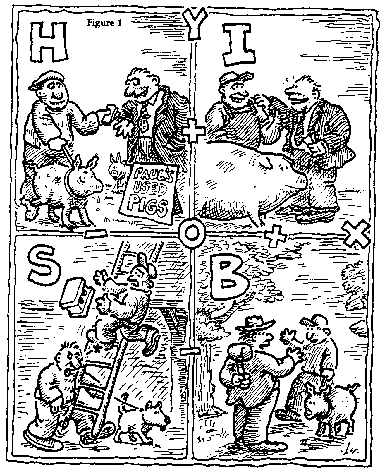
 Cipolla created a quadrant of human types that accurately defines the possibilities, clockwise from top right: Helpless, Intelligent, Bandit, & Stupid.

Figure 1 - The basic graph Hopefully, you can see from his illustration that this was a semi-light-hearted essay. Or maybe he just figured we were all too dumb to take his warning seriously and went for the humor; since we have to laugh about the stuff we'd cry about otherwise. Anyway, I recommend the essay and . . . look out for stupid people.

7/03/2021

Giving Up the Begging Bowl

For a lot of years, the whole “tip economy” has not just baffled but irritated me. And for a lot of years, some people I know have ragged on me for not properly valuing unskilled menial labor, “Somebody’s got to do that work and they should be properly compensated for it.” Teaching entitled Millennials about reality-based concepts is one of the most painful things I have ever experienced and at this point in my life I’ve found that it is also the least rewarding. Turns out, reality is doing a fairly good job of it without my contributions.

We’re currently experiencing a fairly impressive awakening of the US labor force. Some are calling it “The Great Resignation.” Been there, done that but not on a scale anywhere near this one. In the 70s, the after-effects of unrestrained irrational Vietnam War spending sent the country into an economic death spiral that didn’t end until Reaganomics and the rest of the Republican delusionary dribble-down thinking was briefly replaced by Bill Clinton’s “it’s about the economy, stupid” and actual conservative fiscal policy that resulted in the only balanced national budgets since Jimmy Carter (the only other economic conservative President in that period). For 30 years of my career’s 55-year lifetime, the economy was changing, collapsing, and relocating so quickly that a 3-year employment seemed like a whole career. My kids were conditioned to start throwing away toys and saying goodbye to friends on a triennium schedule.

Musicians and other semi-skilled food service and bar laborers have long depended on tips for the majority of their income and that is an aspect of that kind of work that has grated against my pride for as long as I’ve been associated with the “entertainment” business. In fact, my billing system was partially determined by coming up with an hourly rate that would guarantee my customers did not feel the need to add a tip to my invoice. At one point around 2011 that number was as high as $225 per hour. After I retired, I volunteered to run the sound system and help out at a couple of the local venues in Red Wing. That ended, in each place, when my contribution was so disrespected that someone offered me a pittance of a tip for my work that evening. I figured that if they really needed my help, the next time they could pay me a decent wage, say $225 per hour, so that they wouldn’t have to feel sorry for me. I fuckin’ hate tipping.

With that lifelong attitude in mind, I have often voiced my opinion about unskilled laborers bitching about receiving insufficient tips for their easily-replaced or automated “work.” This bullshit has gone so far as practically requiring tips for cash register operators and fast food janitors when you pay for something at the counter. Really? You have the gall to ask for 15-25% tip for punching the keys on a math-ability-disabled cash register and handing a piece of pie across a counter? That opinion has gotten me all sorts of nasty and entertaining feedback mostly from young people who wasted lots of money getting a “higher education” at a “follow your passion” institution of con-artistry and discovered that those kinds of passion also require a lot of skill, work, commitment, and sacrifice. Who knew that a job that 99% of the population would do for free might be hyper-competitive?

So, now to this moment of the “The Great Resignation” where all sorts of people are either going back to their old jobs, back to their old offices, or looking at finding work in either the business where they worked before the COVID moment or looking for something new. There is lots of faux-conservative jabber about how “people just don’t want to work when they get that $300 Unemployment boost,” but the fact is that many (95% of) people have discovered how much time and energy they are giving to dead-end, unskilled, pointless (bullshit) jobs that don’t pay well enough to even be considered worthy of Minimum Wage protection.

This week, I discovered a couple of Facebook “Notification” flags on comments I’d made on this subject more than 2 years ago. Normally, I just clear Notifications without bothering to see who made them or what group or person they came from, but these near-ancient flags made me curious. Sure enough, they were responses to an argument we’d had about tips and tipping from exactly the kind of folks I was describing above, kids who had wasted time and money at good old MSCM, pretending to be wannabe musicians or “producers,” and working at restaurants and bars after discovering how hard that business really is. The responses could be summed up to “you are right.” These young people had followed their mildly-held passions deep into debt and the panhandling restaurant lifestyle and COVID disrupted that long enough to force them to re-evaluate their priorities. One of those newly discovered priorities turned out to be finding a sustainable and functional lifestyle and career.

This brief moment in our weird-assed economy has opened up a lot of manufacturing jobs that include old-style training and education benefits to attract labor back to work. Even in small towns like Red Wing, there are opportunities like this available to anyone willing to learn skills that actually require some study, knowledge, and pride. Once you’ve done that kind of work, going back to being a food service drone is, apparently, close to inconceivable. (I don’t know. I’ve never been tempted by food service employment, at least not since I was 13 working at the Boothill concessions in Dodge City.) If you think my opinion of the panhandling/tip-based economy is radical, you really don’t want to read the opinions of the recently converted.